39.21 Troubleshooting covariate selection, posterior stability, and resume
What you will learn
- Qualify the base model and relationship scope
- Track candidate/subject/resample denominators
- Keep checkpoint identity exact
Prerequisites: Chapter 36 exit-code reference, Chapter 38 output completion, and the Chapter 39 overview.
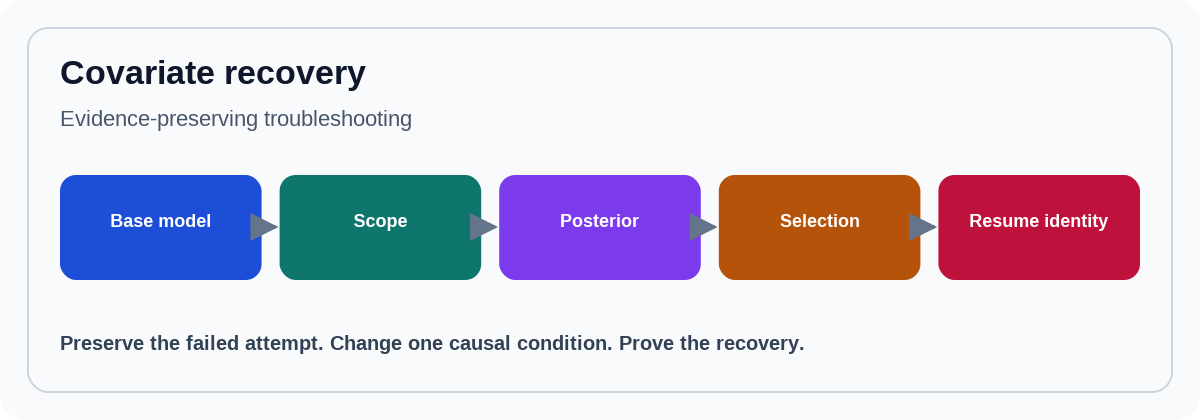
This page describes nlmx 4.16.2. Troubleshooting must preserve the failed attempt: keep its exact command, working directory, log, resolved settings, input/model identities, partial outputs, and process exit code. Correct one causal condition at a time and compare the new evidence with the failed run. Never convert a nonzero exit into success in a wrapper, and never interpret exit 0 as scientific acceptance without the command-native verdict.
Covariate workflows compound earlier layers: base-model artifacts, data/covariate policies, parameter–ETA mapping, candidate equations, covariance/posterior sources, numerical scoring/refits, resampling learners, selection thresholds, and resume state. Diagnose in that order.
For frozen/refit SCM, verify base convergence/covariance, scope, centering/reference, candidate eligibility, one-step information, and every refit status. A negative/ill-conditioned efficient information warning can reflect mismatched likelihood approximations; do not force a p-value. For posterior stability, reconcile subjects reconstructed, feature rows, learner successes, resamples requested/completed, selection frequencies, and fallback/exclusion reasons.
Stepwise selection can add then remove a relationship; that is algorithm behavior, not automatically an error. A candidate absent because it was ineligible is different from tested and not selected. Preserve the path and denominators.
Resume only with exact checkpoint identity (Chapter 39.13). If settings/candidates/base model/version change, begin a new analysis. After resume, compare a controlled interrupted-versus-uninterrupted fixture and verify replicate IDs/seeds, totals, and final selection.
Page checklist
- Did you retain the exact exit code, stage, message, hint, log, and partial output?
- Did you identify one causal layer before changing anything?
- Is the recovery a new, traceable attempt with the same intended estimand?
- Did you check command-native and scientific acceptance after process completion?
Navigation
See the previous page, next page, and complete error reference.