20.13 $OMEGA: BLOCK, FIX, SAME, SD, correlation, and unused ETAs
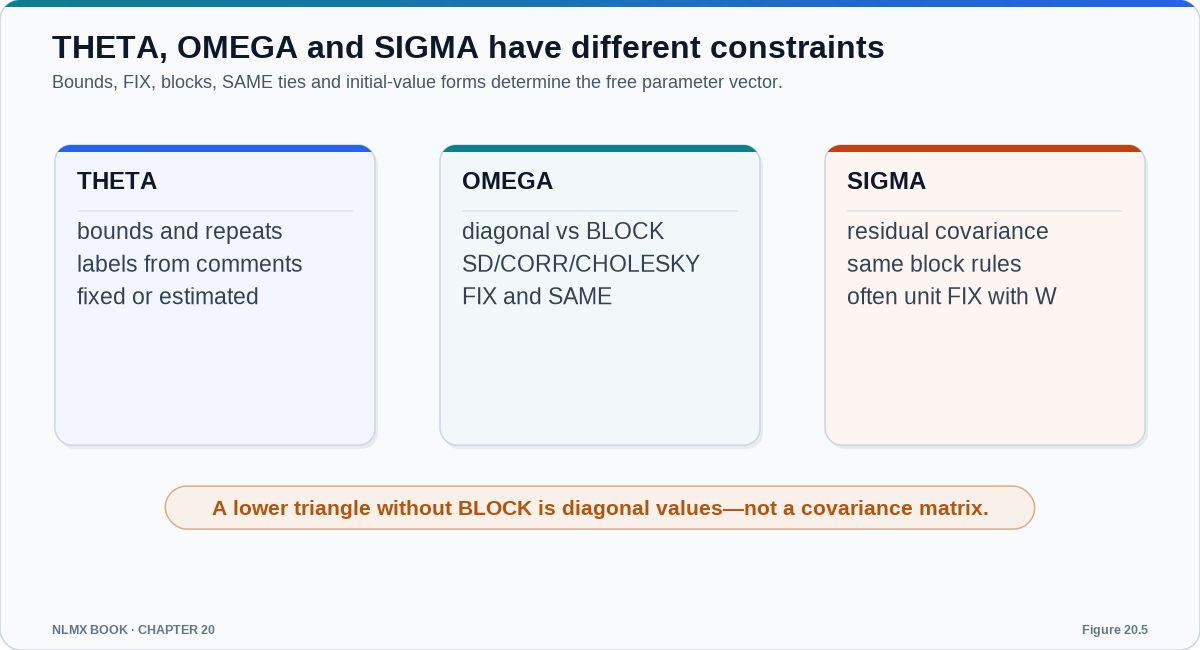
Without BLOCK(n), every value is a separate diagonal variance regardless of line layout. A lower triangle written without BLOCK does not estimate covariance; nlmx warns and suggests BLOCK. With BLOCK(n), enter the lower triangle row by row or supported VALUES(diag,offdiag) form.
FIX can apply to values or entire blocks. BLOCK(n) SAME ties a block to the prior compatible block, useful for inter-occasion variability. SD, CORRELATION and CHOLESKY initial forms convert to covariance: SD is squared, correlations combine with diagonals, and Cholesky reconstructs \(LL^T\).
An ETA declared but never used carries no likelihood information. nlmx leaves it at initial value, excludes it from integration/estimation, labels it UNUSED ETA, and marks unused_eta=true in parameters.csv. Remove it or correct model use rather than interpreting the retained number.
The frozen block example estimates covariance 0.02132 and correlation 0.383 between CL and V ETAs, with better OFV than diagonal on the synthetic data. That is demonstration, not automatic justification for a block.
Random-effects design review
Map every ETA to the exact model expression where it is used and to its biological interpretation. An estimated OMEGA element for an unused ETA is meaningless; an ETA used twice may induce an unintended correlation. Confirm the matrix order after every structural edit.
For BLOCK, calculate the implied correlation matrix from the starting values and final estimates. Verify positive definiteness and examine eigenvalues. SAME can impose useful shared structure across occasions or groups, but only when the repeated blocks truly have matching dimension and interpretation. SD and correlation-scale syntax improves readability only if the user remembers which scale is written and which scale appears in outputs.
Avoid selecting random effects solely from EBE scatter. Shrinkage and sparse designs distort EBE distributions. Combine mechanistic rationale, data information, likelihood evidence, stability across starts, covariance conditioning and predictive diagnostics. When a variance approaches zero, test the reduced model and describe boundary implications.
Common mistakes
Do not read variances as SD/CV, infer covariance from line indentation, or add blocks solely because EBEs correlate. SAME ties parameters and changes free-parameter count.
Checklist
- Expand diagonal/block structure exactly.
- Convert SD/correlation/Cholesky starts.
- Map FIX/SAME/free elements.
- identify unused ETAs.
- Review final correlations/boundaries.
Further reading
See worked block example, Chapter 18 OMEGA/Cholesky, and parameter outputs.