Provenance, logs, manifests, checksums, and privacy
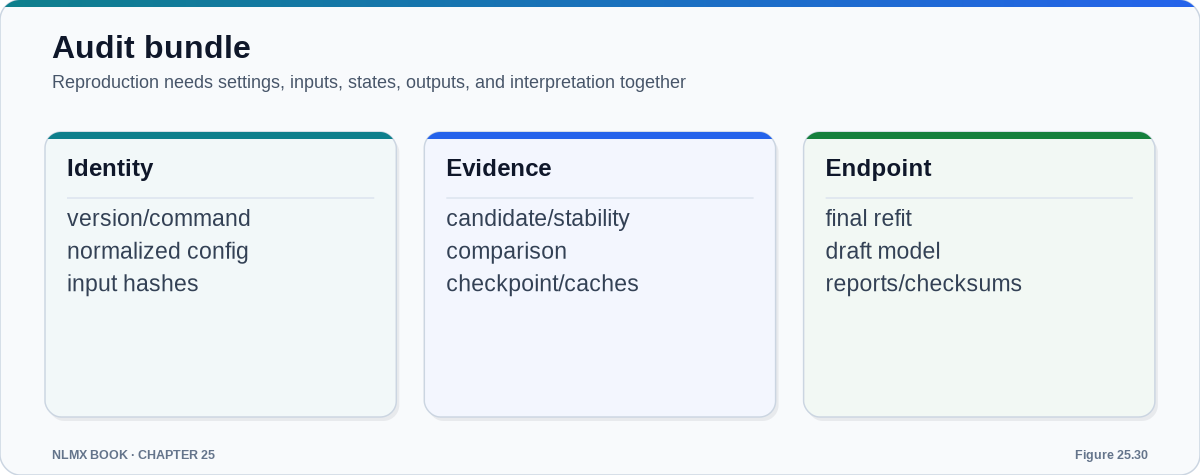
Every run should retain executable version, complete command, original and normalized configuration, input manifest/hashes, run manifest, logs, machine-readable evidence, reports, caches/checkpoints, draft model, final-refit diagnostics, and checksums.sha256. For both, preserve parent and both child bundles.
Use --log-file, verbosity, quiet/suppress-console, and no-color for operational presentation without assuming they change analysis identity. Subject IDs are hashed by default in sensitive outputs; --keep-subject-ids requires an explicit privacy justification. Optional posterior draws and replicate selections can be large and sensitive.
Verify checksums after transfer and before review. Do not edit generated evidence in place; create derived presentation tables with scripts and link them back to sources. Logs are evidence of warnings and recovery steps, not merely debugging debris.
Common mistakes
- Changing the scientific question after seeing the result while presenting it as the original run.
- Reading one engine's summary without checking its prerequisites, failures, normalized settings, and fitted endpoint.
- Treating a generated draft, comparison label, or completed checkpoint as a substitute for model diagnostics and reference-software confirmation.
Page checklist
- The exact command, version, inputs, resolved settings, and output directory are identifiable.
- Engine-specific evidence is interpreted on its own scale before cross-method comparison.
- Recovery state, final refit, diagnostics, and remaining confirmation work are explicit.