19.5 Prior-proposal kernel
The first kernel proposes \(\eta'=L_\Omega z\), an independent draw from \(N(0,\Omega)\). Because proposal and ETA prior are the same, they cancel from the Metropolis–Hastings ratio. Acceptance is
min{1, exp[−(Jy(eta′) − Jy(eta))/2]}.
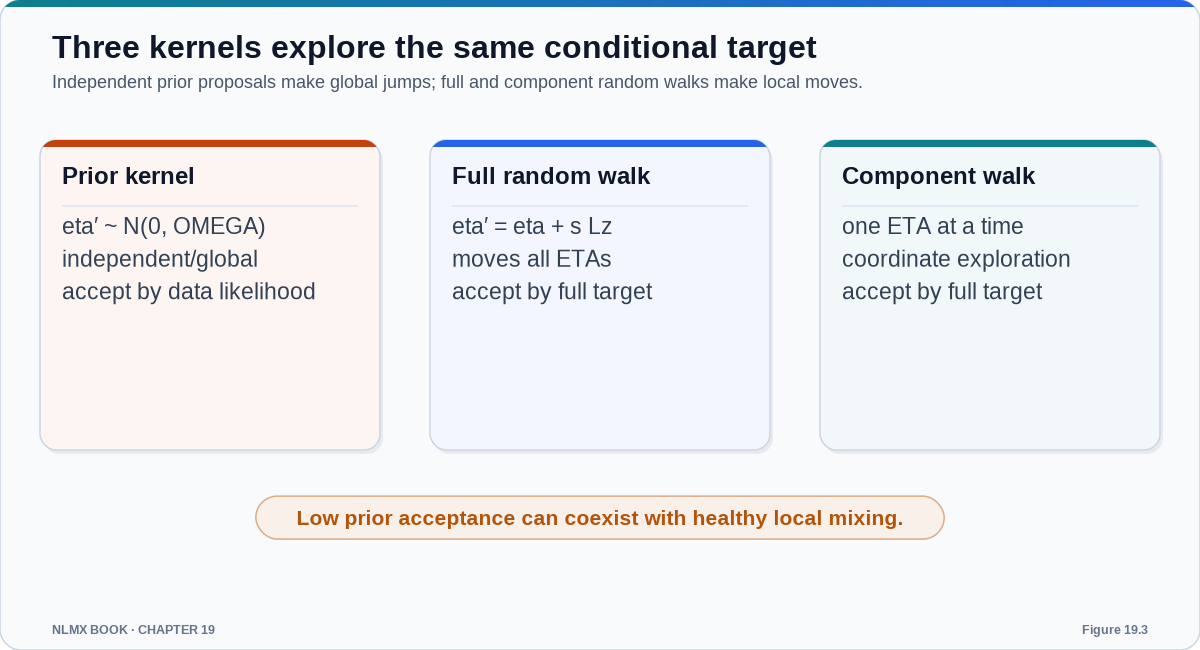
This kernel can make global jumps unrelated to the current state, helping escape local regions. When subject data make posterior much narrower than population prior, most proposals fit poorly and acceptance can be only a few percent. Low prior-kernel acceptance is therefore not automatically unhealthy if local kernels mix.
Two prior proposals per chain/iteration are the default (ISAMPLE_M1=2). The kernel is especially useful early and for weakly informed subjects whose posterior resembles the prior.
Practical interpretation
Compare prior and posterior widths in a normal-normal toy. When the posterior is much narrower, calculate how often a prior draw lands in its central region; low acceptance becomes unsurprising. If posterior is multimodal, an occasional accepted independent proposal can still be disproportionately valuable by jumping between modes. Diagnose usefulness from exploration, not acceptance percentage alone.
As OMEGA changes during burn-in, the proposal changes too. Recalculate its Cholesky factor from the current valid OMEGA and test that simulated prior moments match it under fixed parameters.
Preserve these kernel-specific tests in release validation.
Common mistakes
Do not tune the prior proposal scale like a random walk—it is defined by OMEGA—or judge overall SAEM solely by its low acceptance. Verify the prior terms really cancel in implementation tests.
Checklist
- Draw from the current OMEGA.
- Use data-only acceptance ratio.
- Record acceptance separately by kernel.
- Test global movement on multimodal toys.
- Interpret low rates with posterior concentration.
Further reading
Compare the full random walk and component kernel.