Complete index reference: every page and every output file, A–Z
What you will learn
- Find any page by the first word of its title.
- Find the page that describes an output file, from the file name.
- Know how the entries are sorted and labelled.
Prerequisites: E.1.
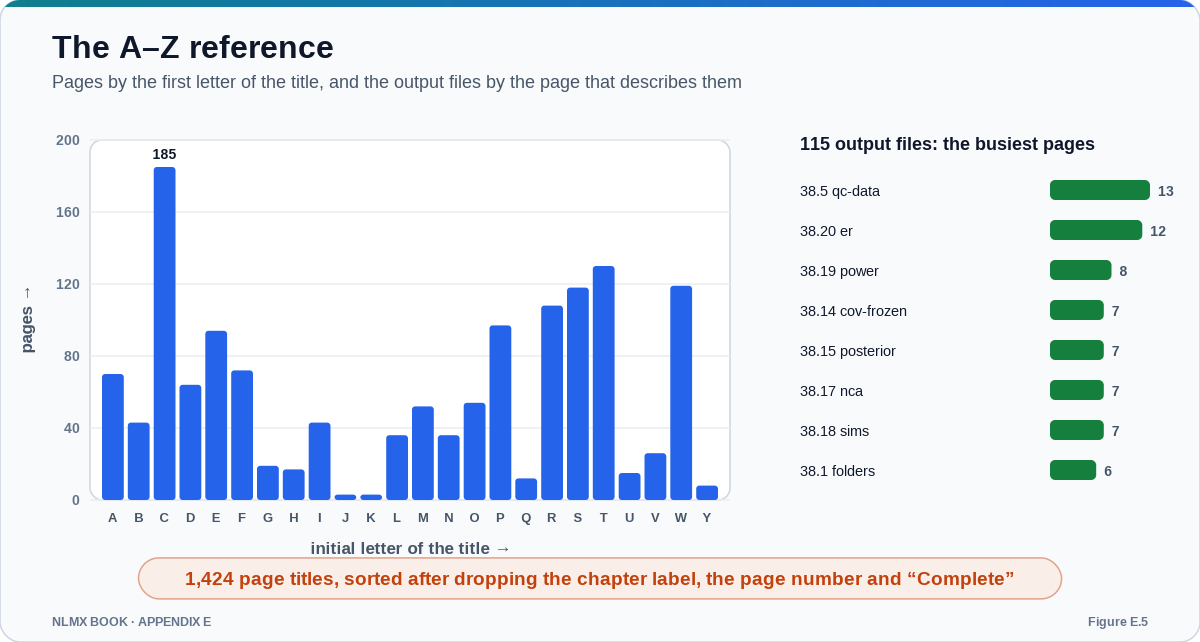
1424 pages and 115 output file names. Section 1 lists every page title once. Section 2 lists the file names of the output chapter. Sorting rules are on E.1 How the index is built: names, kinds and sort order: the leading Chapter N —, the leading page number, a leading Complete and leading punctuation are ignored.
How to read an entry. Each line is the title (a link), then where the page lives: a page number such as 36.7, Ch 36 overview for the overview of a chapter, or Ch 36 index for a chapter-level reference. Jump to a letter: A · B · C · D · E · F · G · H · I · J · K · L · M · N · O · P · Q · R · S · T · U · V · W · Y
1. Page titles A–Z
A
- A cross-software validation framework · 40.23
- A defensible NONMEM-to-nlmx reproduction workflow · 20.33
- A first hour with nlmx: a guided tour · Ch 3 overview
- A regulated-site baseline configuration · 35.16
- A study from first plan to final report · 43.21
- A tolerance with a reason · 42.6
- Absolute bioavailability output · 15.16
- Accumulation and Monte Carlo stability · 19.18
- Accuracy boundaries and review checklist · 8.19
- Accuracy envelope and escalation rules · 23.34
- Adaptive elastic net: the primary learner · 24.21
- Adaptive scales and acceptance · 19.8
- Adding a check to a catalogue:
qc-dataas the model · D.7 - Adding a command: the checklist · D.8
- Adding an option: the eight places it must appear · D.6
- Additional covariate distributions · 28.11
- ADDL, II, SS and resets · 6.7
- ADDL, steady state, resets and model events · 8.14
- Adult population generation · 28.7
- ADVAN/TRANS support matrix · 8.6
- After an upgrade: version changes and requalification · 39.15
- AIC, BIC, and corrected BICc · 17.18
- Allowed commands, self-invocation, and the no-shell boundary · 34.5
- Always-include and always-exclude relationships · 23A.20
- Analysis hash and random-stream identity · 25.19
- Analysis intervals, steady state, tau, and duplicates · 15.7
- Analysis, design and method tables · 7.13
- Analytic and matrix-exponential propagation · 8.8
- Anatomy of a .covar configuration · 25.3
- Anatomy of an nlmx app · 43.3
- Anatomy of the HTML report · 10.3
- Annealing and positive definiteness · 19.15
- Antithetic and quasi-random draws · 9.4
- Appendix A — Mathematical background · App A overview
- Appendix B — Glossary · App B overview
- Appendix C — Bibliography · App C overview
- Appendix D — Developer guide · App D overview
- Appendix E — Index · App E overview
- Appendix F — Frequently asked questions · App F overview
- Approximating the integral: linearisation (FO, FOCE, FOCE-I) and Laplace · A.8
- Architecture and trust boundaries · 34.2
- Archiving, sharing and review bundles · 10.18
- Arms and allocation modes · 31.9
- Artifact discovery and ambiguity · 5.4
- Complete ask command and settings index · Ch 35 index
- Ask command reference · 36.27
- Ask Maxson, and where to go next · 3.7
- Asymptotics: information, the covariance step, the delta method and the three tests · A.12
- Attempt zero and the retry handoff · 20.37
- AUC method, partial areas, and extrapolation · 15.9
- AUC to infinity and the extrapolated fraction · 14.13
- AUCtau and Cavg · 26.23
- AUCtau and CAVG · 28.27
- Audience, prerequisites, and the novice ramp · front matter
- AUMC and first-moment area · 14.8
- AUMC, mean residence time, and steady-state volume · 14.16
- Auto mode, guide mode, plan-only, and slash commands · 35.9
- Auto versus single-method runs · 16.12
- Complete autoinit command and option index · Ch 16 index
- Autoinit command reference · 36.9
- Autoinit output dictionary · 38.9
- Autoinit starts and parameter mapping · 17.12
- Autoinit, screen and fit · F.4
- Autoinit: initial estimates from the dataset alone · Ch 16 overview
- Automatic binning · 27.16
- Automatic differentiation and finite differences · 18.18
- Automatic type detection · 22.10
- Automatic-initialisation settings: complete generated key catalogue · 37.18
- Automatic-initialisation settings: purpose, structure, and workflow · 37.17
- Automation by chaining · 43.20
B
- Back-transformation for log-DV models · 21.19
- Backend privacy, reproducibility, and qualification · 35.5
- Backward elimination step by step · 23A.11
- Backward retention and uncertain relationships · 23.25
- Backward-only workflows · 23A.23
- Bar, col, counts, percent, and position · 13A.15
- Base-model readiness · 22.6
- Base-parameter uncertainty and probability swing · 24.16
- Base-parameter uncertainty from the covariance matrix · 23.30
- Base-solution stationarity · 23.13
- Baseline and time-varying covariates · 6.8
- BE & DDI Studio · 43.14
- Best-fit window selection and adjusted R² · 14.10
- Best_model.ctl and prepared data · 17.25
- Between-subject variability rows · 26.15
- BFGS outer optimization · 18.21
- Complete bibliography reference · App C index
- Binary diagnostics, sparse data, and separation · 32.12
- Binary endpoints and logistic exposure-response · 32.11
- Binary, ordinal, count, TTE, and longitudinal controls · 33.13
- Bioavailability and group-ratio methods · 14.19
- BLQ behavior by command · 6.12
- BLQ coding, flags and quantification limits · 6.11
- BLQ handling, sampling schedules, and allocation · 30.26
- BLQ panel, NPC exclusions, and M3 simulation · 27.26
- BLQ rules and sensitivity analysis · 14.20
- BLQ simulation actions · 28.24
- BLQ, LLOQ, and censoring controls · 15.8
- Bolus, infusion, lag and bioavailability · 8.13
- Bolus, infusion, RATE and dose compartment · 6.6
- Book map, chapter anatomy, and navigation · front matter
- Boosting and conditional permutation importance · 24.25
- Bootstrap and SIR parameter files · 26.11
- Bootstrap, seeds, threads, and deterministic evidence · 33.11
- Bootstrap, SIR, and posterior parameter files · 27.29
- Both mode and joint final refit · 22.27
- Both-direction search · 23A.13
- Boundaries and non-positive-definite matrices · 18.30
- Box plots, scatter plots, and smoothers · 28.35
- Boxplot, violin, and subject-level distributions · 13A.13
- Build: autoinit, screen, fit · 3.4
- Built-in derived record and subject columns · 13.25
- Burn-in purpose and controls · 19.16
C
- Candidate construction, design columns, and scaling · 23.19
- Candidate set and parent hierarchy · 17.5
- Case 1: a dirty file, line by line · 41.3
- Case 1: a repair plan and the clean re-run · 41.4
- Case 1: the gate and the handover · 41.5
- Case 2: an infusion and a steady-state interval · 41.7
- Case 2: bioavailability from a crossover, and a sparse study with BLQ · 41.9
- Case 2: is exposure proportional to dose? · 41.8
- Case 2: one oral dose, from profile to parameters · 41.6
- Case 3: from a recommendation with a caution to a fit · 41.12
- Case 3: where should the fit start? · 41.10
- Case 3: which structure does the data support? · 41.11
- Case 4: a fit that recovers, and what to check afterwards · 41.16
- Case 4: a FOCE-I fit, read line by line · 41.13
- Case 4: does the block OMEGA earn its extra parameter? · 41.15
- Case 4: iteration limits, evaluate-only, and reading the ending · 41.17
- Case 4: three estimation methods, one answer · 41.14
- Case 5: a forest plot, rebuilt by hand · 41.24
- Case 5: five variants of the screen, and the one that fails · 41.21
- Case 5: stability selection, and how often each candidate is chosen · 41.22
- Case 5: stepwise covariate modelling on refits · 41.20
- Case 5: the covariate question and its base model · 41.18
- Case 5: the frozen engine, step by step · 41.19
- Case 5: three engines side by side, cheap checks first, and a run that survived an interruption · 41.23
- Case 6: a pooled check that passes and a stratified check that does not · 41.26
- Case 6: a prediction-corrected VPC of the final model · 41.25
- Case 6: the numerical check, censored observations and parameter uncertainty · 41.27
- Case 7: a covariate method tested on known truth, with too few replicates · 41.32
- Case 7: children, weight-based doses and mixed populations · 41.29
- Case 7: dose levels against an exposure window · 41.28
- Case 7: four generated projects, a known truth and a design to review · 41.31
- Case 7: how many subjects, from the Fisher information · 41.33
- Case 7: power by simulation and estimation, and what the formula missed · 41.34
- Case 7: three checks on a simulation before it is trusted · 41.30
- Case 8: a change score, a survival time and a score over visits · 41.36
- Case 8: one exposure, three endpoint types · 41.35
- Case 9: one Markdown file, three ways in, and what "done" means · 41.38
- Case 9: the assistant, and what its guardrails do with nine different replies · 41.37
- Case study: BLQ, outliers and sampling · 11.31
- Case study: covariate defects · 11.32
- Case study: dosing and same-time records · 11.30
- Case study: event and time defects · 11.29
- Case study: file, header and value defects · 11.28
- Complete case-study reference · Ch 41 index
- Categorical covariates, levels, and labels · 26.7
- Categorical stratification · 27.20
- Categorical, grouped, and ordinal equations · 22.15
- Centering and reference values · 22.16
- Centres, error bars, time bins, and smoothers · 13.19
- Chains, subject streams, and initialization · 19.4
- Complete Chapter 25 command and settings index · Ch 25 index
- Chapter 30 formula and decision index · Ch 30 index
- Chapter 32 model and estimand catalogue · Ch 32 index
- Chapter 34 guardrail, policy, and audit index · Ch 34 index
- Chart design: colors, legends, axes and tooltips · 10.9
- Check: qc-data and qc-nm · 3.2
- Checklist and findings tables · 11.24
- Checkpointing, analysis identity, and resume · 24.34
- Cholesky parameterization of OMEGA and SIGMA · 18.20
- Choosing and qualifying a language model · 35.1
- Choosing frozen, SCM, posterior, or both · 25.2
- Choosing generate or simulate-study · 29.1
- Choosing Markdown, Word, PDF, and HTML outputs · 36A.15
- Choosing SSE, FIM, or both · 30.27
- Choosing sse, fim, or both · 31.2
- Choosing VPC, pcVPC, pvcVPC, or NPC · 27.12
- Classification: retained, uncertain, and rejected · 23.32
- Classification: retained, uncertain, proxy, and rejected · 24.33
- Clearance and terminal volume by route · 14.15
- CLI mapping, precedence, and relative paths · 33.24
- Clinical interpretation and forest plots · 22.34
- Cmax, Cmin, and Ctrough · 26.22
- CMAX, TMAX, CMIN, TMIN, and CTROUGH · 28.26
- Code blocks and footnotes · 36A.9
- Code syntax, control flow, Y and scope · 12.10
- Color, fill, shape, size, linetype, and grouping · 13A.18
- Column mapping, mutation, and filters · 15.4
- Columns, filters and groups · 11.6
- Complete command and option index · Ch 20 index
- Command grammar and option anatomy · 36.1
- Complete command index · Ch 36 index
- Command line, settings, and item precedence · 13A.8
- Command-line grammar · 4.5
- Command-line overrides and effective values · 7.2
- Command-line reference · Ch 36 overview
- Command-specific extensions · 7.4
- Common figure families and interpretation · 10.10
- Common input, execution and output keys · 7.12
- Common misspecification patterns and what to test next · 21.28
- Common output files by command · 10.17
- Common versus own regimens · 26.24
- Comparing continuous models and identifiability · 32.10
- Comparing FO, FOCE, FOCE-I, and Laplace · 18.15
- Comparing models: information criteria, weights and the likelihood-ratio test · A.13
- Comparing nlmx with NONMEM · 18.38
- Comparing posterior, frozen, and SCM evidence · 24.41
- Compartments, observation routing, and resets · 20.10
- Compatibility, aliases, deprecated structures, and interface drift · 37.35
- Complementary pairs and PFER theory · 24.18
- Compliance review and the final trust gate · 34.18
- Compliance, LLOQ, and BLQ actions · 31.11
- Component-wise kernel · 19.7
- Computational advantage and cost drivers · 23.3
- Concentration profile plots: P01-P03 · 13.9
- Concentration-time profile plots · 28.34
- Concepts and conventions · Ch 4 overview
- Condition numbers and PSD repair · 9.8
- Condition numbers, shrinkage, and warning flags · 17.21
- Conditional density and the subject objective · 18.7
- Conditional forward inclusion · 23.24
- Conditional modes and empirical Bayes estimates · 18.11
- Conditional power, assurance, and precision · 30.2
- Conditional target and complete-data objective · 19.3
- Conditional-mode search · 18.17
- Configuration layers and precedence · 7.1
- Configuration, output folders, and path resolution · 36.3
- Complete configuration-only reference · 24.39
- Confirmation levels, --yes, plan-only, and guide mode · 34.9
- Confirmations, --yes, and reviewing the exact proposal · 35.8
- Confounding, reverse causation, and causal limits · 32.4
- Constructing a simulated trial · 30.8
- Continuous and crossed stratification · 27.21
- Continuous covariates: quantiles and explicit values · 26.6
- Continuous endpoints: hockey-stick threshold · 32.9
- Continuous endpoints: sigmoid Emax · 32.8
- Continuous endpoints: the Emax model · 32.7
- Continuous endpoints: the linear model · 32.5
- Continuous endpoints: the log-linear model · 32.6
- Control-stream anatomy · 20.4
- Control-stream records and parser support · 5.1
- Control-stream-QC settings: complete generated key catalogue · 37.8
- Control-stream-QC settings: purpose, structure, and workflow · 37.7
- Controlling corrections: no-fix, skip-fixes and fix-output · 12.23
- Core record consistency: REC01–REC12 · 11.13
- Correction philosophy and complete catalogue · 12.18
- Correlated covariates and path dependence · 23A.21
- Correlated covariates and redundant signal · 22.21
- Correlated features, proxies, and cluster switching · 24.30
- Correlation matrices and condition numbers · 18.29
- Correlation tables: Pearson and Spearman · 13A.27
- Count and rate endpoints · 32.14
- Complete cov command and method index · Ch 22 index
- Cov command reference · 36.20
- Cov, posterior, and resume: running and comparing the engines · Ch 25 overview
- Covariance failures, zero variances, and F_FLAG problems · 20.32
- Covariance matrices, standard errors, and parameter scales · 40.8
- Covariance step and covariance matrix · 31.26
- Covariance-based parameter draws and admissibility · 27.28
- Covariance-based parameter uncertainty · 26.10
- Covariance-step overview · 18.25
- Covariate dependence and generator limitations · 28.12
- Covariate discovery, types, and time variation · 13.7
- Covariate encoding and fixed adjustment · 33.7
- Covariate levels, outliers, correlation and derived values: COV05–COV11 · 11.21
- Covariate model-building comparison · 40.12
- Covariate modelling concepts · Ch 22 overview
- Covariate plots: P12-P17 · 13.12
- Covariate selection, missingness and ranges: COV01–COV04 · 11.20
- Covariate type detection, levels and centring · 6.9
- Covariate, level, and parameter labels · 26.29
- Complete covariate-analysis checklist · 22.36
- Covariate-analysis settings: complete generated key catalogue · 37.4
- Covariate-analysis settings: purpose, structure, and workflow · 37.3
- Covariates and evaluation: cov, forest, vpc · 3.5
- Covariates, adjustment, selection, and interpretation · 32.22
- Covariates, posterior stability, resume and forest plots · F.5
- Cox proportional-hazards exposure-response · 32.18
- CPU threads, CUDA builds, GPU layers, and performance · 35.4
- Cramér–Rao bound, SE, RSE, and correlation · 30.22
- Creating a project from an existing dataset · 29.8
- Cross-software acceptance matrices · 42.15
- Cross-software acceptance tolerances · 18.39
- Complete cross-software comparison and known-limit reference · Ch 40 index
- Cross-validation, tuning, and selection rules · 24.27
- CSV: quoting, missing values and numeric conventions · 10.11
- Curvature repairs, failed subjects, and point-EBE mode · 24.8
- Complete custom command and option index · Ch 13A index
- Custom command reference · 36.15
- Custom plot axes, smoothing, facets, and pages · 13.23
- Custom plot-and-table settings: complete generated key catalogue · 37.12
- Custom plot-and-table settings: purpose, structure, and workflow · 37.11
- Custom plots: kinds, scopes, and variables · 13.22
- Custom tables: summary, count, and listing · 13.24
- Custom: reproducible plots and tables from any dataset · Ch 13A overview
- CWRES: conditional weighted residuals · 21.10
D
- $DATA and selection checks: DAT01-DAT10 · 12.8
- Data input, IGNORE/ACCEPT, and column mapping · 20.8
- Data integrity and reproducibility · 42.13
- Data requirements and column mapping · 13.2
- Data summary, missingness, and subjects: T01, T09, T10 · 13.15
- Data, events, BLQ and quality control · F.2
- Data, PK-PD, and time-varying plots: P21-P24 · 13.14
- Data-driven PK logic and variable persistence · 20.11
- DataGen: data whose truth you know · 43.6
- Dataset format, identifiers, and row grain · 33.2
- Dataset limits, memory and performance · 6.15
- Dataset schema and event records · 16.3
- Dataset schema, records, and prepared datasets · 17.3
- Dataset, dosing, censoring, and population differences · 40.10
- Dataset-QC settings: complete generated key catalogue · 37.6
- Dataset-QC settings: purpose, structure, and workflow · 37.5
- Declaring scope on the command line and in configuration · 22.8
- Decompositions and positive definiteness: Cholesky, eigenvalues and condition numbers · A.4
- Defaults, configuration, CLI, and precedence · 25.5
- Define the diagnostic population before interpreting a plot · 21.2
- Delimited tables: headers, row grain, missing values, and numbers · 38.2
- Delimiters, headers and quoting · 6.1
- Demographic and covariate tables: T02-T03 · 13.16
- Demographics: Table 1 · 13A.24
- Dense matrices and Cholesky paths · 9.6
- Dense, sampled, and observed metric profiles · 28.30
- Derived columns with mutate · 6.14
- $DES and ODE models · 20.6
- $DES models and solver selection · 8.10
- Descriptive statistics and type-7 quantiles · 9.9
- Design criteria beyond power · 30.28
- Design principles · 1.3
- Design replay: dosing, covariates, and occasions · 27.5
- Design, power and simulation · C.4
- Determinism and the seed · 4.3
- Determinism, resume and the guard: the tests that protect the promises · D.12
- Complete developer reference · App D index
- Complete diagnostic and publication option index · Ch 21 index
- Complete diagnostic checklist and reporting template · 21.30
- Diagnostics and goodness of fit · Ch 21 overview
- Diagnostics, confirmation, and validation · 22.35
- Diagnostics, VPC, NPC, and uncertainty · 40.13
- Differences from NONMEM, PsN, PopED, and Monolix—and known limits · Ch 40 overview
- Differences from PsN SCM · 23A.36
- Distinct, sort, head, and select · 13A.7
- Distribution functions and confidence intervals · 9.10
- Documentation checks: DOC01-DOC03 · 12.17
- Dose groups, placebo, and exposure eligibility · 33.4
- Dose levels and treatment arms · 28.14
- Dose normalisation and dose proportionality · 14.18
- Dose proportionality and the automatic TMDD trigger · 17.11
- Dose, interval, infusion, and dosing compartment · 26.25
- Dose-proportionality settings and output · 15.14
- Doses, occasions, and profile selection · 15.3
- Dosing and observations by time: T04-T05 · 13.17
- Dosing and regimen checks: DOS01–DOS07 · 11.16
- Dosing, infusion, repeated dose, and steady state · 20.9
- Draft control streams and unconfirmed code · 10.15
- Draft-model coding, MU referencing, and confirmation · 22.32
- Dropout and intermittent missing observations · 31.10
- Dropout, missingness, and compliance · 30.25
- Dry runs, overwrite protection, logging, and identifier privacy · 33.25
- Dry-run and automation gates · 25.10
- DVID and multiple-endpoint diagnostics · 21.23
E
- EBEs and posterior covariance · 18.31
- Eda and custom output dictionaries · 38.7
- Complete eda command and option index · Ch 13 index
- Eda command reference · 36.14
- Eda, custom and nca · F.3
- Eda: exploratory data analysis · Ch 13 overview
- EDA: seeing the data · 43.9
- Edition, copyright, licence, and citation · front matter
- Effect contrasts and predictions at useful exposures · 33.10
- Effect multipliers and scenario labels · 31.13
- Effect, information, and the noncentral chi-square · 30.6
- Effective rank, pseudo-inverse, and ridge stabilization · 23.18
- Efficient information and the Schur complement · 23.10
- Efficient score and residual base-score correction · 23.9
- Eligibility: convergence, covariance, and RSE · 17.20
- EM and stochastic approximation · 19.2
- Embedded, server, and mock backends · 34.8
- Empirical parameter distributions and bounds · 30.15
- Empirical parameter-set files · 31.24
- Empirical Type I error calibration · 30.13
- Endpoint types and estimands · 32.3
- Engine concordance labels · 25.26
- Environment variables and external runtime context · 36.34
- Equal-count and equal-width binning · 27.17
- Equation-form comparison and AIC refits · 23.21
- Equation-form selection before the path · 23A.18
- Er command reference · 36.17
- Er output dictionary · 38.20
- Er: the command · Ch 33 overview
- Complete error, warning, and troubleshooting reference · Ch 39 index
- Errorbar, pointrange, and summary functions · 13A.16
- Errors, exit codes and the failure record · D.3
- Errors, exit codes, and troubleshooting · 15.26
- Errors, misleading shared help, and recovery · 31.43
- Errors, other software and validation · F.8
- Errors, warnings, and troubleshooting · Ch 39 overview
- Estimation and algorithms: from the mixed-effects likelihood to SAEM and BFGS · C.1
- Estimation and covariance checks: EST01-EST09 · 12.15
- Estimation and table corrections · 12.22
- Estimation approximations and numerical controls · 17.16
- Estimation controls, covariance, SAEM, and evaluate-only · 20.16
- Estimation method, base fit, covariate fit, and no-fit · 29.9
- Estimation records, settings, and precedence · 20.15
- Estimation theory: likelihoods and algorithms · Ch 18 overview
- Estimation-method comparison · 40.11
- ETA and EPS shrinkage · 18.34
- ETA and EPS shrinkage · 21.17
- ETA distributions and the population random-effects model · 21.15
- ETA pairs, empirical correlation, and OMEGA correlation · 21.16
- ETA selection, pruning, and refitting · 17.14
- ETA, EPS, and variance scaling · 28.21
- Evaluate-only runs, iteration limits, and rescue · 20.30
- Evaluation, covariate modelling and censored data · C.2
- Every [assistant] and [model] setting · 35.13
- Every [limits] setting, CLI option, and precedence rule · 35.15
- Every [policy] and max-values setting · 35.14
- Every change is a release: choosing the number and writing the entry · D.13
- Every data and analysis setting group · 33.21
- Every section of the .power file · 31.38
- EVID, MDV and CMT · 6.5
- Exit code 10: nothing evaluable remains · 39.12
- Exit code 11: checkpoint or resume incompatibility · 39.13
- Exit code 12: internal invariant violation · 39.14
- Exit code 2: invalid command-line usage · 39.4
- Exit code 3: discovery, files, output, and server I/O · 39.5
- Exit code 4: invalid settings · 39.6
- Exit code 5: unsupported model or method feature · 39.7
- Exit code 6: inconsistent model artifacts · 39.8
- Exit code 7: data validation failure · 39.9
- Exit code 8: posterior reconstruction failure · 39.10
- Exit code 9: numerical or learner failure · 39.11
- Exit codes and machine-readable completion · 36.35
- Exit codes, errors, warnings and notes · 4.4
- Exit status, fail_on and pipelines · 11.9
- Explicit edges and nominal-time binning · 27.18
- Exploratory-data-analysis settings: complete generated key catalogue · 37.10
- Exploratory-data-analysis settings: purpose, structure, and workflow · 37.9
- Explore: eda and nca · 3.3
- Exponential and linear continuous effects · 31.16
- Exponential, linear, standardized, and spline forms · 22.13
- Exposure and correlation tables: T06-T08 · 13.18
- Exposure bins and reference denominators · 26.26
- Exposure contrasts, uncertainty, and bootstrap · 32.23
- Exposure groups and observed summaries · 32.15
- Exposure Lab: simulation, power and exposure-response · 43.13
- Exposure metrics, windows, units, and provenance · 32.2
- Exposure targets and attainment · 28.33
- Exposure, response, type, and the analysis grid · 33.3
- Exposure-response concepts and models · Ch 32 overview
- Exposure-response settings: complete generated key catalogue · 37.30
- Exposure-response settings: purpose, structure, and workflow · 37.29
- Exposure–response likelihoods: curves, counts, categories and survival · A.17
- Expressions, operators and functions · 8.3
- EXT, COV, COR, and COI files · 20.21
F
- F1, apparent parameters, and mixed-route data · 16.17
- F_FLAG, censored, and user-likelihood records · 18.35
- Facet grid, wrap, panels, and free scales · 13A.19
- Fail-on, exit status and automation · 12.26
- Failed fits, runtime, memory, and determinism · 24.35
- Failure fixtures and negative tests · 42.14
- Failures and power denominators · 30.11
- Failures, changed corrections, and stopping rules · 34.16
- Failures, convergence, and denominators · 31.27
- Complete FAQ reference: every question, by page and by command · App F index
- Feature registry, equations, and target ETAs · 24.10
- Feedback, errata, and update policy · front matter
- Figure export, size, format, and accessibility · 13.20
- Figure, plot, and output settings · 33.23
- Figure, table, and example numbering; companion files · front matter
- Figures, plot export, and accessibility · 16.21
- File and format checks: FIL01-FIL07 · 12.5
- File and format checks: FIL01–FIL12 · 11.10
- Files, report, and a fixed diagnostic review order · 21.3
- Filter versus stratification · 27.23
- Filtering diagnostic views without changing the fit · 21.22
- Filters, BLQ, censoring, and log-DV data · 16.4
- FIM files and sample_size.csv · 31.36
- Final joint refit and reference confirmation · 25.28
- Finding help and the authoritative interface · 36.2
- Finite differences and the covariance trace term · 30.18
- Finite-difference steps and derivative sensitivity · 23.17
- First-order estimation (FO) · 18.10
- First-order input, no absorption, and mixed routes · 17.7
- Fisher information intuition · 30.16
- Fit command reference · 36.7
- Fit result and diagnostic dictionary · 38.11
- Fit retry, batch, and NONMEM-compatible artifacts · 38.12
- Fit supplement and retry overview · 20.35
- Fit: the command · Ch 20 overview
- Five layers of equivalence · 40.2
- Fixed and weight-based dosing · 28.13
- Fixed data-step order and row grain · 13A.5
- Fixed-estimate versus parameter-uncertainty VPC · 27.27
- Floating-point and platform differences · 9.16
- FLUCT, SWING, PTR, and CLSS · 28.28
- FO, FOCE, and FOCE-I information · 30.20
- FO, FOCE, FOCE-I, draws, and step · 31.30
- FOCE · 18.12
- FOCE-I and ETA–EPS interaction · 18.13
- Folder layout of an installation and a first sanity check · 2.4
- Font size, page numbers, and long documents · 36A.14
- Forced statuses, active sets, and competition groups · 23.22
- Complete forest command and settings index · Ch 26 index
- Forest command reference · 36.25
- Forest output dictionary · 38.16
- Forest: covariate effects and exposure · Ch 26 overview
- Form generation and comparison · 22.18
- Forward and backward directions and thresholds · 22.28
- Forward and retention thresholds · 23A.14
- Forward inclusion step by step · 23A.9
- Forward stopping rules and near ties · 23A.10
- Forward, backward, and stepwise covariate selection · 33.8
- Forward-mode automatic differentiation · 8.16
- Forward-only workflows · 23A.22
- Free, Pro, validated use and limits · 43.22
- Frequency tables and percent denominators · 13A.25
- Frequently asked troubleshooting questions · 39.23
- From a diagnostic finding to a model decision · 21.29
- From control stream to executable model · 8.1
- From subject information to population information · 30.19
- Frozen score selection · 22.24
- Frozen, posterior, and SCM reference engines · 29.15
- Complete frozen-engine command and settings index · Ch 23 index
- Frozen-score and refit-SCM covariate outputs · 38.14
- Full PsN-style candidate search with a zero cap · 23A.16
- Full-vector random-walk kernel · 19.6
G
- GAM splines and effective degrees of freedom · 24.24
- General linear models with ADVAN5 and ADVAN7 · 8.9
- Generate and simulate-study · Ch 29 overview
- Complete generate and simulate-study command and settings index · Ch 29 index
- Generate command reference · 36.24
- Generate project-file dictionary · 38.21
- Generated covariates and correlation structure · 29.7
- Generated population or supplied design · 28.5
- Generated project layout and downstream handoff · 29.10
- Generating and using the annotated .er template · 33.20
- Generating templates with --print-config · 7.5
- Getting started, settings and output folders · F.1
- Complete glossary reference · App B index
- Greeting, command catalog, manual, and file context · 34.3
- Group comparisons and reference selection · 15.15
- Group elastic net and equation-level selection · 24.22
- Grouping, colour, stratification, and panels · 13.6
- Groups, dosing, sampling, BLQ, and sparse designs · 29.5
- Groups, regimen pooling, and consistency checks · 16.6
H
- Hand checks, and where each formula is used · A.18
- Hashes, checkpoints and numerical identity · 9.15
- Header and column checks: HDR01–HDR08 · 11.11
- Headings, title blocks, front matter, and contents · 36A.5
- High-shrinkage, correlated, and rare-category scenarios · 29.14
- Histogram, density, ECDF, and Q-Q geoms · 13A.14
- How INPUT controls the generated dataset · 28.6
- How steady-state simulation is computed · 26.19
- How the case studies are built · 41.1
- How the index is built: names, kinds and sort order · E.1
- How the scenario grid multiplies · 31.7
- How to read a cross-software comparison · 40.1
- How to read this book: five practical paths · front matter
- How to read this settings reference · 37.1
- HTML output, CSS, MathML, and embedded images · 36A.18
- HTML report, SVG charts, and publication plots · 27.33
- Hypotheses and repeatable test · 31.14
I
- ICALL, random streams, threads, and memory · 27.6
- Identifiability, boundaries, and condition diagnostics · 21.18
- Identifiers: exit codes, check IDs, plot codes and file extensions · E.4
- Images, paths, copying, and missing-file warnings · 36A.11
- Implementation architecture and numerical methods · 33.36
- Importance sampling and the size of Monte Carlo error · A.11
- Importance-sampling objective · 19.20
- Independent reproduction and acceptance standards · 33.37
- Index by task: where to look when you want to do something · E.2
- Complete index reference: every page and every output file, A–Z · App E index
- Indices, definition and use: COD03-COD06 and COD12 · 12.11
- Individual and NCA evidence files · 16.23
- Individual and subject checks: SUB01–SUB06 · 11.19
- Individual profiles and influential subjects · 21.25
- Inference, model comparison and response models · C.5
- Information from the mean and covariance · 30.17
- Infusion, RATE, and dosing compartment · 28.17
- Infusion, repeats, steady state and duplicates: REC13–REC20 · 11.14
- Initial and final estimate selection · 28.19
- Initial_estimates.csv and parameter sources · 16.22
- Input artifacts and run-family discovery · 22.7
- Input discovery and explicit artifact overrides · 25.6
- Input formats, column types, and missing values · 13A.3
- Input manifests and SHA-256 · 7.10
- $INPUT mapping checks: INP01-INP08 · 12.7
- $INPUT mapping, aliases and DROP · 6.2
- Input resolution: control stream, data, and run family · 20.3
- Input, data and subroutine corrections · 12.20
- Inputs, data override and NONMEM version · 12.4
- Inputs, scientific scope, and equation forms · 23A.4
- Inspect command reference · 36.5
- Inspect, validate, schema, and resume · 22.9
- Inspect, validate, schema, and version outputs · 38.4
- Inspect: the readable preflight · 25.8
- Installation qualification · 42.8
- Installing and selecting the embedded backend · 35.2
- Installing the executable · 2.2
- Installing, licensing and upgrading · Ch 2 overview
- Instructions, custom rules, and prompt-injection resistance · 34.11
- Interpreting terminal half-life · 14.14
- Inverse parameter sections · 26.16
- Investigating engine disagreement · 25.27
- IWRES: individually weighted residuals · 21.8
J
- JSON, JSONL, text, reports, figures, logs, and checksums · 38.3
- JSON, text, HTML, and conditional comparison files · 15.25
- JSON: schemas, null and machine use · 10.12
K
- KA, ALAG, and flip-flop ambiguity · 16.18
- Kaplan–Meier, hazard-ratio, and longitudinal figures · 33.17
- Keeping the program, the assistant, the guides and the book in step · D.9
L
- Labels, axes, palettes, size, and export formats · 33.18
- Lag-time candidates · 17.8
- Laplace and conditional-Gaussian approximations · 24.7
- Laplace approximation · 18.14
- Licence and citation · 2.3
- Light and dark themes, contrast and accessibility · 10.5
- Likelihood approximation and conditional modes · 23.5
- Likelihood refits and nested models · 23A.5
- Likelihood-ratio statistic, degrees of freedom, and p-values · 23A.6
- Likelihood-ratio tests and nesting · 17.19
- Likelihood-ratio, Wald, and score tests · 30.5
- Limitations of inverse clearance for exposure · 26.17
- Limits and a validation plan · 11.33
- Limits and final trust checklist · 31.44
- Limits and validation of the checker · 12.28
- Limits, architecture, validation, and performance · 15.34
- Limits, good practice, and validation · 13.28
- Limits, performance, validation, and good practice · 13A.34
- Line numbers and the flagged dataset · 11.25
- Line search and step scaling · 18.22
- Line, path, step, and area geoms · 13A.11
- Linear-up/log-down and linear-log methods · 14.6
- Linearisation and the G matrix · 18.9
- Linearized versus exact uncertainty propagation · 23.31
- Listing tables · 13A.22
- Lists, task lists, quotations, and rules · 36A.7
- LLOQ censoring and percentile behavior · 27.25
- LOESS smoothers: useful summaries with important limits · 21.14
- Log weights, conditional moments, and ESS · 19.22
- Log-zero, outliers, and prediction intervals · 33.12
- Logarithmic axes and semi-log diagnostic views · 21.20
- Logging, audit evidence, and reproducible reruns · 36.4
- Logging, stages and verbosity · 9.14
- Logging, strict mode, dry runs, threads, and reproducibility · 20.19
- Longitudinal endpoints and visit-specific association · 32.20
- LRT, JSON, text, and HTML summaries · 17.24
M
- Machine-learning neighbours and shrinkage correction · 16.11
- Manifests, checksums and output contracts · 10.16
- Marginal likelihood and OFV · 18.8
- Markdown, HTML and multi-format tables · 10.13
- Mathematical notation, parameter scales, and version stamps · front matter
- Complete mathematical reference · App A index
- Matrix calculus: gradients, Jacobians and Hessians · A.3
- Maxson and Super: analysis by conversation · 43.17
- Maxson session and audit outputs · 38.23
- Maxson, report, determinism and reproducibility · F.7
- Maxson-assistant settings: complete generated key catalogue · 37.34
- Maxson-assistant settings: purpose, structure, and workflow · 37.33
- Maxson: concepts, guardrails, and the audit trail · Ch 34 overview
- Measuring speed without sacrificing accuracy · 40.22
- Mechanical file and record corrections · 12.19
- Method selection map · 22.23
- Metric interval and concentration source · 28.25
- Michaelis–Menten and QSS TMDD candidates · 17.10
- Migrating a Monolix project · 40.19
- Migrating a NONMEM analysis to nlmx · 40.16
- Migrating a PopED design evaluation · 40.18
- Migrating a PsN workflow to nlmx · 40.17
- Minimum dataset schema and record roles · 15.2
- Missing covariates and missing codes · 22.19
- Missing-covariate policies and carry-forward · 6.10
- Mixed populations · 28.9
- Mixing, autocorrelation, and difficult posteriors · 19.9
- Model eligibility, ranking, and criteria · 33.9
- Model-code support and no-effect notes · 26.9
- Model_comparison.csv schema · 17.23
- Models I: initial estimates, structure and estimation · 43.11
- Models II: covariates, predictive checks and effects · 43.12
- Moment identity, shrinkage, and weak information · 24.9
- Monte Carlo precision and replicate planning · 30.12
- MU-link detection and closed-form updates · 19.12
- MU-referencing and parameterization · 18.6
- Multi-covariate scenarios and joint support · 26.8
- Multi-degree-of-freedom categorical and spline blocks · 23.20
- Multi-df categorical and spline relationships · 23A.19
- Multi-step workflows, failures, and corrections · 35.12
- Multicompartment rules and transit blocks · 16.19
- Multiple analyses, inheritance, labels, and subgroups · 33.22
- Multiple hypotheses, LRT, and Wald · 31.19
- Multiplicity adjustment · 23.27
- Multiplicity and calibration · 22.29
- Multivariate sparse-group learning and OMEGA whitening · 24.26
- Multivariate-normal parameter uncertainty · 31.23
- Multivariate-t proposal and antithetic draws · 19.21
- Mutate grammar and missing results · 13.4
- Mutate recipes and unit conversions · 13.5
- Mutate, filter, and expression grammar · 13A.6
- Mutate, filters, and the exclusion sequence · 33.5
N
- Named schedules and tolerance · 31.12
- Complete nca command and option index · Ch 15 index
- Nca command reference · 36.11
- NCA figure families and individual pages · 15.17
- Nca output dictionary · 38.17
- NCA: model-free exposure · 43.10
- Nca: running it · Ch 15 overview
- NCA: theory and method · Ch 14 overview
- Nca_lambda_z.csv and nca_profiles.csv: the audit tables · 15.24
- Nca_summary.csv: statistics, units, and missingness · 15.23
- Complete nlmx er command and settings index · Ch 33 index
- Nlmx posterior versus cov --method posterior · 25.16
- Complete nlmx report reference · Ch 36A index
- --no-final-refit and screening-only output · 25.29
- Non-compartmental analysis, bioavailability and dose proportionality · C.3
- Non-compartmental analysis: the formulas, derived and checked · A.15
- Noncompartmental-analysis settings: complete generated key catalogue · 37.16
- Noncompartmental-analysis settings: purpose, structure, and workflow · 37.15
- Nonconvergence, boundary estimates, and local optima · 20.31
- NONMEM confirmation and cross-software tolerances · 23A.37
- NONMEM files nlmx reads and writes · Ch 5 overview
- NONMEM readiness: NMT01–NMT03 · 11.22
- Normal, antithetic, and Sobol draw methods · 24.14
- Notation and conventions · A.1
- Notation and formula index · Ch 14 index
- Notation and symbol index · Ch 18 index
- Nuisance information: observed versus from-cov · 23.16
- Nuisance parameters and why adjustment is required · 23.8
- Null and alternative hypotheses · 30.3
- Null replicates and empirical Type I error · 31.22
- Numeric values, missing tokens and errors · 6.3
- Numerical core and reproducibility · Ch 9 overview
- Numerical integration foundations · 14.3
- Numerical predictive check · 27.11
- Numerical safety and MU referencing: COD08 and COD11 · 12.12
- Numerical-accuracy case studies · 42.10
O
- Observation outliers, spikes and sampling: OBS06–OBS13 · 11.18
- Observations, BLQ, zero and negative values: OBS01–OBS05 · 11.17
- Observed-exposure plots: P18-P20 · 13.13
- Observed-Hessian information and its boundary · 23.15
- Obtaining the program: the release archive and versions · 2.1
- ODE solvers, analytic propagation, and event semantics · 40.7
- ODE tolerances, error control and stiffness · 8.11
- OFV, likelihood, approximation, and constants · 40.4
- OFV, parameter count, and comparability · 17.17
- Oliver: the large-model agent · 43.18
- OMEGA estimation, source hierarchy, and floors · 16.13
- OMEGA updates and structure · 19.13
- OMEGA, SIGMA and variance structure · 12.14
- OMEGA: BLOCK, FIX, SAME, SD, correlation, and unused ETAs · 20.13
- One command from start to finish:
qc-data, traced · D.2 - One in nlmx: every command in one workspace · 43.16
- One-, two-, and three-compartment models · 17.6
- One-shot requests, conversations, stdin, and questions · 35.7
- One-step coefficient, standard error, and sign · 23.12
- Operating characteristics and acceptance matrices · 25.34
- Operational qualification and the anatomy of a test · 42.9
- Complete operational reporting and review checklist · 25.38
- OPG information: the default · 23.14
- Optimisation: transformed parameters, BFGS and derivatives · A.9
- Optimizers, convergence, and solution basins · 40.5
- Option parsing, forbidden flags, and numeric caps · 34.6
- Option-to-setting mapping · 7.14
- Ordinal endpoints and proportional odds · 32.13
- Other THETA and SIGMA updates · 19.14
- Output bundle map · 20.20
- Output bundle, files and unified diff · 12.24
- Output bundle, schemas, and provenance · 13A.30
- Output checksums, logs and analysis hashes · 7.11
- Output directory and evidence layers · 31.33
- Output directory, overwrite, logging, and provenance · 15.19
- Output directory, reports, tables, and audit evidence · 33.19
- Output file reference · Ch 38 overview
- Output files and audit bundle · 23.36
- Output files and replicate directory schema · 29.19
- Output files and the covariate evidence bundle · 22.31
- Output files and the SCM audit bundle · 23A.31
- Output files, privacy, and audit bundle · 24.36
- Output files, report, and provenance · 13.26
- Output files, schemas, and audit bundle · 26.33
- Output files, schemas, and audit bundle · 27.32
- Output files, tables and figures · 11.8
- Output folders, identities, overwrite, and completion · 38.1
- Output folders: what is written, never overwritten, and the log · 4.2
- Output schemas and the audit bundle · 28.36
- Output stability policy and safe downstream parsing · 38.24
- Output-bundle layers and consumers · 10.2
- Complete output-file reference · Ch 38 index
- Outputs, logging and determinism: the three promises behind every run · D.5
- Outside flags and multiple comparisons · 27.15
P
- Packaging and handover: the archive and the report · D.16
- Page size, orientation, and margins · 36A.13
- Pair probability, form stability, and algorithm agreement · 24.29
- Paragraphs, emphasis, links, and raw HTML · 36A.6
- Parallel execution architecture · 9.11
- Parameter and covariate filters · 26.28
- Parameter availability by route and structure · 16.16
- Parameter bounds, redraws, and failures · 26.12
- Parameter columns: identity, direct observations, exposure, and partial areas · 15.20
- Parameter columns: steady state, accumulation, flags, and skipped profiles · 15.22
- Parameter columns: terminal fit, clearance, volume, and MRT · 15.21
- Parameter corrections: bounds, zero_fix and block_pd · 12.21
- Parameter mappings, compartments and scaling · 8.7
- Parameter transforms and bounds · 18.19
- Parameter uncertainty and assurance · 30.14
- Parameter uncertainty and SCM classification · 23A.27
- Parameter uncertainty from covariance or empirical rows · 28.22
- Parametric bootstrap and Westfall–Young adjustment · 23.29
- Parent warm starts and peripheral initialization · 17.13
- Partial AUC and boundary interpolation · 14.7
- Partial AUC, point concentrations, and dose normalisation · 28.29
- PASS, WARN, FAIL, COMMENT, N/A and verdicts · 11.3
- PcVPC lower bound and log-transformed data · 27.9
- PDF output and archival review · 36A.17
- Pediatric CDC weight generation · 28.8
- Per-relationship classifications, evidence, estimates, bias, and RMSE · 29.18
- Percentile definition and selection · 27.13
- Performance and scaling measurement · 9.13
- Performance qualification and the open benchmark collection · 42.12
- Permutation calibration · 23.28
- PFER enforcement and calibrated FDR · 24.32
- Pharmacometric equations in four formats · 36A.10
- Pharmacometric-forest settings: complete generated key catalogue · 37.24
- Pharmacometric-forest settings: purpose, structure, and workflow · 37.23
- PHI and parameter files · 20.22
- PHI means and ETC covariance · 24.5
- Pivot tables and matrix summaries · 13A.26
- Placebo anchoring and placebo correction · 32.21
- Plain VPC · 27.7
- Plot axes, labels, colors, and visibility · 27.34
- Plot grammar: layers and aesthetics · 13A.9
- Plots, export, and accessibility · 17.26
- Plots, GOF transforms, stratification, filters, and publication controls · 20.18
- PNG: dpi, physical size and pixel limits · 10.8
- Point estimate, draw median, and confidence interval · 26.13
- Point, jitter, and text geoms · 13A.10
- Portable project layouts · 7.9
- Positivity, bounds, and extrapolation · 22.17
- Post hoc exposure source · 26.20
- Post-retry qualification and the Chapter 20 upgrade checklist · 20.44
- Posterior checkpoint lifecycle · 25.18
- Complete posterior command and settings index · Ch 24 index
- Posterior command reference · 36.21
- Posterior draw schedule and coefficient summaries · 24.15
- Posterior draws versus posterior means · 24.13
- Posterior source policies · 24.4
- Posterior stability selection · 22.26
- Posterior-analysis reporting template · 24.42
- Posterior-stability, both-engine, and resume outputs · 38.15
- Power and design: Fisher information, the non-central $\chi^2$ and simulation–estimation · A.16
- Complete power command and settings index · Ch 31 index
- Power command reference · 36.19
- Power output dictionary · 38.19
- Power plots, RSE plots, and the HTML report · 31.37
- Power-and-sample-size settings: complete generated key catalogue · 37.28
- Power-and-sample-size settings: purpose, structure, and workflow · 37.27
- Power-form continuous covariates · 31.15
- Power: the command · Ch 31 overview
- $PRED models and general likelihoods · 20.7
- PRED, IPRED, and conditional predictions · 18.32
- PRED, IPRED, and the two levels of fit · 21.4
- Prediction-corrected VPC · 27.8
- Predictions, residual error and likelihood records · 8.15
- Predictions.csv schema · 20.23
- Predose policy, tables, and carried columns · 20.17
- Predose, F_FLAG, and excluded records · 21.24
- Preface: why this book exists · front matter
- Prep Studio: raw files to a NONMEM-ready dataset · 43.7
- Prerequisites and base-model readiness · 23A.3
- Prerequisites and final-model readiness · 26.2
- Prerequisites and final-model readiness · 27.2
- Prerequisites and model readiness · 28.4
- Prerequisites, inputs, and base readiness · 23.4
- --print-options and resolved fit settings · 20.43
- Prior-proposal kernel · 19.5
- Processing order: mutate, filter, and analysis · 13.3
- Profiles, doses, occasions, and time origin · 14.2
- Projects, run families and stems · 4.1
- Proportional categorical effects · 31.17
- Provenance, logs, manifests, checksums, and privacy · 25.30
- Publication and regulatory quality control · 10.19
- Publication plot export and accessibility · 15.18
- Publication plots: formats, dimensions, and colors · 26.31
- Publication-quality figures without losing diagnostic meaning · 21.26
- Purpose, questions, and accuracy boundary · 26.1
- Purpose, scope, and accuracy boundary · 27.1
- Purpose, scope, and accuracy boundary · 28.1
Q
- QC, NCA, EDA, reporting, and assistant scope · 40.15
- Complete qc-data command and option index · Ch 11 index
- Qc-data command reference · 36.12
- Qc-data output dictionary · 38.5
- Qc-data: quality control of a dataset · Ch 11 overview
- Complete qc-nm command and option index · Ch 12 index
- Qc-nm command reference · 36.13
- Qc-nm output dictionary · 38.6
- Qc-nm: quality control and correction of a control stream · Ch 12 overview
- QC: verdicts on data and model code · 43.8
- Quick start and the three input modes · 36A.2
- Quick start: a first power run · 31.1
R
- R in the browser and the Plot builder · 43.19
- Random effects and OMEGA · 18.4
- Random numbers and simulation: streams, generators, draws and Monte Carlo precision · A.14
- Random numbers, seeds, threads, and stochastic equivalence · 40.6
- Re-estimation inside every replicate · 30.10
- Read boundaries, session-only writes, and resolved paths · 34.7
- Reading an nlmx error · 39.1
- Reading and citing nlmx result files · 36A.4
- Reading before-and-after results · 12.25
- Reading candidate results · 23A.30
- Reading comparison.csv and comparison.md · 25.25
- Reading DV versus IPRED · 21.6
- Reading DV versus PRED · 21.5
- Reading er, er-models, er-bins, and effects · 33.15
- Reading errors, codes and hints · 7.7
- Reading FIM parameter, power, and matrix results · 31.32
- Reading location, spread, and timing patterns · 27.35
- Reading retry outcomes and exit semantics · 20.41
- Reading small simulation studies and Monte Carlo error · 29.20
- Reading the fit listing without missing a warning · 20.25
- Reading the HTML and text report · 11.23
- Reading the selection trace · 23A.29
- Recommendation rule, ties, and passed-over models · 17.22
- Reconstructing modes and curvature · 24.6
- Record presence, order and includes: REC01-REC10 · 12.6
- Reduced versus full FIM in practice · 31.31
- Reduced versus full Fisher information · 30.21
- Reference band and within/overlaps/outside classes · 26.14
- Reference data sets and fixtures · 42.7
- Reference-software agreement and validation design · 14.24
- Reference-software reproduction workflow · 15.33
- Refinement, refit cache, and joint final refit · 23.33
- Refit convergence, boundaries, and failures · 23A.24
- Refit initialization, warm starts, and bounds · 23A.7
- Refit-cache identity and reuse · 23A.25
- Regimens, summaries, report, and plots · 16.24
- Relationship status and competition rules · 22.22
- Relative, absolute and Windows paths · 7.8
- Release gates, revalidation and extending the package · 42.17
- Repeated dosing and steady state · 28.16
- Replicate count, Monte Carlo stability, and seed · 27.30
- Replicate counts and Monte Carlo precision · 31.21
- Replicates, seeds, threads, runtime, and failures · 29.16
- Report command reference · 36.16
- Complete report command-line reference · 36A.19
- Report publication outputs · 38.8
- Complete report settings reference and precedence · 36A.20
- Report-publication settings: complete generated key catalogue · 37.14
- Report-publication settings: purpose, structure, and workflow · 37.13
- Report: publishing Markdown as Word, PDF, and HTML · Ch 36A overview
- Reportable OFV, covariance, and common random numbers · 19.23
- Reporting a problem that can be reproduced · 39.24
- Complete reporting and publication checklist · 26.38
- Complete reporting and review checklist · 28.44
- Reporting, validation, and the final trust checklist · 32.24
- Reports, figures and output files · Ch 10 overview
- Reproducibility, parallelism, runtime, and checksums · 17.28
- Reproducibility, performance, and known limits · 18.40
- Reproducibility, thread independence, and speed · 16.27
- Requirements that can be tested · 42.3
- RES and IRES: raw residuals in observation units · 21.7
- RES, IWRES, WRES, and CWRES · 18.33
- Residual distributions, QQ plots, and outliers · 21.13
- Residual error and CL-V correlation · 16.14
- Residual error and SIGMA · 18.5
- Residual error models and log DV · 17.15
- Residual, Q–Q, covariate, and exposure diagnostics · 33.16
- Residual-error models: where $V_{ij}$ comes from · A.7
- Residuals versus prediction: finding mean and variance mismatch · 21.12
- Residuals versus time: finding missing dynamics · 21.11
- Responsive, collapsible and print behavior · 10.4
- Result grounding and honest reporting · 34.15
- Results files and parameter labels · 5.2
- Resume and interrupted SCM searches · 23A.26
- Resume command reference · 36.22
- Resume fingerprints and deterministic streams · 31.28
- Resume refusals, exit code 11, and recovery · 25.23
- Resuming a both-method run · 25.21
- Resuming frozen and SCM refit work · 25.22
- Retries 2–N: random perturbations with guardrails · 20.39
- Retry 1: autoinit mapping into the submitted model · 20.38
- Retry folders, the attempt ledger, and provenance · 20.40
- Retryable versus non-retryable failures · 20.36
- Reviewing and versioning settings · 7.17
- Rich and sparse scenarios · 29.13
- Ridge stabilization and pseudoinverses · 9.7
- Risk scoring and test depth · 42.4
- RNG versioning, checkpoints and resume · 9.5
- Roadmap, feature requests, and versioned claims · 40.24
- Robust scripting in PowerShell, shells, and pipelines · 36.36
- Role and accuracy contract · 23.1
- Role, question, and accuracy contract · 24.1
- Round trips and worked conversions · 5.5
- Rounds, command counts, timeouts, and correction limits · 34.10
- Route detection per dose and mixed designs · 16.5
- Route detection, groups, filters, and censoring · 17.4
- Route detection, mixed routes, and C0 · 15.5
- Route-specific starts, infusion, and multiple-dose boundaries · 14.22
- Row and observation filters · 6.13
- Running both engines · 25.15
- Running posterior stability selection · 25.14
- Running SCM and its refit cache · 25.13
- Running the frozen method · 25.12
- Running the package: records, deviations and the summary report · 42.16
- Running with a local model server · 35.3
- Runs, tags and reproducibility · 43.5
- Runtime, limits, NONMEM differences, and validation · 28.38
- Runtime, memory, disk, and run planning · 25.32
S
- SAEM and the importance-sampling objective · Ch 19 overview
- Sample sizes and bracketing the crossing · 31.8
- Sampling times and reference dose · 28.18
- Sampling, dosing, and BLQ plots: P08-P11 · 13.11
- Saving datasets, threads, and runtime · 31.29
- Scales, limits, reference lines, and coordinates · 13A.20
- Schema command reference · 36.23
- Complete SCM command and settings index · Ch 23A index
- Score statistic, effective degrees of freedom, and p-values · 23.11
- Score-ranked acceleration and its accuracy envelope · 23A.17
- Complete screen command and option index · Ch 17 index
- Screen command reference · 36.10
- Screen output dictionary · 38.10
- Screen: structural model screening · Ch 17 overview
- Search directions: forward, backward, and both · 23A.8
- Seed, label and stream derivation · 9.2
- Selecting standard plots and tables · 13.8
- Selection modes and the question each answers · 23.23
- Selection probability, intervals, sign, form, and agreement · 24.28
- Sensitivity, false-positive, proxy, exact recovery, agreement, and runtime · 29.17
- Session-folder structure and evidence ownership · 34.13
- Settings and symbol index · Ch 19 index
- Settings file, defaults, and precedence · 28.37
- Settings file: complete structure and precedence · 26.32
- Settings files and exact rerunability · 34.12
- Settings files, paths, and command-line precedence · 31.6
- Settings lifecycle, precedence, paths, and evidence · 37.2
- Complete settings reference · Ch 37 index
- Settings reference · Ch 37 overview
- Settings sections, precedence, and paths · 17.27
- Settings, seeds, threads, speed, and diagnostics · 19.24
- Settings-file sections, precedence, and paths · 15.6
- Settings-file sections, precedence, and paths · 16.20
- Settings-file structure and precedence · 27.31
- Settings-used files and rerun records · 7.15
- Sex assignment and coding · 28.10
- Shared data, filter, BLQ, and column options · 36.31
- Shared method, approximation, retry, and threads options · 36.29
- Shared model-artifact selection options · 36.30
- Shared output, plotting, logging, and privacy options · 36.33
- Shared scope, equations, statuses, and competition groups · 25.7
- Shared simulation, uncertainty, and compute options · 36.32
- Shrinkage and post hoc exposure interpretation · 26.27
- SIGMA and residual-error parameterizations · 20.14
- Complete sims command and settings index · Ch 28 index
- Sims command reference · 36.18
- Sims output dictionary · 38.18
- Sims: simulating a study · Ch 28 overview
- Simulate and plan: sims and power · 3.6
- Simulate-study as the operating-characteristics bridge · 25.33
- Simulate-study command reference · 36.26
- Simulate-study output dictionary · 38.22
- Simulated-percentile confidence intervals · 27.14
- Simulation from the compiled model · 8.17
- Simulation protocol and reporting requirements · 30.29
- Simulation target and random variables · 27.4
- Simulation truth and random variation · 30.9
- Simulation, SSE, FIM power, and optimal design · 40.14
- Smooth methods, bands, and interpretation · 13A.12
- Software, practice and guidance · C.6
- Source normalisation, lexing and names · 8.2
- Sparse bins and minimum observations · 27.19
- Sparse, destructive, and irregular sampling · 14.21
- SSE approximation, starts, and iteration limit · 31.25
- SSE from virtual trial to decision · 31.20
- SSE power, parameter, and scenario summaries · 31.35
- Sse_replicates.csv: one row per virtual trial · 31.34
- Stacked/side layouts, axes, and clipping · 26.30
- Standard errors, RSE, and confidence intervals · 18.28
- Standardization, zero variance, and redundancy clusters · 24.11
- Starting a first request and reading the greeting · 35.6
- Starting values, restarts, and local optima · 18.24
- Statements, branches, loops and special variables · 8.4
- Stationarity test · 19.17
- Statistical and clinical relevance · 22.5
- Statistical checks and Monte Carlo tolerance · 42.11
- Statistics, quantiles, missingness, and denominators · 13A.28
- Steady-state and accumulation metrics · 14.17
- Steady-state exposure sections: overview · 26.18
- Step-size schedule · 19.11
- Stepwise covariate modelling (SCM) · 22.25
- Stepwise covariate selection with cov · Ch 23A overview
- Stochastic approximation: SAEM, Metropolis–Hastings and the M-step · A.10
- Stochastic simulation and estimation · 30.7
- Stratification, small strata, and design preservation · 24.20
- Stratification: finding bias hidden by pooling · 21.21
- Structural model and prediction · 18.3
- Structural models, routes, lag, and DES · 29.4
- Structural, variability, residual, and censoring support · 40.9
- Structural-screening settings: complete generated key catalogue · 37.20
- Structural-screening settings: purpose, structure, and workflow · 37.19
- Structuring a pharmacometric report · 36A.3
- Study-simulation settings: complete generated key catalogue · 37.26
- Study-simulation settings: purpose, structure, and workflow · 37.25
- Subject identity, blocks and record order · 6.4
- Subject posterior means, covariances, and draws · 24.3
- Subject rows, subgroups, minimum information, and dry-run checks · 33.6
- Subject tables and diagnostic plots · 11.26
- Subject timelines and record execution · 8.12
- Subject-filter syntax and semantics · 27.22
- Subject-level likelihood and score contributions · 23.6
- Subject-level resampling and independent units · 24.17
- Subject-specific terminal overrides · 15.11
- Subproblems, seed, random streams, and threads · 28.20
- Subroutines, model and required PK: SUB01-SUB07 · 12.9
- Subsampling, bootstrap, and repeated k-fold · 24.19
- Sufficient statistics S1 and S2 · 19.10
- Summaries, listings and command records · 10.14
- Summaries, report, final control, command, and checksums · 20.24
- Summary and dose plots: P04-P07 · 13.10
- Summary groups, crossings, and continuous bins · 28.31
- Summary statistics, percentiles, and digits · 28.32
- Summary strata, statistics, and parameters · 15.13
- Summary tables and statistics · 13A.23
- Supported ADVANs and transforms · 20.5
- SVG files: editing and preservation · 10.7
- Synthetic-project generation settings: complete generated key catalogue · 37.32
- Synthetic-project generation settings: purpose, structure, and workflow · 37.31
T
- Table checks: TAB01-TAB06 · 12.16
- Tables that survive Word, PDF, and HTML · 36A.8
- Terminal slope and log-linear regression · 14.9
- Terminal span, stability, and diagnostic flags · 14.12
- Terminal-slope methods and quality thresholds · 15.10
- Termination and convergence evidence · 18.23
- Terms of covariate modelling, model evaluation, simulation and trial design · B.4
- Terms of estimation and inference: likelihood, methods, standard errors and tests · B.2
- Terms of non-compartmental analysis and exposure–response · B.5
- Terms of operating nlmx: commands, settings, outputs, exit codes, the assistant and validation · B.6
- Terms of the data and the control stream: records, events, censoring and files · B.3
- Terms of the model: subjects, parameters and the pharmacokinetic vocabulary · B.1
- Testing without a language model · 35.17
- The .eda settings file · 13.21
- The .qcd settings file · 11.5
- The .qcn settings file · 12.3
- The app suite at a glance · 43.2
- The autoinit NCA method · 16.8
- The backward-only full-model start · 23A.12
- The binary proportional equation · 22.14
- The both output-directory layout · 25.24
- The candidate score vector · 23.7
- The code map: layers, modules and what depends on what · D.1
- The command map and your first run · 33.1
- The command matrix: command, chapter, reference, settings and outputs · E.3
- The complete .custom settings file · 13A.29
- The complete covariate workflow · 22.2
- The complete forest workflow · 26.3
- The complete plot catalogue and selection syntax · 33.14
- The complete VPC workflow · 27.3
- The continuous power equation · 22.12
- The cov command: complete operational sequence · 25.11
- The dataset as a design template · 31.4
- The dataset: reading, events and covariates · Ch 6 overview
- The decision log · 41.2
- The demo project and what is in it · 3.1
- The distributions the program uses · A.5
- The documentation checklist: what must change with the code · D.14
- The end-to-end role of Chapter 25 · 25.1
- The final joint refit · 23A.28
- The first five minutes: a safe triage · 39.2
- The frozen-model engine · Ch 23 overview
- The gates: what must be green before a release · D.15
- The individual NLS method · 16.9
- The linear trapezoid rule · 14.4
- The log-rank test across exposure groups · 32.17
- The logarithmic trapezoid rule · 14.5
- The Maxson trust model · 34.1
- The mixed-effects model and its likelihood · A.6
- The model engine · Ch 8 overview
- The nlmx web apps · Ch 43 overview
- The output-directory lifecycle · 10.1
- The parameter-effect ratio and model evaluation · 26.4
- The posterior-stability engine · Ch 24 overview
- The problem nlmx solves: the fragmented pharmacometrics toolchain · 1.1
- The R matrix: observed information · 18.26
- The reference control stream · 31.3
- The reference subject and denominator · 26.5
- The reproducibility contract · 9.1
- The resume command interface and decision tree · 25.17
- The role of fit in the workflow · 20.1
- The role of SCM and the question it answers · 23A.1
- The S matrix and sandwich covariance · 18.27
- The SAEM trace objective is not a likelihood · 19.19
- The schema command and versioned settings · 25.4
- The SCM candidates-per-step control · 23A.15
- The settings system · Ch 7 overview
- The settings system: extensions, templates, unknown keys and the echo · D.4
- The simulate-study pipeline · 29.11
- The structured reply protocol · 34.4
- The synthetic-project pipeline · 29.3
- The test layers: unit, end-to-end and independent · D.10
- The three generate modes · 29.2
- The three-stage pipeline · 28.3
- The trial-design question · 30.1
- The typical individual and random effects · 22.4
- The validation lifecycle: plan, seal, execute, report · 42.2
- The web, print and publication figure pipeline · 10.6
- Themes, palettes, export, and accessibility · 13A.21
- THETA bounds, initial values and fixed effects · 12.13
- THETA hypotheses and nonzero nulls · 31.18
- THETA records, bounds, labels, and fixed values · 20.12
- THETA scenarios and table variables · 28.23
- Thread-count determinism · 9.12
- Threads, determinism, seeds, and reproducibility · 25.31
- Three levels: population, individual, and observation · 18.2
- Three methods and the recommendation rule · 16.7
- Thresholds, check selection and severity · 11.7
- Thresholds, stopping rules, and path dependence · 23.26
- Ties, proportional hazards, and changing effects · 32.19
- Tile heatmaps and two-dimensional summaries · 13A.17
- Time, order, TAD and nominal time: TIM01–TIM09 · 11.15
- TIME, TAD, PRED, and custom x axes · 27.24
- Time-to-event data, censoring, and Kaplan-Meier · 32.16
- Time-varying covariates · 22.20
- Time-varying covariates and parameter limitations · 24.12
- Title page · front matter
- Titled, headerless, and NONMEM tables · 13A.4
- Titles, authors, dates, language, and file names · 36A.12
- Tmax exclusion, manual windows, and regression weighting · 14.11
- Tolerance-based numerical tests · 9.17
- TOML syntax, tables, arrays and comments · 7.3
- Traceability, provenance, and automated rebuilds · 36A.21
- Transcript, JSONL events, commands, and settings history · 34.14
- Transit-compartment absorption · 17.9
- Triage, correction and rerun · 11.27
- Trial design theory: sample size, power, SSE, and FIM · Ch 30 overview
- Trial Simulator: probability of success · 43.15
- Troubleshooting and numerical failure recovery · 23.37
- Troubleshooting builds, model files, servers, and performance · 35.18
- Troubleshooting covariate selection, posterior stability, and resume · 39.21
- Troubleshooting data from raw file to analysis population · 39.18
- Troubleshooting failed, imprecise, and ineligible models · 17.33
- Troubleshooting files, paths, permissions, and partial outputs · 39.16
- Troubleshooting fit, covariance, and controlled retry · 39.20
- Troubleshooting method disagreement and poor starts · 16.26
- Troubleshooting plots, reports, and Maxson · 39.22
- Troubleshooting refusals, settings, context, and sessions · 35.19
- Troubleshooting settings, command-line precedence, and versions · 39.17
- Troubleshooting the control stream and run family · 39.19
- Troubleshooting, limitations, and the final trust gate · 33.38
- Troubleshooting, limitations, and validation · 26.37
- Troubleshooting, limitations, and validation · 27.36
- True, null, and proxy relationships · 29.12
- Two-compartment checking and curve stripping · 16.10
- Type I error, Type II error, and power · 30.4
- Type, reference, and form overrides · 22.11
- Typical parameters, IIV, residual error, and covariate truth · 29.6
- Typical-subject exposure source · 26.21
- Typographic conventions, command grammar, and callouts · front matter
U
- Uncertainty, selection bias, and stability · 22.30
- Uniform, normal, integer and shuffle algorithms · 9.3
- Units, dose factor, and labels · 15.12
- Units, dose factors, rounding, and numerical stability · 14.23
- Units, scaling, and control-stream S-lines · 16.15
- Units, time and missing values · 4.6
- Unknown keys, types and range validation · 7.6
- Unsupported constructs and diagnostic boundaries · 8.5
- Unsupported NM-TRAN records and constructs · 40.20
- Upgrading and keeping several versions · 2.5
- Using help, manual search, templates, and file reading · 35.10
- Using init_blocks.txt safely · 16.25
- Using Maxson · Ch 35 overview
- Using other nlmx and NONMEM outputs · 13A.33
- Using synthetic projects for validation, scaling, and training · 29.24
V
- Validate command reference · 36.6
- Validate: the numerical preflight · 25.9
- Validation and testing · Ch 42 overview
- Complete validation and testing reference · Ch 42 index
- Validation boundaries, selection bias, and known limits · 17.34
- Validation framework and final checklist · 30.30
- Validation, accuracy boundaries, and known limits · 16.34
- Validation, performance qualification, and known limits · 20.34
- Validation, reporting, and complete checklist · 23.38
- Validation, reporting, and the complete SCM checklist · 23A.38
- Validation, troubleshooting, and complete checklist · 24.38
- Values, types and missingness: VAL01–VAL10 · 11.12
- Variability-corrected VPC · 27.10
- Variance consistency and IIV explained · 24.31
- Vectors, matrices and the identities the program relies on · A.2
- Version and license reference · 36.28
- Version migration and qualification playbook · 37.36
- Viewers and run comparison · 43.4
- Visual QA, accessibility, troubleshooting, and exit codes · 36A.22
- Visual-predictive-check settings: complete generated key catalogue · 37.22
- Visual-predictive-check settings: purpose, structure, and workflow · 37.21
- Vpc and npc output dictionary · 38.13
- Complete vpc command and settings index · Ch 27 index
- Vpc command reference · 36.8
- Vpc, sims, generate, power and er · F.6
- Vpc: visual and numerical predictive checks · Ch 27 overview
W
- Wald power and sample-size scaling · 30.23
- Warnings, notes, and the meaning of exit 0 · 39.3
- Weight bands, limits, and dose rounding · 28.15
- Weighted GLS and posterior-variance weights · 24.23
- What a covariate coefficient means · 22.3
- What diagnostics can—and cannot—establish · 21.1
- What is checked and in what order · 12.2
- What is frozen—and what still changes · 23.2
- What is inside: the command map · 1.2
- What Maxson cannot establish · 34.17
- What may and may not change on resume · 25.20
- What NCA is—and is not · 14.1
- What nlmx is not · 1.4
- What nlmx is, and when to use it · Ch 1 overview
- What qc-data can and cannot prove · 11.2
- What refit-based means · 23A.2
- What validation does and does not cover · 42.1
- When to use SAEM instead of FOCE-I · 19.25
- When to use sims · 28.2
- Where an expected value may come from · 42.5
- Where estimates and covariance come from · 31.5
- Where likelihood approximations fail · 18.16
- Why a pharmacometric analysis ends with a report · 36A.1
- Why and when to use custom · 13A.1
- Why correct implementations can give different numbers · 40.3
- Why covariate models exist · 22.1
- Why estimation theory matters · 18.1
- Why initial estimates matter · 16.1
- Why perform exposure-response analysis · 32.1
- Why point-EBE screening is biased · 24.2
- Why quality control precedes modeling · 11.1
- Why SAEM exists · 19.1
- Why structural screening matters · 17.1
- Why web apps for pharmacometrics · 43.1
- Word output and editable review · 36A.16
- Workarounds, alternate tools, and honest limits · 40.21
- Worked 24-scenario FIM grid · 31.41
- Worked analytic-versus-ODE verification · 8.18
- Worked both run and comparison · 25.36
- Worked case studies · Ch 41 overview
- Worked CLI-to-settings-to-rerun round trip · 7.16
- Worked closed-form example and validation plan · 14.25
- Worked CL~WT screen and confirmation · 31.39
- Worked comparison of posterior variants · 24.40
- Worked custom synthetic project · 29.21
- Worked determinism and scaling experiment · 9.18
- Worked diagnostic review of the oral FOCE-I fit · 21.27
- Worked example, validation, and known limits · 19.26
- Worked example: absorption lag · 17.31
- Worked example: accelerated versus full search · 23A.34
- Worked example: adult fixed-dose exposure · 28.39
- Worked example: BIC versus LRT · 17.30
- Worked example: BLQ-heavy and sparse profiles · 15.30
- Worked example: both-direction SCM · 23A.32
- Worked example: comparing exposure metrics · 33.27
- Worked example: continuous quick start · 33.26
- Worked example: correlated CL and V with BLOCK OMEGA · 20.28
- Worked example: crossover absolute bioavailability · 15.31
- Worked example: diagnostic plot pack · 13A.31
- Worked example: dose proportionality · 15.32
- Worked example: exact linear likelihood · 18.36
- Worked example: filters, subgroups, and one multi-endpoint file · 33.35
- Worked example: forward and backward comparison · 23A.33
- Worked example: intravenous infusion · 15.29
- Worked example: intravenous-oral crossover data · 16.32
- Worked example: longitudinal placebo-corrected change · 33.34
- Worked example: mixed-population target attainment · 28.42
- Worked example: nonlinear approximations · 18.37
- Worked example: one-compartment oral data · 16.28
- Worked example: oral distribution structure · 17.29
- Worked example: oral one-compartment FOCE-I fit · 20.26
- Worked example: ordered adverse-event grades · 33.31
- Worked example: pediatric weight-based dosing · 28.41
- Worked example: PFS with KM, log-rank, and Cox · 33.33
- Worked example: placebo correction and adjustment · 33.29
- Worked example: Poisson and negative binomial rates · 33.32
- Worked example: pooled mixed regimens · 16.30
- Worked example: profiles, covariates, and exposure · 13.27
- Worked example: report table pack · 13A.32
- Worked example: RESP and objective response · 33.30
- Worked example: SAEM followed by importance sampling · 20.29
- Worked example: saturable elimination and TMDD · 17.32
- Worked example: seven corrections · 12.27
- Worked example: single-dose oral NCA · 15.27
- Worked example: sparse pediatric-style sampling · 16.31
- Worked example: steady-state oral interval · 15.28
- Worked example: stepwise covariate selection · 33.28
- Worked example: switching the oral model to Laplace · 20.27
- Worked example: three dose levels · 28.40
- Worked example: threshold sensitivity · 23A.35
- Worked example: two-compartment intravenous data · 16.29
- Worked example: unit scaling and transit blocks · 16.33
- Worked examples and reproducibility · 6.16
- Worked examples: supplied design and parameter uncertainty · 28.43
- Worked frozen and SCM example · 22.33
- Worked frozen run, interpreted line by line · 23.35
- Worked hand calculation: 44 subjects · 30.24
- Worked interruption, resume, and protective refusal · 25.37
- Worked LLOQ and BLQ panel · 27.40
- Worked missing-covariate diagnosis · 27.41
- Worked NPC tables and complete reporting checklist · 27.42
- Worked operating-characteristic and SCM studies · 29.23
- Worked parameter effects, inverse section, and scenario · 26.34
- Worked parameter-uncertainty VPC · 27.39
- Worked post hoc steady-state exposure · 26.35
- Worked posterior-stability run · 24.37
- Worked preflight: inspect, validate, and posterior stage · 25.35
- Worked preset, existing-data, and ODE no-fit projects · 29.22
- Worked primary pcVPC · 27.37
- Worked retry recovery · 20.42
- Worked stratified pvcVPC · 27.38
- Worked THETA test with a nonzero null · 31.40
- Worked typical-subject exposure · 26.36
- Worked uncertainty, Type I, saved data, and resume · 31.42
- WRES: population-level whitened residuals · 21.9
- Writing an end-to-end test: a worked example · D.11
- Writing NONMEM-format output · 5.3
- Writing settings from real templates and running them · 35.11
- Writing strong requests and reviewing the result · 35.20
Y
- Your first autoinit run · 16.2
- Your first eda run · 13.1
- Your first fit · 20.2
- Your first nca run · 15.1
- Your first plot and table · 13A.2
- Your first qc-data run · 11.4
- Your first qc-nm run · 12.1
- Your first screen run · 17.2
2. Output files A–Z
A file name appears with the page of Chapter 38 that describes it first (the lowest page number), and the other pages of that chapter that name it. A name in angle brackets stands for the model's stem.
| File | Page | Also named on |
|---|---|---|
ask_log.jsonl |
38.23 | — |
ask_settings.ask |
38.23 | — |
best_model.ctl |
38.10 | — |
checkpoint.json |
38.15 | — |
checksums.sha256 |
38.1 | 38.3, 38.21 |
commands.txt |
38.23 | — |
covariate_summary.csv |
38.14 | — |
data_columns.csv |
38.11 | — |
eda_<table>.csv |
38.7 | — |
eda_subjects.csv |
38.7 | — |
equations.csv |
38.14 | 38.15 |
er_<analysis>_at_exposures.csv |
38.20 | — |
er_<analysis>_by_exposure_group.csv |
38.20 | — |
er_<analysis>_data.csv |
38.20 | — |
er_<analysis>_effects.csv |
38.20 | — |
er_<analysis>_excluded.csv |
38.20 | — |
er_<analysis>_models.csv |
38.20 | — |
er_<analysis>_parameters.csv |
38.20 | — |
er_<analysis>_placebo_correction.csv |
38.20 | — |
er_<analysis>_predictions.csv |
38.20 | — |
er_analyses.csv |
38.20 | — |
er_exposure_correlation.csv |
38.20 | — |
er_exposure_summary.csv |
38.20 | — |
feature_registry.csv |
38.15 | — |
fim_matrices.csv |
38.19 | — |
fim_parameters.csv |
38.19 | — |
fim_power.csv |
38.19 | — |
fit_batch.csv |
38.12 | — |
fit_command.txt |
38.11 | — |
forest_draws.csv |
38.16 | — |
forest_results.csv |
38.16 | — |
frozen_refits.json |
38.14 | — |
groups.csv |
38.21 | — |
individual_estimates.csv |
38.9 | — |
information_matrices.json |
38.14 | — |
init_blocks.txt |
38.9 | — |
initial_estimates.csv |
38.9 | — |
input_manifest.json |
38.1 | 38.3, 38.4 |
log_*.txt |
38.3 | — |
log_<id>.txt |
38.1 | 38.3 |
lrt_tests.csv |
38.10 | — |
model_comparison.csv |
38.10 | — |
<name>.docx |
38.8 | — |
<name>.html |
38.8 | — |
<name>.md |
38.8 | — |
<name>.pdf |
38.8 | — |
nca_bioavailability.csv |
38.17 | — |
nca_comparison.csv |
38.17 | — |
nca_dose_proportionality.csv |
38.17 | — |
nca_lambda_z.csv |
38.17 | — |
nca_parameters.csv |
38.17 | — |
nca_profiles.csv |
38.17 | — |
nca_results.csv |
38.9 | — |
nca_summary.csv |
38.17 | — |
no_drug_records.csv |
38.11 | — |
normalized_config.covar |
38.1 | 38.3 |
npc_results.csv |
38.13 | — |
numerical_diagnostics.json |
38.14 | — |
parameters.csv |
38.1 | 38.11, 38.24 |
posterior_refits.json |
38.15 | — |
posterior_summary.csv |
38.15 | — |
power_scenarios.csv |
38.19 | — |
predictions.csv |
38.11 | — |
qc_checklist.csv |
38.5 | — |
qc_columns.csv |
38.5 | — |
qc_covariate_correlation.csv |
38.5 | — |
qc_covariates_categorical.csv |
38.5 | — |
qc_covariates_continuous.csv |
38.5 | — |
qc_dosing.csv |
38.5 | — |
qc_events.csv |
38.5 | — |
qc_findings.csv |
38.5 | — |
qc_flagged_data.csv |
38.5 | — |
qc_nm_changes.csv |
38.6 | — |
qc_nm_checklist.csv |
38.6 | — |
qc_nm_findings.csv |
38.6 | — |
qc_nm_parameters.csv |
38.6 | — |
qc_nm_variables.csv |
38.6 | — |
qc_nonmem.txt |
38.5 | — |
qc_sampling.csv |
38.5 | — |
qc_subjects.csv |
38.5 | — |
README.md |
38.21 | — |
regimens.csv |
38.9 | — |
replicate_status.csv |
38.15 | — |
report.html |
38.5 | 38.6, 38.7 |
sample_size.csv |
38.19 | — |
selection_probabilities.csv |
38.15 | — |
selection_trace.csv |
38.14 | — |
shrinkage_summary.csv |
38.15 | — |
sse_parameters.csv |
38.19 | — |
sse_power.csv |
38.19 | — |
sse_scenarios.csv |
38.19 | — |
<stem>.ext |
38.11 | — |
<stem>.phi |
38.11 | — |
<stem>_data.csv |
38.18 | — |
<stem>_metrics.csv |
38.18 | — |
<stem>_profiles.csv |
38.18 | — |
<stem>_subjects.csv |
38.18 | — |
<stem>_summary.csv |
38.18 | — |
<stem>_summary_simulations.csv |
38.18 | — |
<stem>_targets.csv |
38.18 | — |
study_metrics.csv |
38.22 | — |
study_report.md |
38.22 | — |
study_results.csv |
38.22 | — |
study_summary.csv |
38.22 | — |
subject_scores.csv |
38.14 | — |
summary.json |
38.1 | — |
system_prompt.txt |
38.23 | — |
transcript.md |
38.23 | — |
truth.ctl |
38.21 | — |
validation_report.md |
38.4 | — |
validation_verdict.json |
38.4 | — |
vpc_bins.csv |
38.13 | — |
vpc_observations.csv |
38.13 | — |
vpc_parameters.csv |
38.13 | — |
vpc_simulations.csv |
38.13 | — |
Review checklist
- Can you find a page by a word of its title, ignoring the chapter label?
- Do you look for an output file by its name, and not only by the command?
- When a file name is listed under several pages, do you start with the first?
Navigation
See the previous page, and the overview.