27.21 Continuous and crossed stratification
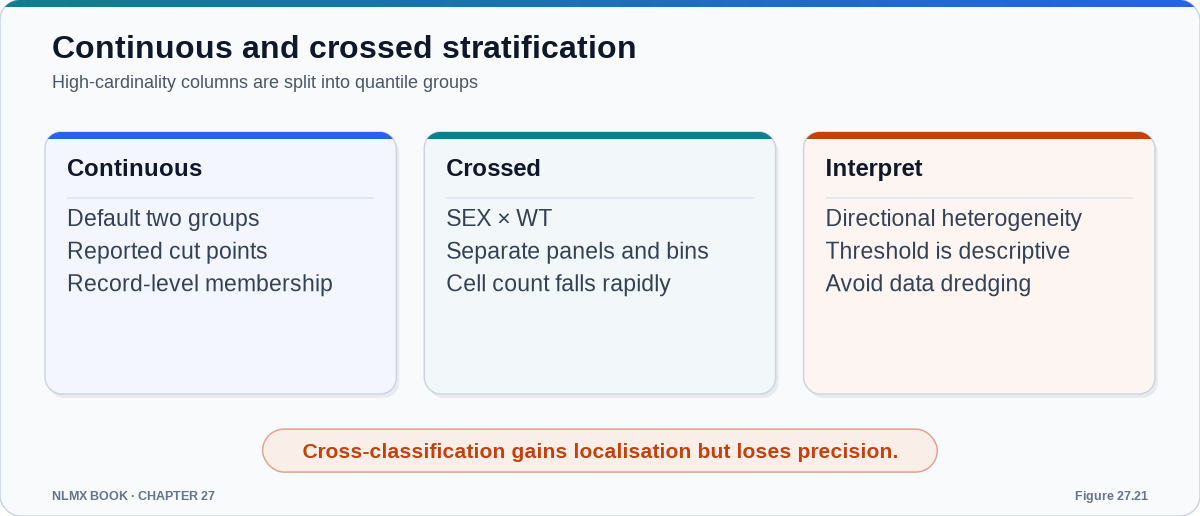
Columns with more than max_categories values are divided into stratify_groups quantile groups, default two. Cut points are reported in notes. Multiple stratification columns form a cross-classification, such as SEX × WT, with independent binning in every resulting cell.
Novice translation
This topic changes three practical decisions in a predictive-check review. First, quantile groups balance record counts approximately but their cut points are descriptive, not clinical thresholds. Second, crossing two binary groups yields four panels and quickly reduces subjects per panel. Third, use predefined clinical cutoffs by creating an appropriate data column when a median split is not scientifically meaningful. Keep those decisions separate: one defines what is simulated or summarised, another controls how evidence is displayed, and the last controls what conclusion the evidence can support. A reviewer should be able to reproduce each decision from the resolved settings and numerical tables, not infer it from the appearance of the figure.
What to understand
- Quantile groups balance record counts approximately but their cut points are descriptive, not clinical thresholds.
- Crossing two binary groups yields four panels and quickly reduces subjects per panel.
- Use predefined clinical cutoffs by creating an appropriate data column when a median split is not scientifically meaningful.
Practical interpretation
The worked pvcVPC crosses SEX with two WT groups and shows why cell counts must accompany any apparent subgroup signal.
Evidence to retain
For continuous and crossed stratification, retain the issued command, vpc_settings.vpc, the source model/data/result identifiers, seed and replicate count, the relevant CSV/JSON fields, warnings and notes, and the exact figure used for interpretation. Record any sensitivity run that changed the conclusion. If an option was selected after seeing the data, label that analysis exploratory. This evidence separates a reproducible diagnostic decision from a visual impression and lets another pharmacometrician check counts, transformations, exclusions, and uncertainty assumptions.
Common mistakes
- Interpreting a median split clinically
- Overstratifying
- Comparing panels with different bin structures unknowingly
Page checklist
- Report cut points
- State record-level assignment
- Check cell size
- Avoid exploratory proliferation
Further reading
See previous page, next page, complete VPC command and settings index.