16.29 Worked example: two-compartment intravenous data
This example asks a harder structural question than the oral example: can autoinit recognise clearly biexponential intravenous profiles and supply useful central-volume, intercompartmental-clearance, and peripheral-volume starts? The reproducible fixture contains 20 subjects given a single intravenous bolus with rich sampling from the early distribution phase through the terminal phase. It was generated with typical values CL = 4, V1 = 20, Q = 6, and V2 = 60.
Files:
What the program recovered
The recommended structural values are CL = 4.047, V1 = 20.382, Q = 6.084, and V2 = 61.051. These are close to the generating values and, more importantly, are supported by two-compartment fits from all 20 subjects. Read the SOURCE and NOTE columns alongside every number: they explain why ML is not allowed to dilute the two-compartment CL recommendation with its one-compartment approximation.
The ordinary V row is about 59.968. It is an apparent one-compartment summary produced by combining method values; it is not the central volume and it is not guaranteed to equal V1 + V2. For a two-compartment control stream, use V1 and V2 according to the intended parameterisation. Treat V as diagnostic evidence of how a one-compartment approximation views the complete curve.
How to review the result
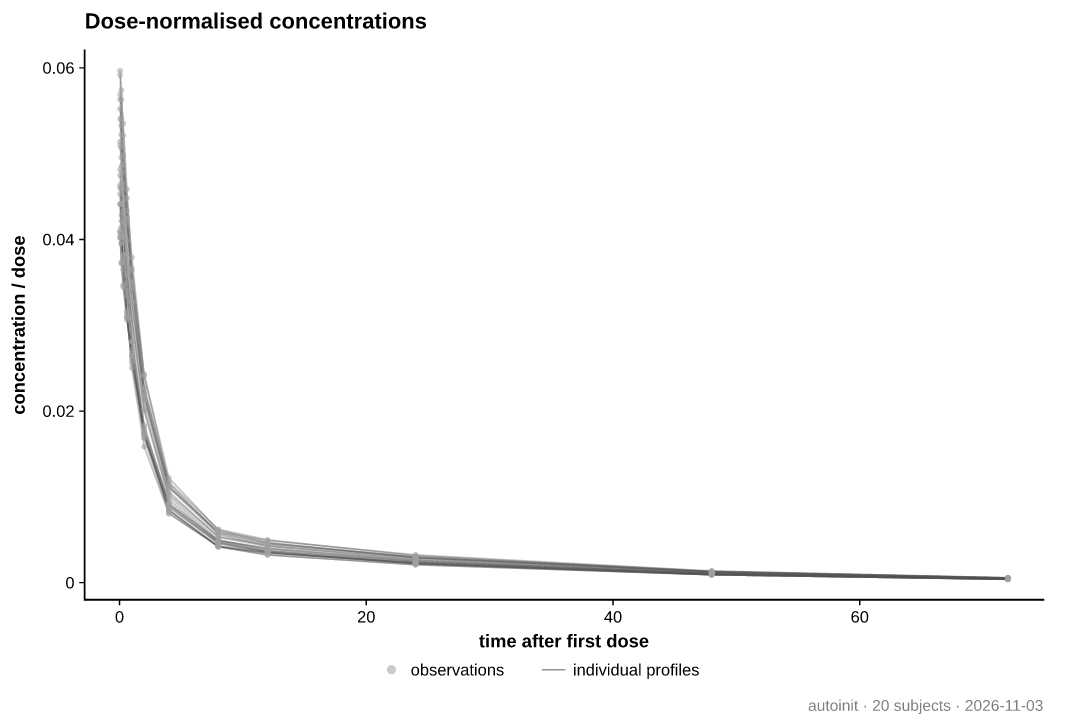
Start with the profile graphic. A rapid initial decline followed by a slower terminal slope provides visual support for distribution. Then verify the subject-level two-compartment success count and compare NCA curve-stripping values with NLS values. Agreement on the order of magnitude is more important than exact equality because the methods solve different approximations.
Finally, inspect init_blocks.txt. Match its compartment numbers, ADVAN/TRANS assumptions, and scale statements to the model you actually plan to fit. The Q3 and V3 rows remain explicit three-compartment rules of thumb; this dataset does not validate a third distribution compartment.
Common mistakes
- Using the
Vrow as V1 or as V1 + V2. - Claiming Q3 and V3 were estimated from these data.
- Assuming a visually curved semilog profile proves that every subject supports two compartments.
- Copying blocks without reconciling bolus and infusion records.
- Treating close simulation recovery as proof for every real dataset.
Checklist
- Confirm 20 subjects and an intravenous route.
- Verify that V1, Q, and V2 cite two-compartment evidence.
- Distinguish the one-compartment
Vsummary from structural volumes. - Confirm that generated compartment and scaling statements match the target model.
- Re-estimate all parameters in the population model and assess uncertainty.
Further reading
See the two-compartment check, parameter availability, using generated blocks safely, and validation boundaries.