Model-code support and no-effect notes
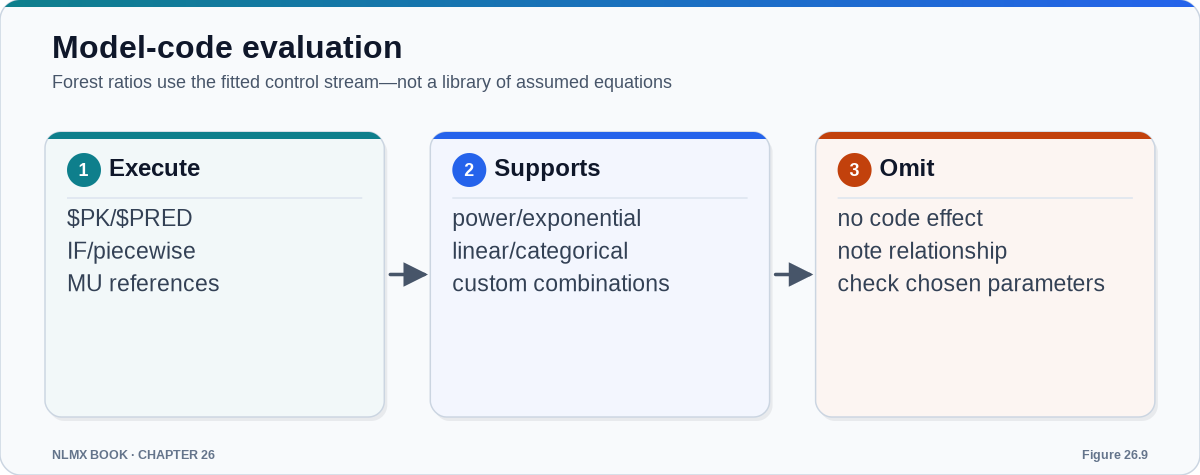
Forest evaluates $PK/$PRED rather than assuming a fixed library equation. MU-referenced effects, IF blocks, piecewise functions, category-specific coefficients, and interactions are therefore respected. This also means model-code errors propagate exactly into the plot.
The command compares candidate parameter values after changing covariates. If a requested covariate does not affect a chosen parameter, the row is omitted and a note is written. In the primary example, V~EGFR is left out because the fitted V code contains WT but not EGFR.
Review omissions against the intended final model. Unexpected absence may indicate a spelling mismatch, code path, parameter filter, or missing covariate effect. Do not add a zero-effect row manually; correct the fitted model or report the supported matrix.
Common mistakes
- Treating a forest ratio or reference-band class as covariate-selection evidence, causality, or an automatic dosing recommendation.
- Omitting the reference subject, uncertainty source, regimen, subgroup denominator, data support, or fitted-model diagnostics.
- Confusing parameter-uncertainty intervals, BSV ranges, and subject-bootstrap intervals because they share one graphic.
Page checklist
- The numerator, denominator, fitted model, covariate settings, and units are explicit.
- The interval source and clinical meaning are distinguished from BSV and selection uncertainty.
- Tables, resolved settings, commands, diagnostics, limitations, and confirmation evidence are retained.