22.1 Why covariate models exist
Population parameters describe a distribution, not one universal subject. Covariate models explain part of the systematic variation in that distribution using observed characteristics such as body weight, renal function, age, formulation, genotype, disease state, or study design.
The scientific goals differ. A covariate may improve prediction, reduce unexplained variability, quantify a mechanistic relationship, support dose adjustment, explain subgroup exposure, stabilize extrapolation, or control confounding. State the primary goal before choosing a selection strategy; a model optimized for in-sample fit is not automatically optimal for dosing decisions.
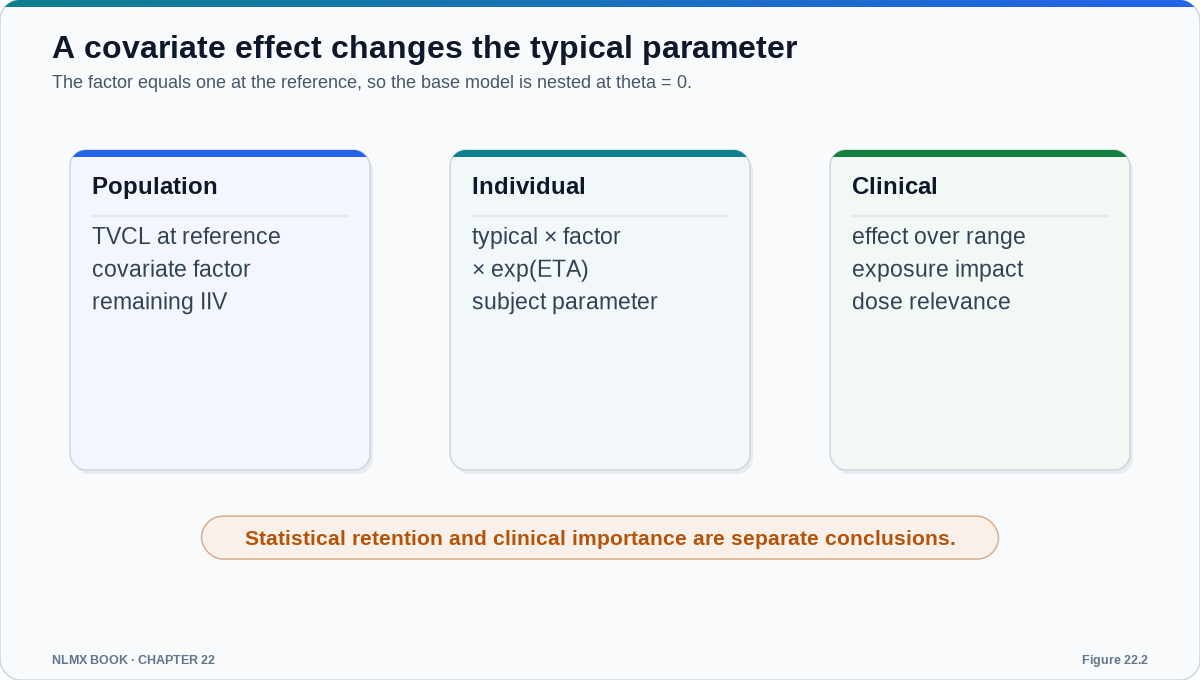
For a parameter P, nlmx expresses an effect as a multiplicative factor on the typical value. At the reference covariate value, the factor equals one and the typical value retains a clear meaning. Individual variability remains through ETA unless the model removes or changes it.
Covariate modelling does not prove causality. A retained WT effect can proxy age, organ size, dose design, or study membership. A rejected relationship may be obscured by collinearity, missingness, narrow range, measurement error, shrinkage, or inadequate sampling. Separate evidence from interpretation.
The final model must be parsimonious enough to estimate reliably, rich enough for its intended predictions, and transparent enough for review. Statistical selection is one input. Mechanistic knowledge, clinical relevance, precision, robustness, diagnostics, and external evidence are equally important.
Common mistakes
- Starting selection without defining the scientific purpose.
- Treating retained covariates as causal discoveries.
- Assuming rejected covariates have no biological effect.
- Maximizing OFV improvement without considering prediction use.
- Removing all IIV after explaining only part of the variation.
Checklist
- State the prediction or decision the model must support.
- Define plausible parameter–covariate mechanisms.
- Separate statistical, predictive, and clinical goals.
- Identify confounding and proxy relationships.
- Plan confirmation and sensitivity analyses before selection.
Further reading
Continue with the complete workflow, effect meaning, and clinical relevance.