27.18 Explicit edges and nominal-time binning
Explicit edges implement prespecified scientific or design intervals, while nominal binning creates one bin per distinct x value. Edges are not merged for low counts; empty bins are dropped. Nominal bins are merged when they violate min_obs.
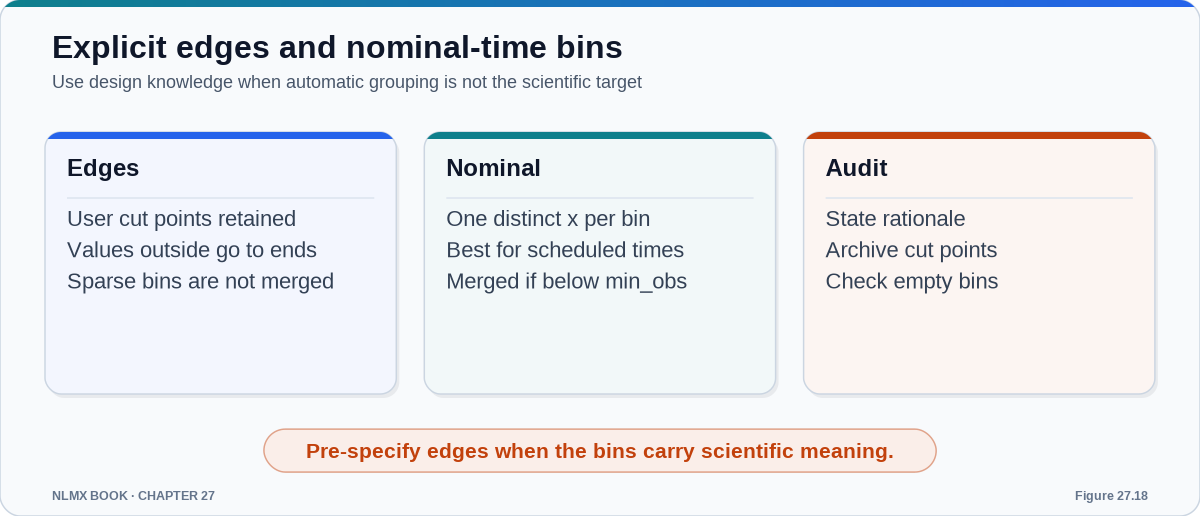
Novice translation
This topic changes three practical decisions in a predictive-check review. First, with edges, values outside the first and last boundary enter the first and last retained bins. Second, nominal binning is ideal for exact scheduled sampling times and can become excessive with jittered or continuous times. Third, archive the edge vector and rationale; a reader should be able to reproduce every record’s bin. Keep those decisions separate: one defines what is simulated or summarised, another controls how evidence is displayed, and the last controls what conclusion the evidence can support. A reviewer should be able to reproduce each decision from the resolved settings and numerical tables, not infer it from the appearance of the figure.
What to understand
- With edges, values outside the first and last boundary enter the first and last retained bins.
- Nominal binning is ideal for exact scheduled sampling times and can become excessive with jittered or continuous times.
- Archive the edge vector and rationale; a reader should be able to reproduce every record’s bin.
Practical interpretation
The Chapter 27 uncertainty example uses explicit edges surrounding each nominal sampling time, while the BLQ example uses nominal bins.
Evidence to retain
For explicit edges and nominal-time binning, retain the issued command, vpc_settings.vpc, the source model/data/result identifiers, seed and replicate count, the relevant CSV/JSON fields, warnings and notes, and the exact figure used for interpretation. Record any sensitivity run that changed the conclusion. If an option was selected after seeing the data, label that analysis exploratory. This evidence separates a reproducible diagnostic decision from a visual impression and lets another pharmacometrician check counts, transformations, exclusions, and uncertainty assumptions.
Common mistakes
- Using nominal bins on jittered time
- Assuming sparse edge bins are merged
- Selecting edges after viewing discrepancies
Page checklist
- Predefine edges
- Check values outside range
- Review empty/sparse bins
- Store bin vector
Further reading
See previous page, next page, complete VPC command and settings index.