21.16 ETA pairs, empirical correlation, and OMEGA correlation
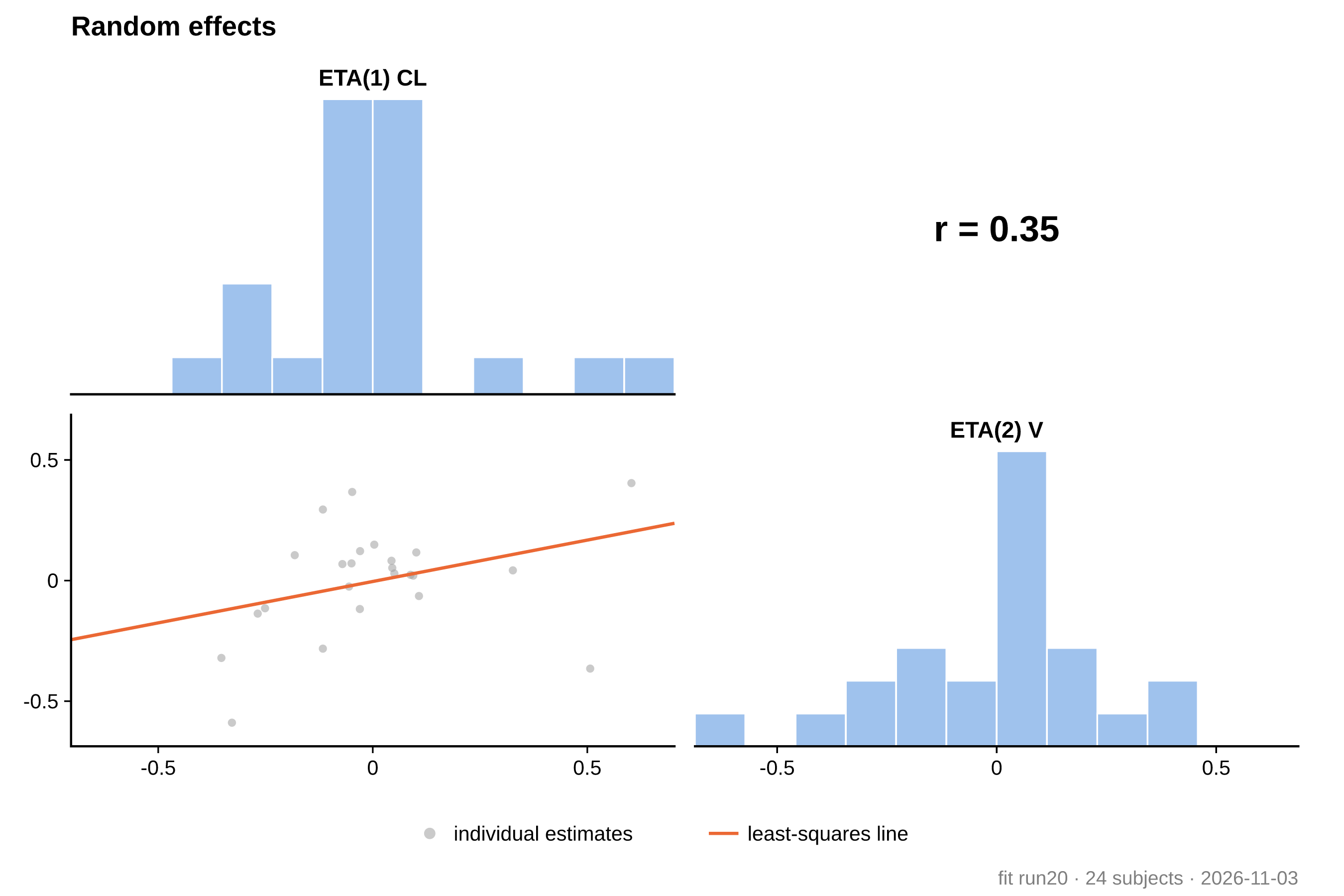
With two or more ETAs, nlmx draws a pairs matrix: EBE scatter plots and least-squares lines below the diagonal, Pearson correlations above the diagonal, and marginal histograms on the diagonal. This is a compact screen for relationships among individual deviations.
An empirical EBE correlation is not the same as an estimated population OMEGA correlation. EBEs are shrunken and share information through the model and data design. A diagonal OMEGA model can still produce correlated EBEs when parameters are hard to distinguish, sampling is sparse, or structural misspecification makes one ETA compensate for another. Conversely, high shrinkage can attenuate or distort an underlying correlation.
The verified Chapter 20 example’s ETA pair panel shows a modest positive empirical association. The diagonal model fixes the population covariance at zero; the separate block-OMEGA worked run estimates a population correlation near 0.383. Those quantities answer different questions and should not be copied interchangeably.
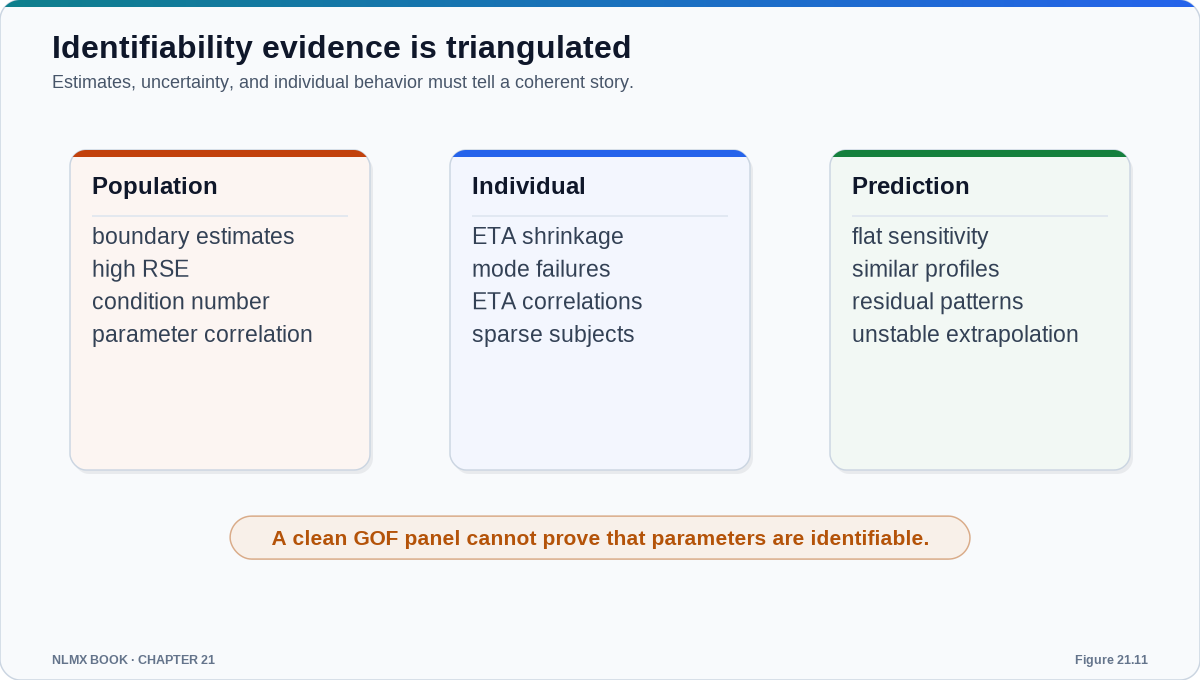
A strong EBE correlation may motivate testing a BLOCK OMEGA, reconsidering structural parameterization, or examining information content. It does not automatically justify adding covariance. Compare likelihood, stability, positive definiteness, parameter uncertainty, multiple starts, shrinkage, biological plausibility, and predictive performance.
nlmx reports very high empirical ETA correlations in the listing when absolute Pearson correlation exceeds the documented threshold. Treat that as an investigation trigger, not a model-selection rule.
Common mistakes
- Reporting EBE Pearson correlation as the OMEGA correlation.
- Adding every covariance suggested by a pairs plot.
- Ignoring shrinkage and sparse sampling.
- Treating a diagonal model as proof that ETAs are empirically independent.
- Keeping a nearly singular block because it lowers OFV.
Checklist
- Distinguish empirical EBE and population OMEGA correlation.
- Review shrinkage and subject information.
- Investigate structural and design causes.
- Test covariance under controlled settings.
- Check uncertainty, conditioning, and plausibility.
Further reading
See OMEGA blocks, the block-OMEGA example, and identifiability.