24.9 Moment identity, shrinkage, and weak information
Under a coherent posterior approximation, OMEGA ≈ Var(mᵢ) + mean(Vᵢ). Between-subject variation in posterior means plus average within-subject posterior uncertainty should recover population random-effect variance. nlmx reports each component, relative error, ETA shrinkage, and subjects whose posterior variance exceeds 80% of OMEGA.
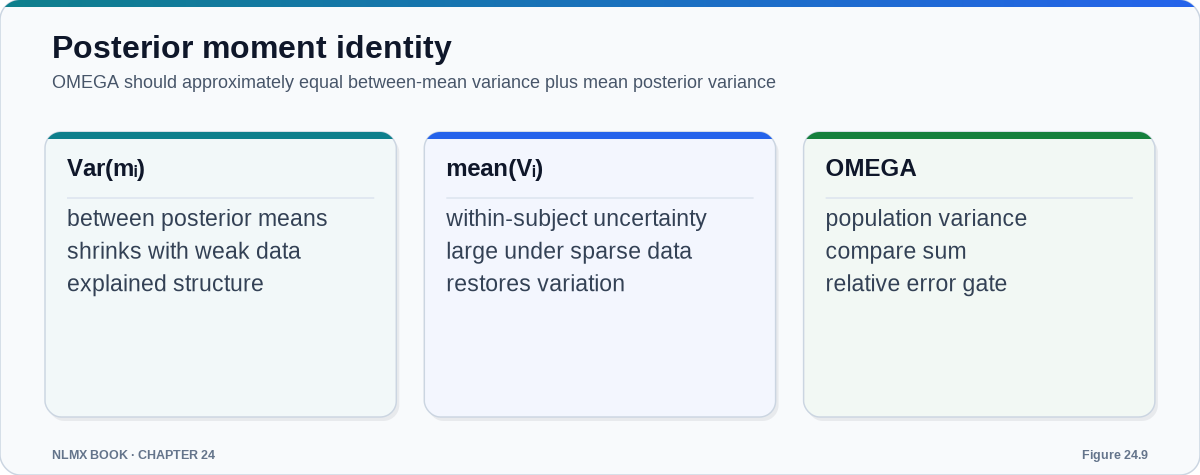
The teaching run had moment errors of 0.3% and 0.5% and ETA shrinkage around 3%, a favorable case. Large error can indicate incompatible PHI/ETC, reconstruction problems, parameter-order mismatch, approximation limitations, or an inadequate OMEGA model. High shrinkage means posterior means contain limited individual signal; draws represent uncertainty honestly but learner power declines.
Treat the identity as a diagnostic, not an equation that must hold exactly in finite samples. The default variance-consistency tolerance is 25%, deliberately wider than an earlier unrealistic 2% rule.
Common mistakes
- Expecting exact equality in every dataset.
- Confusing ETA shrinkage with residual shrinkage.
- Calling low shrinkage proof of model validity.
- Ignoring which ETA fails the identity.
- Tightening tolerance solely to make selection conservative.
Checklist
- Report all three moment components per ETA.
- Review relative error and weak-subject count.
- Investigate source and ordering discrepancies.
- Interpret selection power in light of shrinkage.
- Apply variance-consistency policy prospectively.
Further reading
See variance consistency and Chapter 21's shrinkage documentation.