Refit initialization, warm starts, and bounds
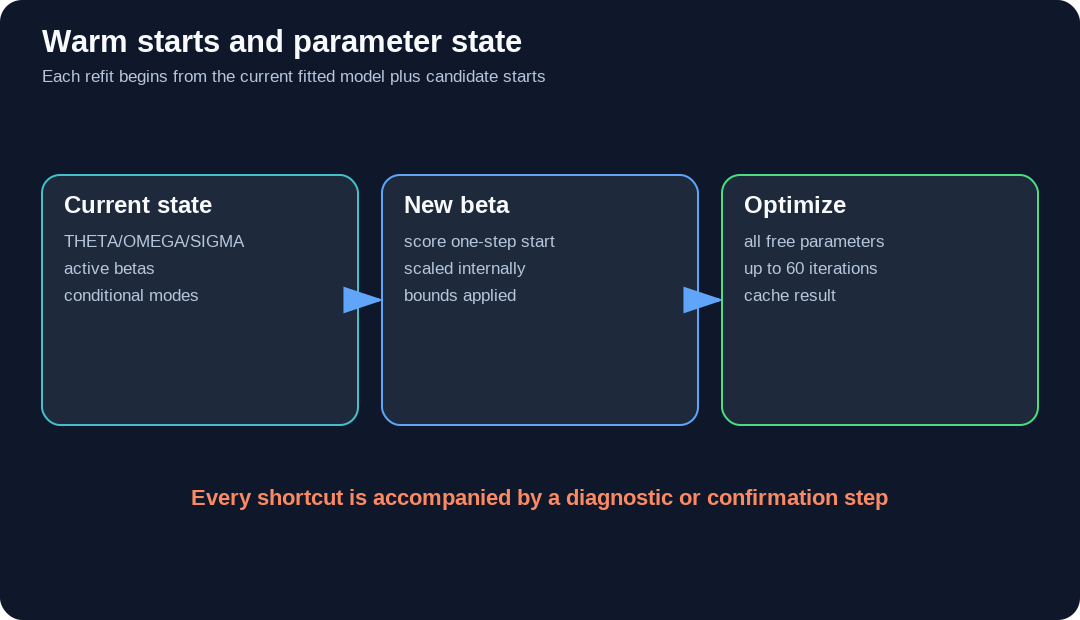
Every candidate refit begins from the current fitted parameter state plus an initial value for the new coefficient, or from the corresponding retained values after a term is removed. Warm starts reduce cost and usually keep adjacent models on a comparable likelihood mode. They do not prove that the optimizer found the global optimum.
Bounds and transformations are part of the model. A candidate driven to a bound may signal weak information, an unsuitable form, a scaling problem, or an optimization failure. Inspect final gradients, iteration-limit messages, bound proximity, positive-definiteness diagnostics, and whether distinct starts converge to the same endpoint. Configuration defaults permit up to 60 refit iterations for the SCM inner fits (selection.refit_max_iterations).
When a refit is suspect, do not overwrite the evidence bundle. Launch a separately named sensitivity run with justified starts, scaling, or bounds, then compare model identity and OFV. Changing numerical controls after seeing one candidate's result must be traceable and consistently applied.
Common mistakes
- Treating a stepwise p-value as clinical importance or causal proof.
- Reading a candidate comparison without its active model, convergence state, degrees of freedom, and exact threshold.
- Reporting only the terminal relationship list while discarding failed models, path decisions, configuration, and provenance.
Page checklist
- The scientific question, model identities, and comparison direction are explicit.
- Numerical validity is reviewed before interpreting statistical evidence.
- The result is linked to the complete trace and final joint-model diagnostics.