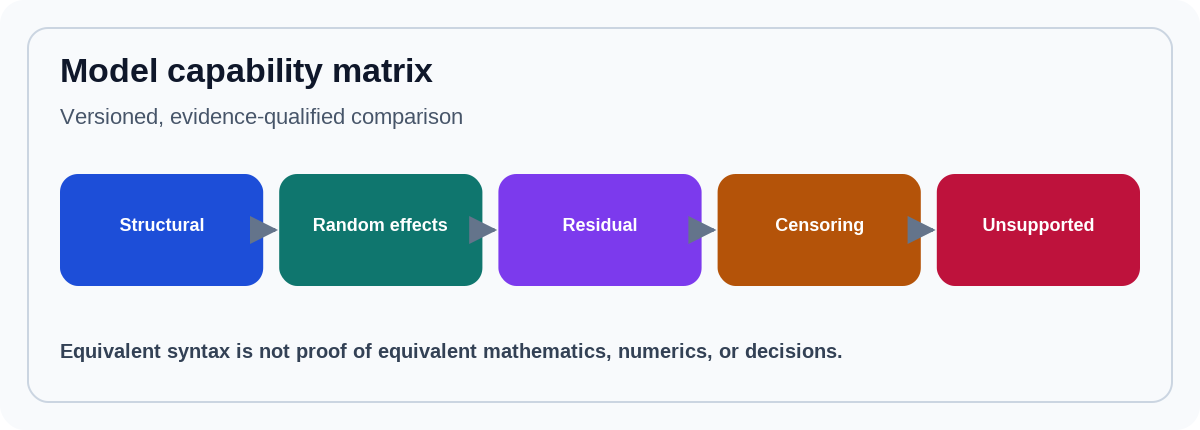
40.9 Structural, variability, residual, and censoring support
What you will learn
- Locate the exact nlmx model boundary
- Interpret matrix cells as scoped claims
- Know when a translation becomes a new model
Prerequisites: Chapter 39 troubleshooting, Chapter 36 command reference, and Chapter 38 output reference.
This page is scoped to nlmx 4.16.2 and an external-documentation snapshot of 2026-11-10. Product names describe different system boundaries; a blank or “outside role” is not a quality ranking. Treat every migration as a new implementation until model semantics, analysis population, objective definition, numerical behavior, outputs, and decisions have been independently reconciled.
nlmx supports $PRED; analytic ADVAN1–4/11/12 with listed TRANS subsets; ADVAN10; general linear ADVAN5/7; and $DES ADVAN6/8/9/13/14/15. It supports diagonal/BLOCK/SAME OMEGA, IOV patterns, several EPS, coded residual models, F_FLAG 0/1/2, and likelihood code under Laplace/SAEM constraints.
This is a subset of NONMEM's language and extension mechanisms. PsN normally delegates model execution to NONMEM, so its model coverage follows the configured NONMEM plus workflow assumptions. PopED requires a design model expressed through R functions/interfaces; curve equivalence does not automatically reproduce an estimation model. Monolix uses its own Mlxtran/project structure and libraries.
The complete matrix distinguishes “can express a comparable model” from “reads the same control stream.” Mixtures, $PRIOR, hierarchy records, verbatim/user subroutines, and several parameter-prior records are refused by nlmx because ignoring them would change the model. An equivalent rewrite must receive a new model identifier, tests of fixed-parameter predictions/likelihood, and reviewer approval.
Model-translation acceptance
A translated model should pass zero-random-effect profiles, selected ETA perturbations, residual-variance checks, dose/event sentinels, and likelihood contributions for ordinary and censored observations. Test typical and extreme covariates. For an ODE model, include a tolerance-convergence study. Only then fit the same dataset. This sequence detects an apparently reasonable curve that came from a different CMT, scale factor, residual model, or random-effect placement.
Review checklist
- Are the exact product versions, task boundaries, inputs, methods, and settings named?
- Were semantics and frozen-parameter results aligned before optimized outputs?
- Is the comparison using a method-appropriate deterministic or stochastic tolerance?
- Are unsupported or analogous features described without implying equivalence?
- Can every claim be reproduced from retained primary evidence?
Navigation
See the previous page, next page, and complete comparison reference.