23.3 Computational advantage and cost drivers
Full stepwise covariate modelling repeatedly optimizes population parameters for competing models. The frozen engine evaluates a shared base objective, caches subject modes and target-score components, and uses local score/information calculations for many candidates. A baseline design column can often be formed from a covariate value multiplied by a cached per-subject target score, so cost grows much more slowly than one complete fit per relationship.
The exact speedup is model- and workflow-dependent. Important drivers include subjects, observations, ETA dimension, ODE cost, likelihood approximation, nuisance-parameter count, candidate columns, selection steps, finite-difference evaluations, uncertainty draws, calibration replicates, equation refits, --refine, and the final joint refit. Exact uncertainty grows with draws and targets; parametric bootstrap simulates and rescores datasets; permutation can reuse cached subject scores and is usually cheaper.
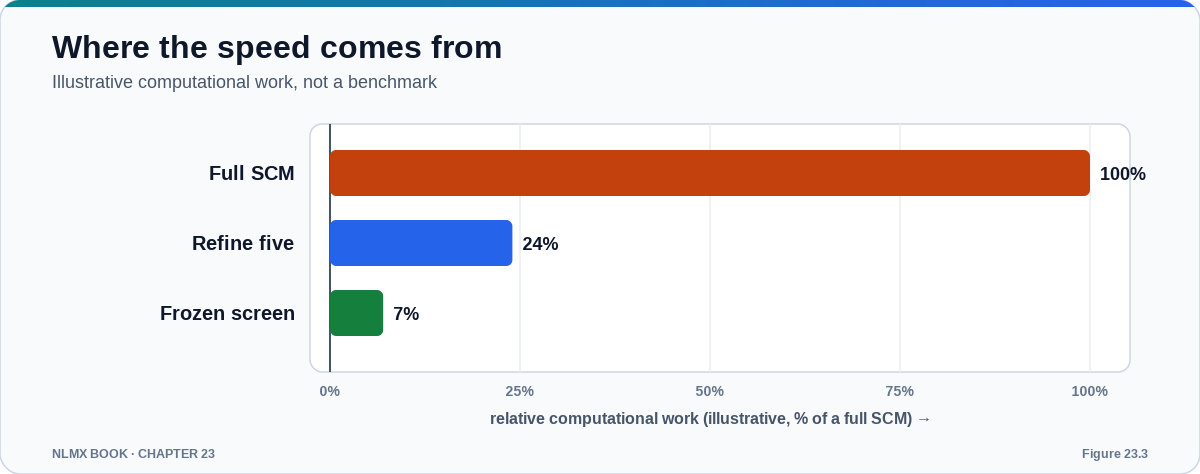
Measure elapsed time and subject-likelihood evaluations, not only wall-clock impressions. Parallel threads can reduce elapsed time but do not reduce mathematical work. Comparisons with SCM should use the same machine, model, scope, data, likelihood approximation, thresholds, and output requirements. Include failed refits and diagnostic production in the reference cost.
A fast screen is most valuable when it eliminates clearly null candidates and directs expensive computation toward uncertain or clinically important effects. Disabling diagnostics merely to improve a benchmark produces a less useful comparison.
Common mistakes
- Quoting one universal speedup factor.
- Comparing a score-only run with an SCM run that includes final refits and reports.
- Ignoring ODE, ETA, draw, and candidate dimensionality.
- Treating thread count as an algorithmic speedup.
- Omitting failed work from timing summaries.
Checklist
- Record hardware, version, threads, and settings.
- Report subjects, observations, candidates, and columns.
- Separate screen, uncertainty, calibration, refine, and final-refit time.
- Count subject evaluations where available.
- Compare like-for-like evidence bundles.
Further reading
See candidate construction, calibration, and validation.