22.17 Positivity, coefficient bounds, and extrapolation
PK/PD parameters such as clearance and volume are usually positive. Power and exponential factors preserve positivity under valid inputs. Linear and proportional factors can cross zero, so nlmx-generated draft THETAs receive bounds that keep the factor positive over the observed covariate range; proportional/grouped coefficients must remain above −1.
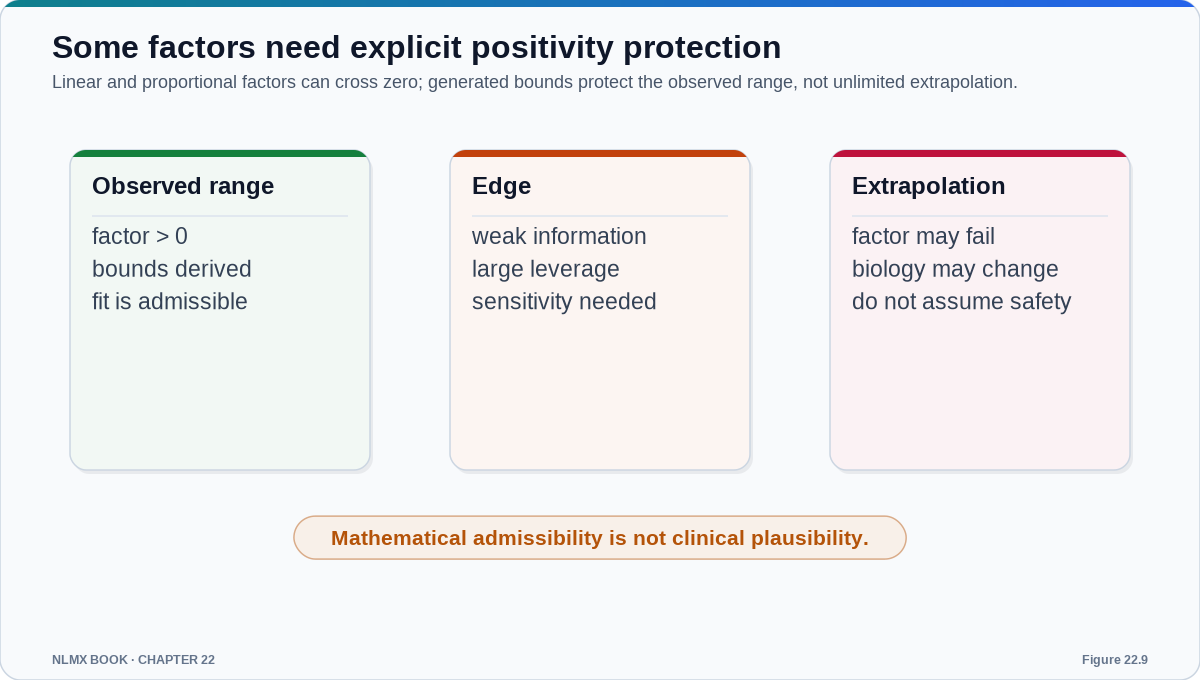
Bounds are mathematical guardrails, not scientific evidence. An estimate near a bound can indicate weak information, incompatible form, sparse levels, or an implausible effect. Review boundary warnings and uncertainty. A factor positive from 45–110 kg may become negative at 150 kg under a linear equation; dose decisions outside observed support require explicit evaluation.
Power forms require positive covariates. Missing codes such as −99 must be declared missing before form generation; otherwise they can disable power or corrupt ranges. Zero can be scientifically meaningful, so do not replace it automatically.
Draft bounds are based on detected support and should be reviewed before NONMEM confirmation. Units, transformation, interactions, and future populations can change admissibility. Simulate parameter factors across the intended clinical domain, not just observed records.
A boundary stress test
Evaluate every proposed equation at the minimum, 5th percentile, reference, 95th percentile, maximum, and any anticipated deployment boundary. Confirm that the multiplier and resulting parameter remain finite, positive where required, and pharmacologically plausible. Repeat the calculation at uncertainty limits, because an acceptable point estimate can have an implausible confidence bound. Then identify which evaluations are interpolation and which are extrapolation. A numerical guardrail prevents invalid arithmetic; it does not create evidence in an unobserved region. If dosing decisions depend on a tail with little support, state the limitation and consider external data, a constrained mechanistic form, or a dedicated sensitivity analysis.
Common mistakes
- Treating generated bounds as proof of plausibility.
- Ignoring boundary estimates.
- Using undeclared negative missing codes.
- Extrapolating a linear factor beyond its positivity range.
- Adding constants to covariates without scientific meaning.
Checklist
- Verify input range and missing codes.
- Calculate factor minima/maxima over observed and intended domains.
- Review generated THETA bounds.
- Investigate estimates near boundaries.
- Choose a safer form or restrict claims when extrapolation fails.
Further reading
See power equations, linear/exponential forms, and validation.