14.17 Steady-state and accumulation metrics
At steady state, the central interval is one dosing interval, tau, rather than an extrapolation to infinity. The profile must be aligned to a dose and contain sufficient observations through the interval boundary. nlmx may use a next-dose sample as the previous interval's boundary observation so that AUCtau closes at tau without duplicating the sample as an ordinary interior point.
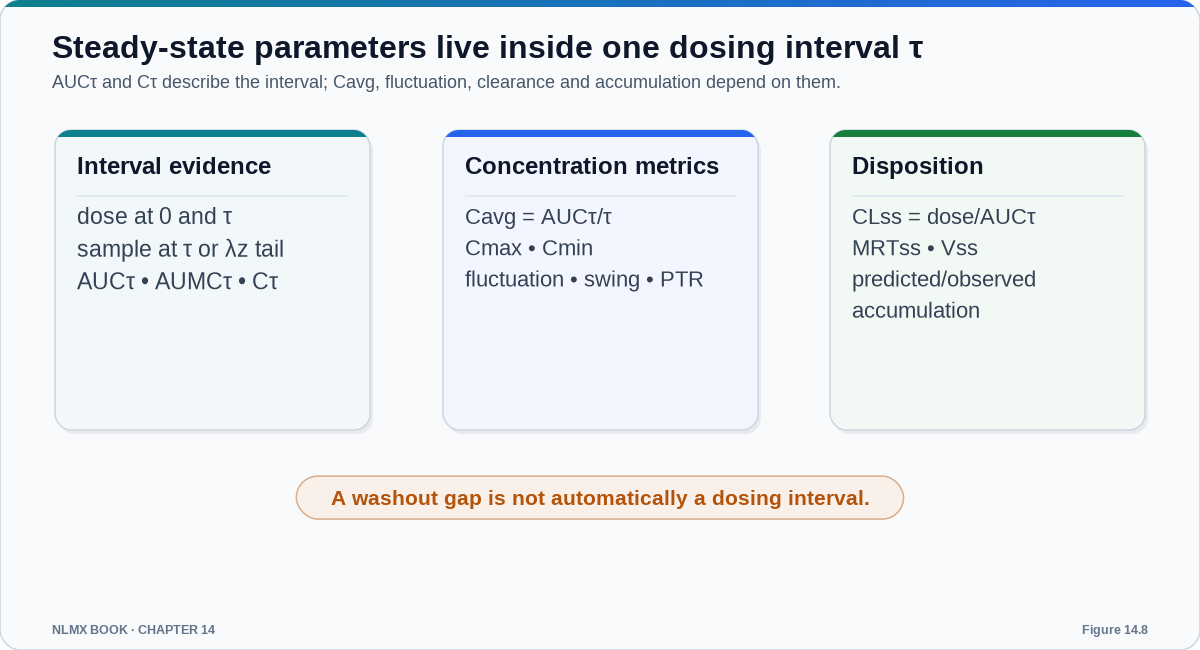
Core quantities include:
AUCtau  = area from 0 to tau
AUMCtau = first-moment area from 0 to tau
Cavg    = AUCtau / tau
Cmax and Tmax are the observed maximum and its time within the interval. Cmin is the minimum concentration according to the configured interval convention, while Ctau is the concentration at the boundary. They can differ when the profile is not monotonic near tau or a boundary is interpolated.
Common fluctuation summaries are
fluctuation (%) = 100 × (Cmax − Cmin) / Cavg
swing (%)       = 100 × (Cmax − Cmin) / Cmin
peak/trough     = Cmax / Cmin
Swing and peak-to-trough are undefined when Cmin is zero. Software may use different denominators or return policies, so names and formulas must be aligned before comparison.
Clearance, volume, and residence time at steady state
For a dosing interval, CLss or CLss/F is effective dose divided by AUCtau. Terminal volume at steady state uses lambda_z with AUCtau. MRT over the interval uses an AUMC/AUC relationship appropriate to repeated dosing, and intravenous Vss follows from clearance and MRT when its assumptions are met. Review the exact output convention rather than transferring a single-dose formula mechanically.
Accumulation can be described from observed exposure ratios when comparable first-dose and steady-state intervals exist, or predicted from lambda_z under a one-exponential, linear, time-invariant approximation:
Racc,pred = 1 / (1 − exp(−lambda_z × tau))
Observed and predicted accumulation answer different questions. A disagreement can reflect multicompartment kinetics, changing clearance, absorption, incomplete interval coverage, or noncomparable sampling.
Common mistakes
- Using AUCinf as the primary steady-state interval exposure.
- Assuming Cmin always equals Ctau.
- Dividing by zero for swing or peak-to-trough.
- Treating predicted accumulation as an observed result.
Checklist
- Verify tau, dose alignment, and boundary handling.
- Confirm the exact definitions of Cmin and Ctau.
- Reproduce AUCtau and Cavg.
- Label observed and predicted accumulation separately.
- Compare only intervals with compatible designs.
Further reading
See profile construction, multiple-dose boundaries, and the command workflow in Chapter 15.