23.20 Multi-degree-of-freedom categorical and spline blocks
A relationship can require several coefficients. A four-level categorical covariate with one reference has three proportional contrasts. A spline may have several basis coefficients. nlmx groups these columns into one candidate block and evaluates the joint efficient statistic U*′(I*)⁺U* using effective rank as degrees of freedom.
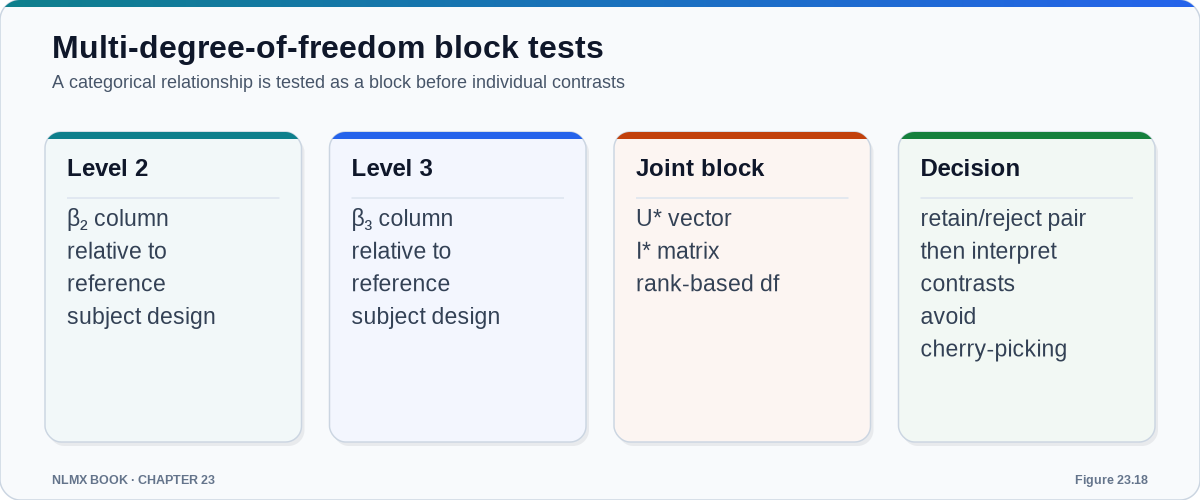
The block test protects against selecting whichever level or knot looks best after inspection. A retained block says that the relationship contains evidence somewhere in its supported coefficient space; it does not say every contrast is individually precise or clinically meaningful. Review refit estimates, covariance, sparse levels, and predicted effect curves after retention.
Grouped and ordinal alternatives impose different structure and degrees of freedom. Grouped coding shares one coefficient across non-reference levels. Ordinal coding assumes ordered progression. These can gain precision when justified but become biased when the constraint is wrong. Form comparison should occur according to the prespecified equation policy rather than selecting individual contrasts.
Effective rank loss changes the null reference. If a level has too few subjects or is perfectly confounded with study, a nominal column may contribute no independent direction.
Common mistakes
- Applying a one-df threshold to a multi-column block.
- Retaining only a favorable category contrast after a nonsignificant block test.
- Assuming ordinal codes imply an ordinal effect.
- Ignoring sparse levels or study confounding.
- Reporting a block p-value as uncertainty for each contrast.
Checklist
- Report nominal columns and effective rank.
- Verify reference and level counts.
- Justify grouped or ordinal constraints.
- Refit and inspect all block coefficients jointly.
- Plot the resulting level or spline effects.
Further reading
See categorical equations, rank, and form comparison.