Chapter 17 — screen: structural model screening
nlmx screen fits a deliberately bounded family of structural population-PK models, applies reliability gates, compares the eligible fits, and writes an auditable recommendation. It is designed to make the repetitive early structural-search stage fast without pretending that an automated winner is the final scientific model.
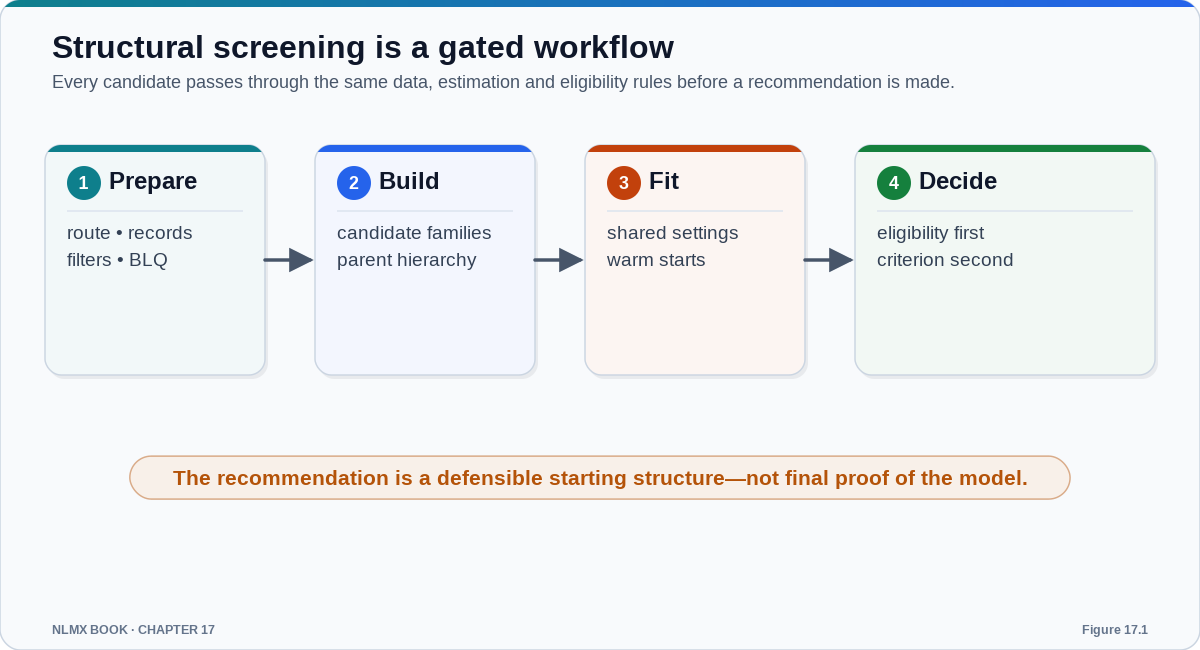
This chapter starts with a complete command and option index, then moves from data preparation through candidate construction, initialization, estimation, comparison criteria, eligibility, outputs, reproducibility, worked examples, troubleshooting, and validation. It is verified against the nlmx 4.6.0 release build dated 2026-11-03. The explanations assume the reader is new to population modelling. Terms such as objective function value (OFV), random effect, covariance step, condition number, shrinkage, nesting, and BICc are introduced before they are used for decisions.
Four frozen example runs accompany the chapter. One compares one-, two-, and three-compartment oral models; a second repeats the same evidence with likelihood-ratio selection; a third demonstrates lag-time selection; and a fourth compares linear, Michaelis–Menten, and QSS target-mediated elimination. These examples are teaching evidence, not validation against an external pharmacometrics package.
What you will be able to do
After completing the chapter, you should be able to define a scientifically sensible candidate set, run it with explicit settings, understand every row of model_comparison.csv, distinguish a numerical winner from an eligible recommendation, and archive enough evidence to reproduce the decision. You should also know when screening is under-supported by the design and when a candidate needs manual follow-up.
Chapter map
Pages 1–16 cover inputs, candidate families, starts, ETAs, residual error and estimation. Pages 17–22 explain OFV, AIC, BIC/BICc, LRT, reliability gates, and recommendation logic. Pages 23–28 document every output and reproducibility control. Pages 29–32 walk through executable examples. Pages 33–34 close with recovery and validation boundaries.
Scope boundary:
screenaccelerates structured comparison. It does not establish mechanistic truth, replace diagnostic plots, repair a weak study design, or justify switching criteria after seeing the result.
Next: Command and option index.