24.2 Why point-EBE screening is biased
Empirical Bayes estimates are conditional estimates, not directly observed subject parameters. Sparse subjects have ETAs pulled toward the population mean; rich subjects are more precise. Regressing one point EBE per subject on covariates treats these unequal and shrunken estimates as error-free responses. The relationship can be attenuated, signs can become unstable, and standard errors can be overconfident.
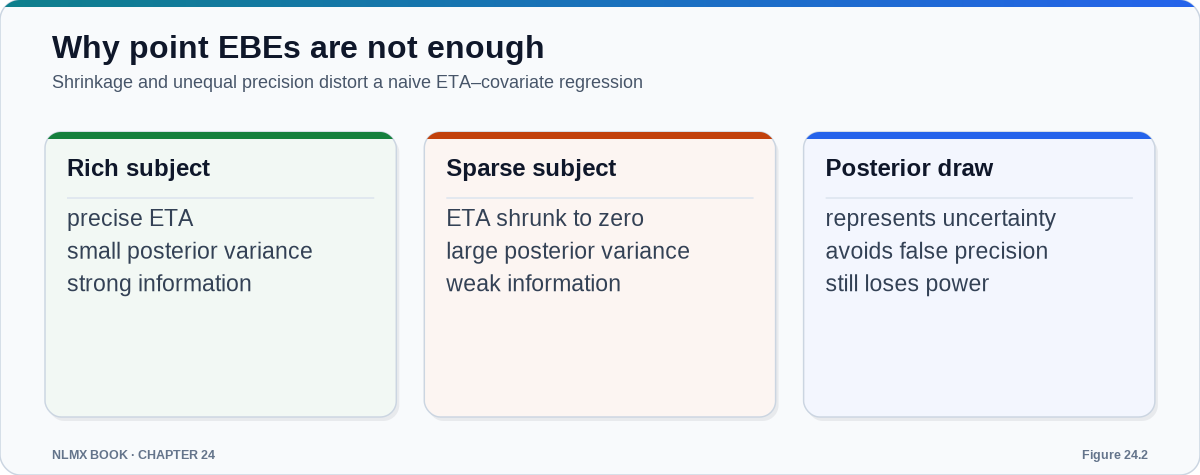
Posterior draws represent each subject by a distribution centered at its posterior mean with covariance reflecting individual uncertainty. Across repeated draws, weak subjects contribute a wider range instead of a falsely precise zero. This improves uncertainty propagation but cannot restore information absent from the study. High shrinkage still reduces power and makes separation of correlated covariates difficult.
The posterior-mean response is a useful sensitivity but returns to point-response behavior. Weighted GLS partly accounts for posterior variance, while draw-based learners propagate it directly. Compare probabilities across response choices when shrinkage is material.
Common mistakes
- Interpreting a shrunken ETA near zero as a known zero deviation.
- Giving sparse and rich subjects equal response precision without justification.
- Assuming draws eliminate shrinkage.
- Treating EBE–covariate scatterplots as confirmatory evidence.
- Excluding sparse subjects solely because their ETAs are uncertain.
Checklist
- Report ETA shrinkage and posterior variance.
- Use posterior draws as the primary response when qualified.
- Compare posterior-mean sensitivity when useful.
- Examine design support by covariate region.
- Confirm retained relationships in the likelihood model.
Further reading
See posterior distributions and response choice.