Input discovery and explicit artifact overrides
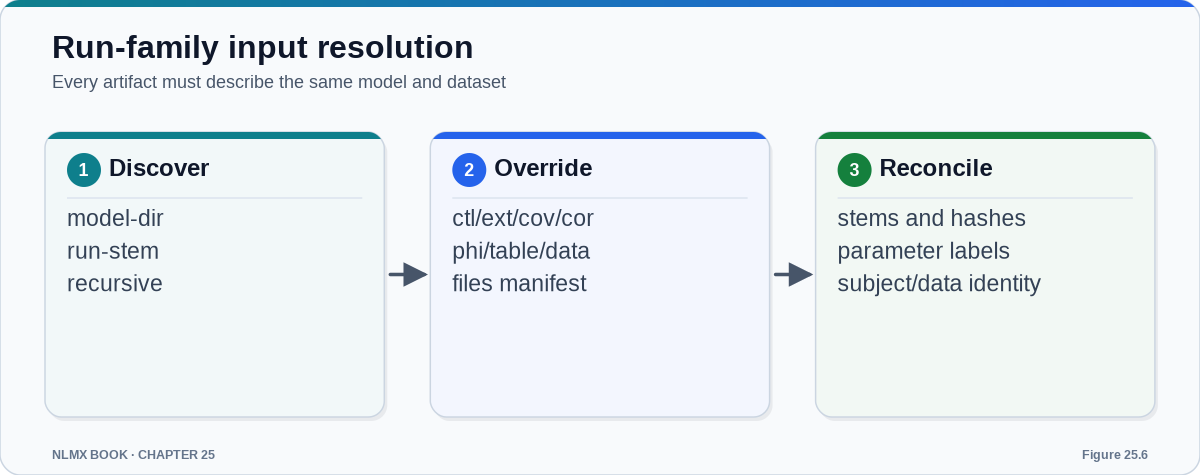
--model-dir asks nlmx to find one run family whose control stream, estimates, covariance/correlation, listing, PHI, table, and data share a coherent stem. Use --run-stem when several families occupy the folder. --recursive expands discovery but still rejects ambiguity. An explicit --files manifest or individual --ctl, --ext, --cov, --cor, --data, --lst, --phi, and --table overrides can remove uncertainty.
Every artifact must represent the same estimation and dataset. Matching filenames are not proof: validate parameter labels/dimensions, OFV, data path and filters, subject IDs, ETA columns, covariance labels, and timestamps/hashes. --data intentionally overrides $DATA; record why. A .phi with ETC covariance supports direct posterior ingestion, while an ID/ETA table is weaker and may require reconstruction.
Prefer a stable run directory or manifest in regulated work. Archive input_manifest.json, which records roles and hashes. Moving an unchanged file is generally operational; changing its bytes changes analysis identity and blocks resume.
Common mistakes
- Changing the scientific question after seeing the result while presenting it as the original run.
- Reading one engine's summary without checking its prerequisites, failures, normalized settings, and fitted endpoint.
- Treating a generated draft, comparison label, or completed checkpoint as a substitute for model diagnostics and reference-software confirmation.
Page checklist
- The exact command, version, inputs, resolved settings, and output directory are identifiable.
- Engine-specific evidence is interpreted on its own scale before cross-method comparison.
- Recovery state, final refit, diagnostics, and remaining confirmation work are explicit.