36A.10 Pharmacometric equations in four formats
nlmx report publishes one Markdown source into retained Markdown, Word and PDF by default, with optional HTML. The command solves document generation; it does not validate the scientific analysis or approve its interpretation. Treat the source Markdown and .report file as the controlled recipe, and treat every released format as a separate review target.
Write math as source, not screenshots
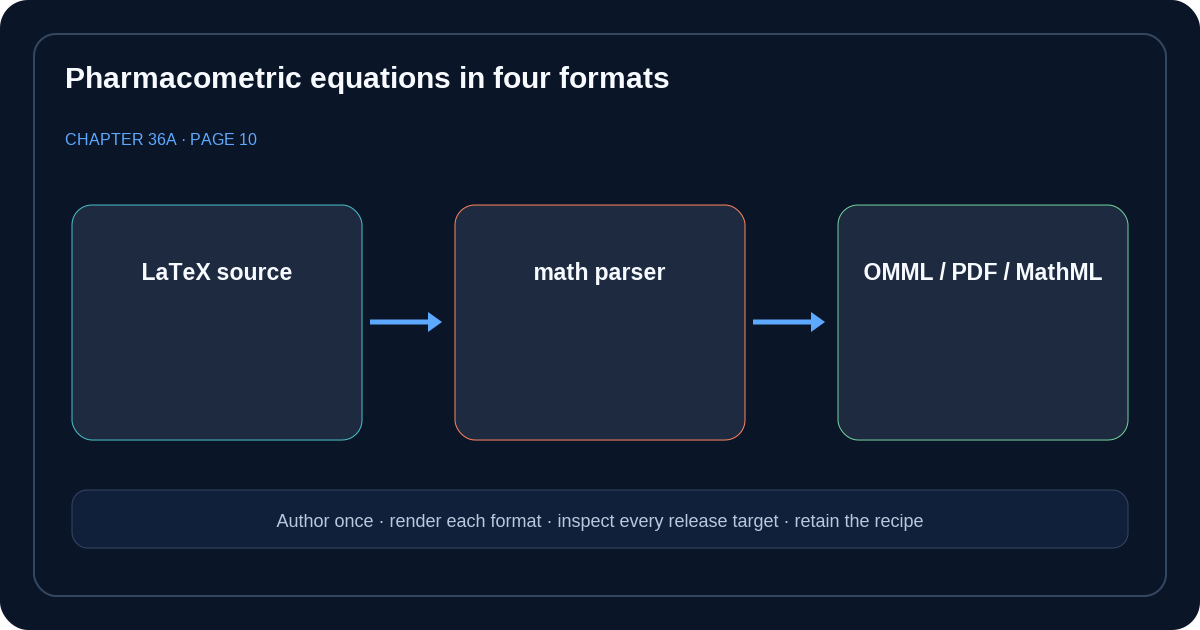
Inline math uses $...$; display math uses $...$. Markdown retains the LaTeX-like source, Word receives editable OMML equations, PDF receives typeset searchable layout, and HTML receives MathML without a network script. This makes the model definition reviewable in each target.
Supported constructs cover typical pharmacometric work: Greek symbols, scripts, fractions, roots, scalable delimiters, sums/integrals, common functions/operators, accents, text/styles, matrices, cases, aligned and gather blocks. Use aligned to split a wide model across lines. Include structural, interindividual/covariate, residual, exposure-response and derived-quantity equations needed to understand the analysis.
The parser warns on unbalanced braces, unmatched \left/\right, unknown environments or unsupported commands. Unsupported source can be printed literally while the rest renders; fix every warning. Equation tags/labels and cross-references are ignored, colors are ignored, and boxed/cancelled content loses the box/strike. Very wide PDF equations are scaled, which can make them unreadable.
Inspect symbols, subscripts, superscripts, fractions, delimiters, spacing and line breaks in every released target. The executed PDF fixture shows the oral one-compartment equation correctly typeset, and structural DOCX inspection found native OMML elements.
Equation review procedure
Read the source equation aloud as parameterization: what is typical value, reference, link function, random effect and residual scale? Then compare Word, PDF and HTML symbol-by-symbol. Check minus signs, exponent scope, subscripts, covariance matrices, brackets and units. Copy/edit a Word equation when editability is required; search/extract PDF text to supplement visual review; inspect HTML MathML in more than one browser if it is a deliverable. A mathematically beautiful equation can still describe the wrong fitted model, so reconcile it with the final control stream/settings.
Practical review questions
- Does the released content answer the stated question without exceeding the evidence?
- Can every number, table, figure and decision be traced to a retained native file and run?
- Were all generated targets—not merely the source—inspected after the latest change?
- Are warnings, failed runs, limitations and unverified steps visible rather than silently omitted?
- Could another qualified analyst rebuild the same document from the retained recipe?
Navigation
See the previous page, next page, and complete report reference.