Always-include and always-exclude relationships
Some relationships belong in every candidate model because they are structural, mandated, or supported by strong prior evidence. Others must never be tested because they are scientifically impossible, post-baseline, redundant, or prohibited by the analysis plan. Encode these statuses in configuration and preserve the normalized configuration that proves how they were resolved.
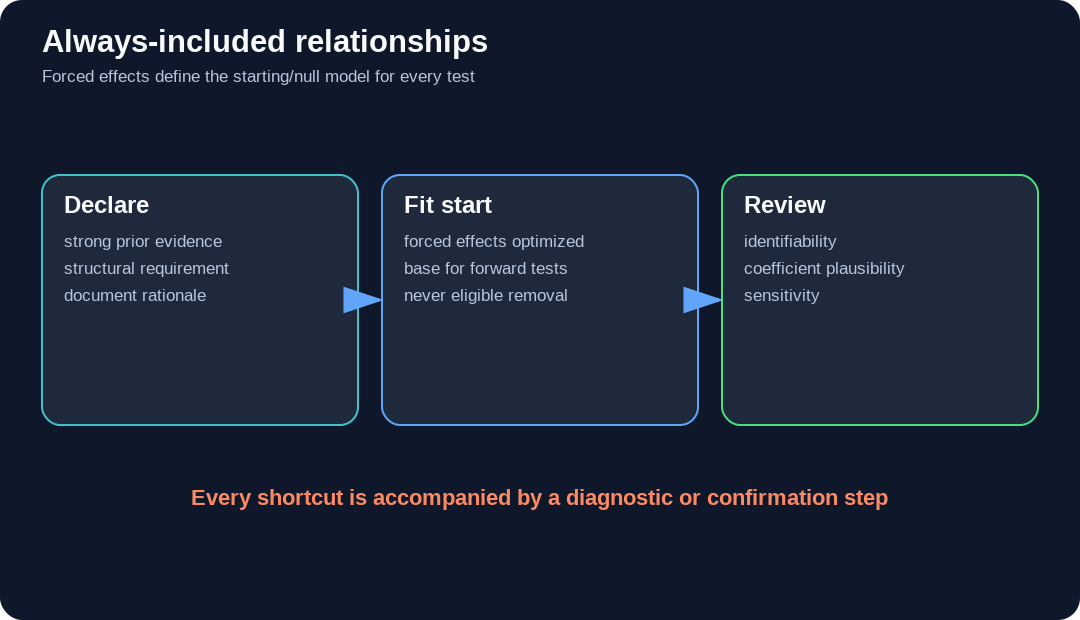
An always-included effect changes the null model for every conditional test. It is optimized in the starting fit and cannot be removed by backward elimination. Its convergence, coding, and coefficient remain subject to diagnostic review. Always-excluded terms should not appear as “rejected by SCM”; they were outside the competition.
Separate prior constraints from data-driven decisions in the report. List included, excluded, tested, unavailable, and failed relationships in different tables. This avoids overstating what the search learned and makes reproduction possible when the scientific scope changes.
Common mistakes
- Treating a stepwise p-value as clinical importance or causal proof.
- Reading a candidate comparison without its active model, convergence state, degrees of freedom, and exact threshold.
- Reporting only the terminal relationship list while discarding failed models, path decisions, configuration, and provenance.
Page checklist
- The scientific question, model identities, and comparison direction are explicit.
- Numerical validity is reviewed before interpreting statistical evidence.
- The result is linked to the complete trace and final joint-model diagnostics.