33.30 Worked example: RESP and objective response
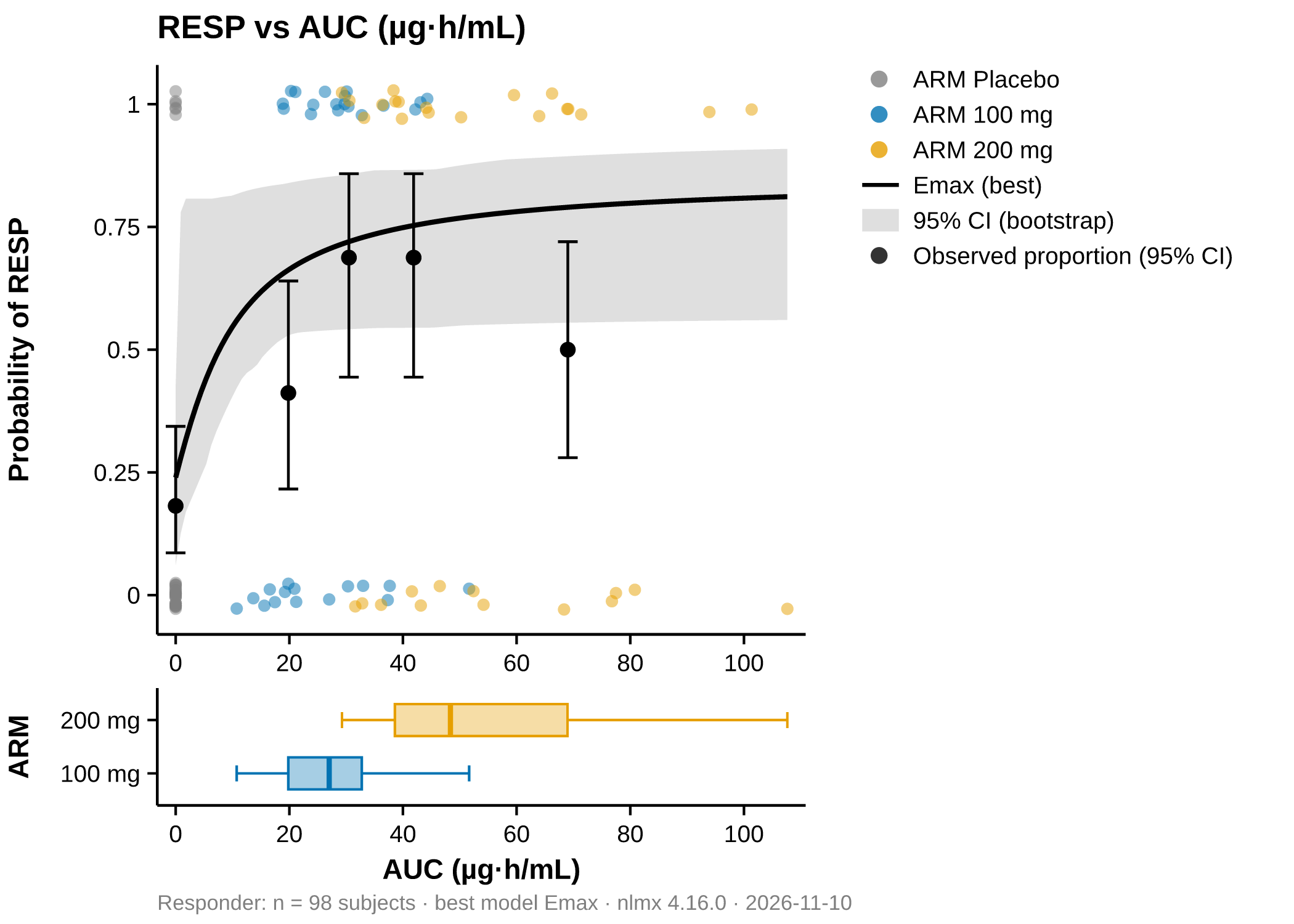
The binary file analyses numeric RESP and text BOR, with CR/PR declared positive. Logistic shapes are fit with selected covariates; the documentation run overrides the configured 200 bootstrap replicates to 50 for a smoke test. Emax is selected but EC50 is broad.
Command or configuration pattern
nlmx er -c data/er/07_binary_response.er --bootstrap 50 -o binary --overwrite
The relevant controls are: positive coding; event/non-event cells; probability plus OR; successful bootstrap count. Use the complete command and settings index for accepted values, defaults, CLI mappings, and settings-only controls.
A reliable operating sequence
- State the endpoint estimand, exposure metric/window/units, analysis population, adjustment set, and clinically useful contrast.
- Reconcile input rows, subjects, arms, exposure availability, endpoint information, and all endpoint-specific fields.
- Run the smallest useful specification first; inspect exclusions and eligible models before adding subgroups, selection, or bootstrap.
- Read absolute predictions and observed support alongside relative effects, information criteria, p-values, and diagnostics.
- Archive the command,
.erfile, mutated/used data, exclusions, transcript, tables, plots, report, version, and checksums.
How to read and review the result
Report actual predicted probabilities at the contrast endpoints, not only odds ratios. Fifty replicates test plumbing but do not stabilize percentile tails. Reconcile RESP and BOR subject-level equivalence before presenting them as separate evidence.
For a novice, the safest reading order is er_summary.txt → er_analyses.csv → the analysis-specific exclusions and model table → effects/predictions → diagnostic plots → row-level data → report.html. The report is a presentation layer; the CSV/JSON files and transcript are the audit layer.
Quality-control questions
- Did the number of analysed subjects, events, categories, exposure groups, and visits match the specification?
- Were placebo, active zeros, missing values, filters, repeated rows, categories, offsets, censoring, and covariate references handled as intended?
- Were ineligible fits retained and explained rather than silently dropped or allowed to win?
- Does the reported contrast stay inside exposure support, and are its units and endpoint direction clear?
- Do diagnostics and sensitivities support the same decision, and are causal and transportability limits explicit?
Common failure modes
- Treating the best criterion or smallest p-value as a clinical conclusion.
- Reading an odds, rate, or hazard ratio without its exposure contrast and absolute outcome context.
- Overwriting an evidence directory before preserving the prior settings, log, and checksums.
Navigation
See the previous page, next page, and complete command and settings index.