23.38 Validation, reporting, and complete checklist
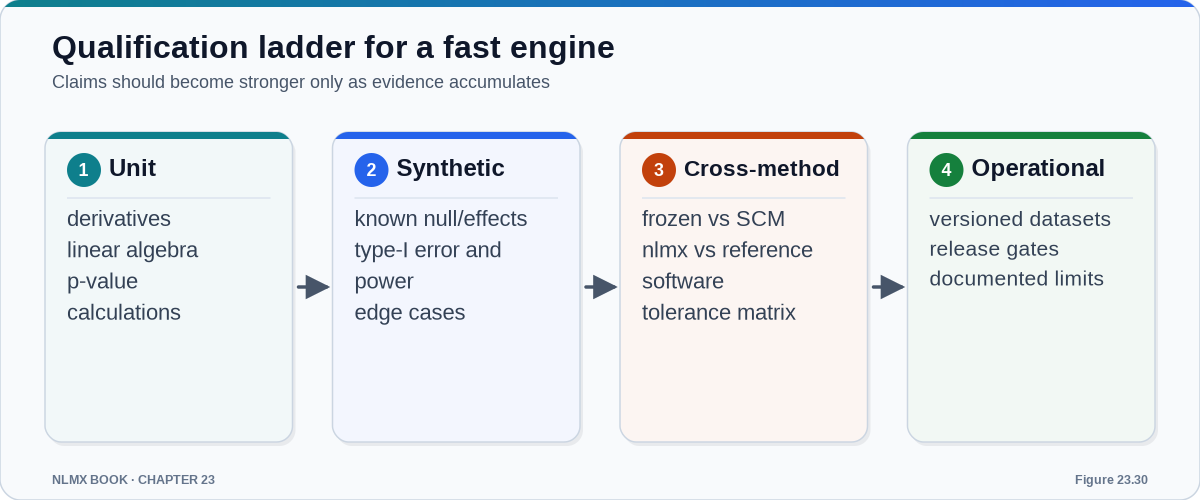
Validation must match the intended claim. Unit checks establish derivatives, linear algebra, ranks, p-values, RNG streams, and file schemas. Synthetic studies evaluate type-I error, power, bias, decision agreement, and numerical failure under known truth. Cross-method studies compare frozen scores with nlmx SCM and targeted refits. Cross-software studies require matched equations, approximations, parameterization, tolerances, thresholds, and datasets.
Report model/data identity, nlmx version, approximation, candidate scope, types/references/forms/statuses, information settings, finite-difference steps, selection mode, thresholds, multiplicity, calibration, uncertainty, seed/draws, stationarity, rank/ridge warnings, path, refinements, final refit, diagnostics, failures, run time, and confirmation boundary. Include effect estimates and clinical consequences only from an appropriate fitted model.
Checklist: before the run
- Base model converged, diagnosed, mapped, and archived.
- Run family, data, EXT, COV/COR, and PHI identities verified.
- Candidate family, statuses, forms, references, and missingness prespecified.
- Primary information estimator, selection mode, thresholds, and escalation policy declared.
- Output directory, seed, threads, privacy, and storage planned.
Checklist: after the run
- Base objective and stationarity reviewed.
- Subject-mode convergence, eigenvalues, rank, ridge, and adjustment examined.
- Raw, adjusted, calibrated, conditional, and uncertainty evidence labeled correctly.
- Forward/backward trace and uncertain relationships reviewed.
- Important candidates refined; retained set jointly refitted and diagnosed.
- Evidence bundle checksums verified and archived.
- Results compared with qualified SCM/reference analyses within prespecified tolerances.
- Claims restricted to validated model classes and version.
Common mistakes
- Validating only successful alternatives.
- Using one example as a release qualification.
- Comparing outputs without harmonizing likelihood and coding.
- Omitting failures or uncertain results from reports.
- Making clinical claims from screening coefficients.
Further reading
Proceed to Chapter 23A for full refit-based SCM, Chapter 24 for posterior stability, Chapter 40 for software differences, and Chapter 42 for validation architecture when drafted.