22.15 Categorical proportional, grouped, and ordinal equations
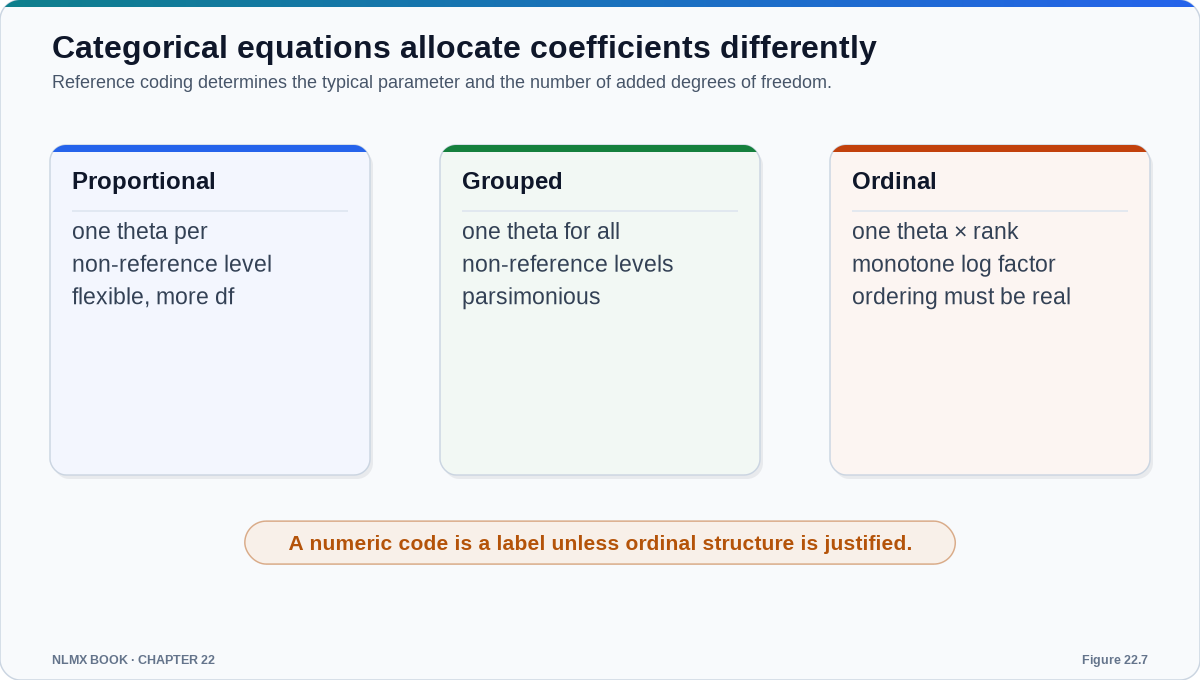
A categorical proportional model estimates one coefficient for each non-reference level. It is flexible and costs levels minus one degrees of freedom. Each coefficient is a fractional parameter shift relative to the reference.
A grouped model estimates one shared coefficient for all non-reference levels. It is parsimonious but assumes those levels have the same effect. Grouped can be useful for a scientifically justified reference-versus-other contrast; it should not be used merely to force significance.
An ordinal model uses one coefficient on level rank, commonly as an exponential factor. It assumes ordered, monotonic log-scale change across ranks. Numeric category codes are not evidence of ordinal spacing.
Reference level determines TVP interpretation and coefficient signs. Choose a clinically standard or well-supported reference. Report original labels, counts, missingness, and any combined levels. Use min_level_subjects to enforce support prospectively.
When --all-equations is requested, categorical candidates can compare proportional and grouped forms. Their degrees of freedom differ, so AIC and likelihood comparisons account for complexity. Ordinal is used when the type is explicitly ordinal; its scientific assumption deserves separate justification.
Sparse levels can destabilize final refits, covariance, and predictions. A seemingly large effect with wide uncertainty may be more important clinically than a selection label conveys.
Common mistakes
- Treating integer labels as ordered scores.
- Combining levels after seeing coefficients.
- Ignoring degrees of freedom in form comparison.
- Choosing a rare reference that destabilizes TVP.
- Reporting level effects without counts and uncertainty.
Checklist
- Define labels, ordering, reference, and counts.
- Justify per-level, grouped, or ordinal structure.
- Set minimum support rules prospectively.
- Compare forms with appropriate df.
- Diagnose the final model by level.
Further reading
See automatic type detection, form comparison, and stratified diagnostics.