36.5 inspect command reference
This chapter is a lookup reference for nlmx 4.16.1. Option tables are generated from the installed release executable. Read an option in the context of the command page: nlmx uses a global parser, but an accepted option can be irrelevant to a command unless its help text names that command or the command's method chapter defines the behavior.
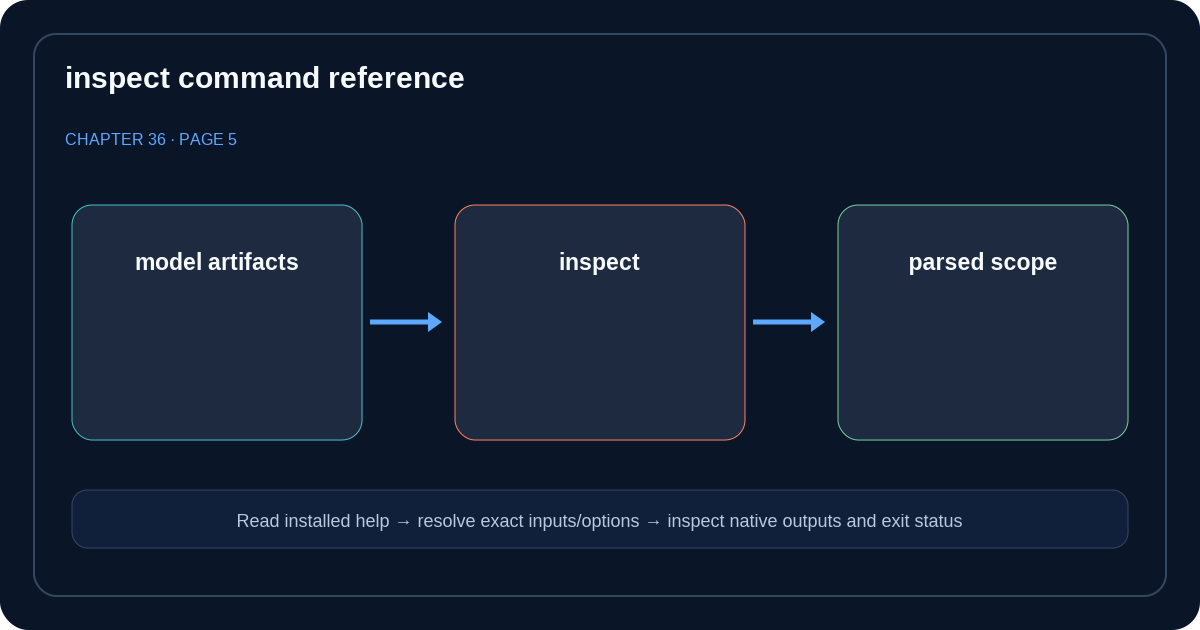
The safe sequence is: identify the installed version, open that command's help, freeze input/settings/output paths, run into a new or empty output directory, inspect both the process status and the command-native verdict, and retain the log/resolved settings/checksums. A command line is reproducible only when its referenced files and software version are also frozen.
Synopsis
nlmx inspect [OPTIONS]
Required context. A .covar configuration, or a control stream/model directory plus an explicit covariate scope.
What it does. Discovers and parses the run family, reports the detected structural model, estimation method, parameters, random effects, covariate types, reference values, candidate equations, and artifact diagnostics. It performs no fit.
Principal outputs. Console/log inspection report. With an output choice, retain the log as evidence; the command is primarily read-only.
Practical invocations
nlmx inspect -c study.covarnlmx inspect --ctl models/run101.ctl --covariates CL=WT,AGE,SEX --covariates V=WT
Start with installed help and, when available, generate the complete settings template before entering study choices. Run into a new or empty output folder. After completion, review the command's native summary/verdict, warnings, logs, resolved settings, and checksum manifest—not only the console's final line.
Complete installed option reference
The following 83 options are parsed directly from nlmx 4.16.1 inspect --help. The unmodified txthelp snapshot and its SHA-256 are preserved in the jsonhelp inventory. Shared descriptions sometimes mention several commands; apply only the clause naming inspect unless its method chapter specifies otherwise.
Options
| Option | Installed description |
|---|---|
-h, --help |
Print help |
Method
| Option | Installed description |
|---|---|
--method <METHOD> |
Selection engine: frozen | scm (stepwise forward/backward on refits) | posterior | both (overrides method in the config) |
--threads <THREADS> |
Worker threads for subject- and replicate-level parallelism (default: all cores). Results do not depend on this value |
Covariates
| Option | Installed description |
|---|---|
--covariates <PARAM=COVS> |
run, inspect, validate: covariates to test on a parameter, PARAM=COV1,COV2 (repeatable, or ';'-separated), e.g. --covariates CL=WT,AGE,SEX --covariates V=WT. Types (continuous, binary, categorical) are detected from the data. Replaces the configuration's scope; with a model (--ctl or --model-dir) no -c file is needed |
--continuous-forms <LIST> |
Equations tried for continuous covariates: power, exponential, linear, standardized_linear, spline (default: power) |
--categorical-forms <LIST> |
Equations tried for binary and categorical covariates: proportional (one θ per level), grouped (one θ for all non-reference levels), ordinal (default: proportional; a binary covariate always has the single proportional equation) |
--all-equations |
Try every standard equation of each covariate type (continuous: power, exponential, linear; categorical: proportional, grouped) and keep the best per pair, instead of the one typical equation (power; proportional) |
--covariate-forms <COV=FORMS> |
Equations for one covariate, COV=FORMS (repeatable), e.g. --covariate-forms WT=power |
--covariate-type <COV=TYPE> |
Covariate type, COV=continuous|binary|categorical|ordinal (repeatable; default: detected) |
--covariate-reference <COV=VALUE> |
Centring value of a continuous covariate (or reference level of a categorical one), COV=VALUE|median|mean (repeatable; default: median, most frequent level) |
--missing-covariates <POLICY> |
Missing covariate values: error (default) | median | drop_subject |
--compare-forms <MODE> |
How the equations of one parameter-covariate pair are compared: auto (default: refit each equation and keep the lowest AIC when there is more than one) | refit | score (score test only: fast, but cannot tell linear from exponential) |
--no-final-refit |
Skip the joint refit of the retained effects (both engines); the final model then uses one-step (frozen) or median two-stage (posterior) coefficients and has no OFV |
Input selection
| Option | Installed description |
|---|---|
--model-dir <MODEL_DIR> |
Directory holding one NONMEM run family, matched on a common stem (e.g. run101.ctl/.ext/.cov); power: the folder with the run's <stem>.ext and <stem>.cov |
--files <MANIFEST.txt> |
Explicit [files] manifest (.txt); paths resolve against the manifest location |
--ctl <CTL> |
Control stream (.ctl/.mod) |
--ctls <PATTERN>... |
fit: run fit once for every control stream matching the patterns (file names, folders, or wildcards * ? and ** such as *.ctl or ./xyz/*.mod), each with all the other options (--retry, --approximation, ...); every run has its own output folder (<name>_fit next to its control stream, or <output>/<name> with --output) and log |
--ext <EXT> |
Final estimates (.ext); sims: the parameter values of --estimates final; power: the final estimates (default: those of the control stream) |
--cov <COV> |
Parameter covariance matrix (.cov); sims: with it every simulation of the study uses a new parameter set (parameter uncertainty); power: needed for --uncertainty |
--cor <COR> |
Parameter correlation matrix (.cor) |
--data <DATA> |
Analysis dataset (overrides $DATA); sims: simulate this dataset instead of generating one |
--lst <LST> |
NONMEM listing (.lst) |
--phi <PHI> |
Individual estimates (.phi) |
--table <TABLE> |
Table file with ID and ETA columns (.tab), used when no .phi is available |
--run-stem <RUN_STEM> |
Disambiguate a directory containing several runs |
--recursive |
Scan --model-dir recursively (still rejects ambiguity) |
Core
| Option | Installed description |
|---|---|
-c, --config <FILE> |
Settings file of the command (TOML syntax), with the command's extension: .covar (cov, posterior, inspect, validate, fit), .qcd, .qcn, .eda, .nca, .init, .screen, .vpc, .forest, .sims, .er, .power, .gen, .ask |
-o, --output <OUTPUT> |
Output directory |
--run-dir <RUN_DIR> |
Existing run directory, for resume |
--overwrite |
Allow writing into a non-empty output directory |
--dry-run |
Run the validation pipeline instead of the full analysis |
--no-checkpoint |
Do not write replicate checkpoints (posterior engine) |
Frozen method
| Option | Installed description |
|---|---|
--approximation <APPROXIMATION> |
Likelihood approximation: auto (from $ESTIMATION, default) | fo | foce | foce-i | laplace; fit and screen also accept saem (SAEM with an importance-sampling objective); screen default foce-i |
--refine <REFINE> |
Re-estimate the N most significant candidates by virtual refitting (0 = off) |
--calibration <CALIBRATION> |
Score-test calibration: none | permutation | parametric-bootstrap |
--calibration-replicates <CALIBRATION_REPLICATES> |
Permutations or bootstrap replicates for --calibration |
--information <INFORMATION> |
Information: efficient | candidate-only |
--information-estimator <INFORMATION_ESTIMATOR> |
Information estimator: opg (default, outer product of per-subject scores) | observed (finite-difference Hessian) |
--nuisance-information <NUISANCE_INFORMATION> |
Nuisance information source: observed | from-cov |
--selection <SELECTION_MODE> |
Selection mode: univariate | hierarchical-conditional | all-joint | refit-scm |
--adjust <ADJUST> |
Multiplicity adjustment: none | bonferroni | holm | bh | by | westfall-young |
--alpha <ALPHA> |
Forward inclusion alpha (stepwise: p-value of the likelihood-ratio test to enter) |
--retention-alpha <RETENTION_ALPHA> |
Backward retention alpha (stepwise: a term whose p-value is above it is removed) |
--scm-direction <DIRECTION> |
Stepwise (--method scm): which stages to run: forward (inclusion only) | backward (elimination from the full model only) | both (forward, then backward; default) |
--scm-candidates-per-step <N> |
Stepwise: candidates refitted at each forward step, best conditional score first; 0 = all of them, as PsN does (default 3) |
--max-candidates <MAX_CANDIDATES> |
Hard cap on evaluated candidates (safety rail) |
--uncertainty |
Enable MVN resampling of the frozen parameters from the .cov |
--no-uncertainty |
Disable .cov uncertainty propagation |
--draws <DRAWS> |
Number of uncertainty draws |
--fd-rel <FD_REL> |
Relative finite-difference step |
--write-subject-scores |
Emit per-subject objective and score contributions (IDs hashed unless --keep-subject-ids) |
--write-matrices |
Emit information / efficient-information matrices per candidate |
Posterior method
| Option | Installed description |
|---|---|
--posterior-source <POSTERIOR_SOURCE> |
Posterior source: require-phi | prefer-phi | reconstruct |
--allow-point-ebe <ALLOW_POINT_EBE> |
Permit point EBEs with no usable curvature (0|1); output is labelled EXPLORATORY |
--response <RESPONSE> |
Response: posterior-draws | posterior-mean er: response (endpoint) column(s), comma separated |
--draw-method <DRAW_METHOD> |
Draw method: normal | antithetic-normal | sobol-normal |
--resampling <RESAMPLING> |
Resampling: complementary-pairs | subsample | bootstrap | repeated-kfold |
--replicates <REPLICATES> |
Number of resampling replicates |
--subject-fraction <SUBJECT_FRACTION> |
Subsample fraction in (0,1] |
--draws-per-resample <DRAWS_PER_RESAMPLE> |
Posterior draws per replicate |
--base-param-draws <BASE_PARAM_DRAWS> |
Base-parameter (.cov) perturbation draws |
--cv-folds <CV_FOLDS> |
Folds for penalty tuning inside each replicate |
--threshold <THRESHOLD> |
Selection-probability threshold for retention |
--uncertain-lower <UNCERTAIN_LOWER> |
Lower edge of the uncertainty band |
--sign-threshold <SIGN_THRESHOLD> |
Required sign stability |
--learners <LEARNERS> |
Learners (comma-separated): adaptive-elastic-net, group-elastic-net, weighted-gls, gam, boosting, multivariate |
--primary <PRIMARY> |
Learner whose selection probability drives retention |
--max-features <MAX_FEATURES> |
Hard cap on generated feature columns (safety rail) |
--variance-consistency <VARIANCE_CONSISTENCY> |
Variance consistency: penalized-matching | moment-correction | none |
--write-subject-level |
Emit per-subject posterior summaries |
--write-posterior-draws |
Emit the generated posterior draws (large) |
--write-replicate-selections |
Emit the per-replicate selection matrix |
Shared numerics
| Option | Installed description |
|---|---|
--seed <SEED> |
Master seed (uncertainty draws, resampling, posterior draws, vpc simulations, autoinit ML) |
--ridge-max <RIDGE_MAX> |
Largest ridge permitted when stabilising a matrix; exceeding it is a failure |
--strict |
Promote every warning to an error |
Logging and output
| Option | Installed description |
|---|---|
--suppress-console <0|1> |
0 (default) prints progress to the terminal; 1 silences it (the log is still written) |
--log-file <LOG_FILE> |
Write the transcript here instead of log_<id>.txt |
--no-color |
Disable ANSI colour |
--license |
Print the license (CC BY-ND 4.0), the third-party components, how long this version may be used and how to contact the author, and stop |
-v, --verbose... |
Increase verbosity (repeatable: info -> debug -> trace) |
-q, --quiet |
Errors only on the terminal (the log file is unaffected) |
--keep-subject-ids |
Do not hash subject identifiers in outputs |
--format <FORMAT> |
Output format for schema: txt | toml | json | json-schema [default: txt] |
Interpretation and common failure
Do not interpret successful parsing as model reproduction. Check detected covariate types and references before moving to validate or cov.
The detailed method and examples are in the relevant book chapter. Common nonzero process classes are documented on 36.35. A process exit of zero still requires command-native scientific and numerical review.
Minimal handoff record
Record the version, exact command and working directory, input/settings hashes, selected options and defaults, output path, process exit, native verdict or convergence state, warnings/exclusions, principal results with uncertainty, checksum verification, and reviewer disposition.
Navigation
See the previous page, next page, and complete command index.