Complete operational reporting and review checklist
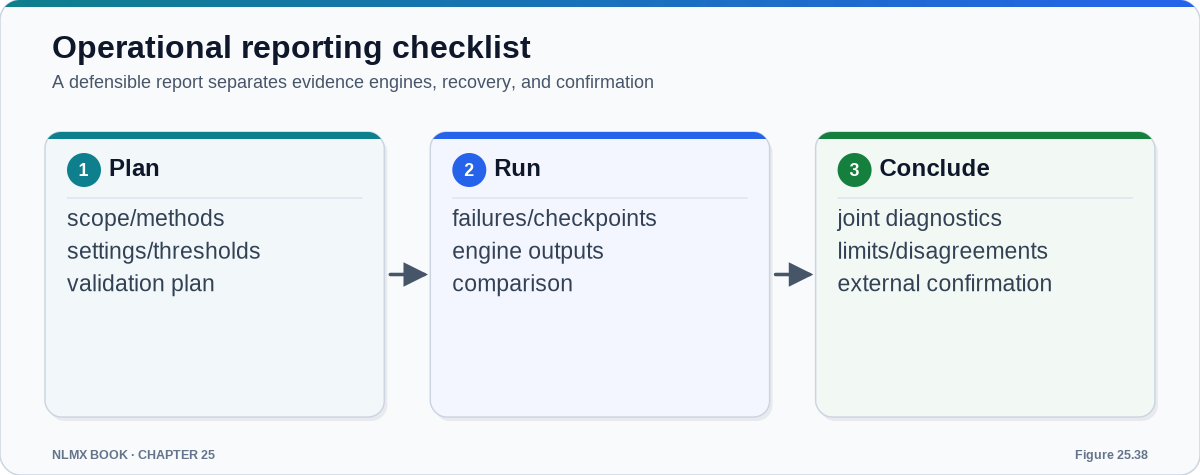
A defensible report begins with objective, base run, data/model hashes, version, scope/forms/references/statuses, primary method, secondary methods, thresholds, seeds, numerical settings, and validation findings. It states engine prerequisites and known limits before results.
For each engine, report complete classifications, evidence metrics, failures, uncertainty, path/stability diagnostics, final joint refit, and clinical effect interpretation. For both, include the comparison table and investigate every discordant or incomplete row. For resumed work, report original and resume commands, interruption point, analysis-hash verification, changed threads, final checkpoint, and output integrity.
Conclude with diagnostics, sensitivity analyses, SCM/targeted refits, reference NONMEM confirmation, unresolved limitations, reviewer decisions, and checksum location. A polished HTML or Markdown report is not sufficient without the machine-readable bundle and reproducible command history.
Common mistakes
- Changing the scientific question after seeing the result while presenting it as the original run.
- Reading one engine's summary without checking its prerequisites, failures, normalized settings, and fitted endpoint.
- Treating a generated draft, comparison label, or completed checkpoint as a substitute for model diagnostics and reference-software confirmation.
Page checklist
- The exact command, version, inputs, resolved settings, and output directory are identifiable.
- Engine-specific evidence is interpreted on its own scale before cross-method comparison.
- Recovery state, final refit, diagnostics, and remaining confirmation work are explicit.