30.25 Dropout, missingness, and compliance
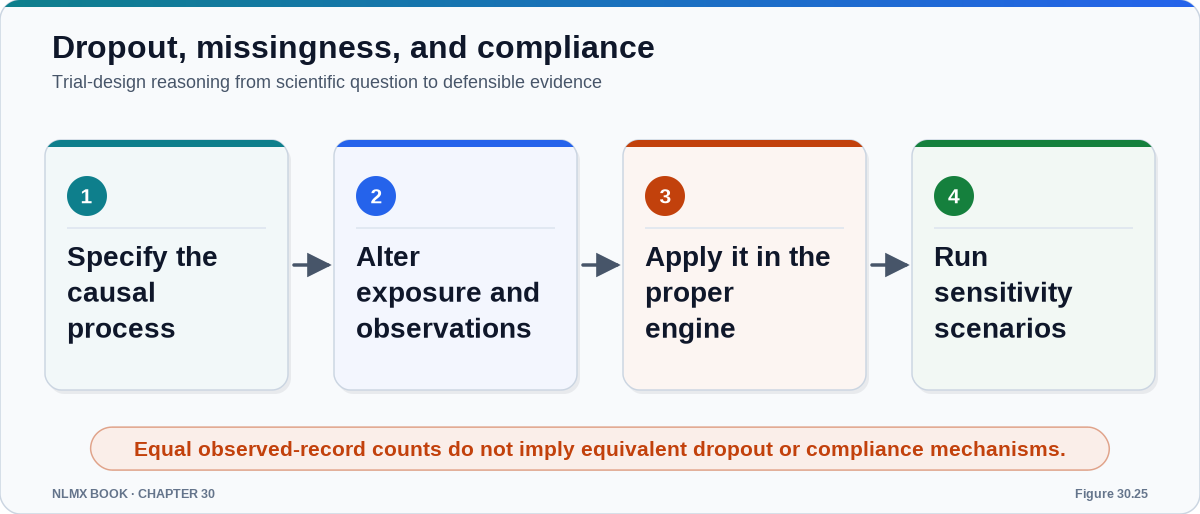
Dropout, intermittent missingness, and imperfect compliance remove information through different causal pathways. Dropout truncates later records and may be related to response or tolerability. Missingness can remove individual observations. Compliance changes delivered dose and therefore both exposure and information. One generic ‘loss rate’ cannot represent all three.
Concepts to keep separate
- nlmx FIM approximates dropout by averaging information from several truncation fractions and scales for the declared missing rate.
- In nlmx 4.14.3, compliance below one is applied by SSE but not by FIM; the FIM then describes a fully dosed design.
- SSE can express the realised record and dose consequences directly, subject to the implemented mechanism.
- Informative dropout or exposure-dependent compliance requires a scientifically justified joint mechanism beyond simple random loss.
Terminology matters because a single scenario can contain several denominators and several sources of randomness. Truth is the parameter vector used to generate a replicate. Estimate is the value recovered from that replicate. Design is the planned arrangement of subjects, arms, doses, and observations. Method is the approximation or simulation–estimation procedure used to predict performance. A credible report labels all four.
Mathematical or operational walkthrough
If 20% dropout primarily removes late samples, CL and terminal-phase precision may deteriorate more than a uniform 20% information reduction suggests. Scenario analysis should vary timing as well as rate.
For novices, read every expression from the inside out: identify the scientific effect, identify the null value, put both on the same parameter scale, identify the variance or information that belongs to the actual design, and only then calculate a test statistic or sample size. Units and parameterisation should cancel in a way that leaves a dimensionless statistic.
How this maps to nlmx
Report randomised N, expected treated N, evaluable denominator, dropout definition, missing mechanism, compliance model, and whether each engine applies them identically.
Chapter 30 explains the statistical and implementation concepts. Chapter 31 gives the complete nlmx power command, every CLI and settings control, precedence, output schema, and production workflow. This separation is deliberate: choosing an option correctly requires understanding which estimand and assumption it changes.
Quality-control checklist
- Are the three mechanisms represented separately?
- Does attrition timing match clinical expectations?
- Do FIM and SSE describe the same design?
- Is inflation applied to the correct sample-size denominator?
The graph is explanatory; the CSV, JSON, resolved settings, model inputs, and replicate rows are the authoritative evidence. When a plotted point looks surprising, diagnose the underlying rows before changing the design.
Common mistakes
- Inflating N by 1/(1−rate) without checking information loss
- Calling missing observations dropout
- Comparing FIM and SSE when compliance differs silently
Also avoid copying a sample size from a nearby project. Power is conditional on the model, tested effect, covariate distribution, schedule, residual and random variability, attrition, test, estimator, and success criteria. Similar-looking studies can have very different information.
Evidence to retain
- scientific question, estimand, hypothesis, alpha, target, and criteria;
- model/data/design inputs, parameter source and uncertainty distribution;
- software version, method, approximation, seed, threads, command, and resolved settings;
- scenario grid, row-level results, failures, denominators, intervals, diagnostics, and checksums;
- scripts that calculate derived tables and figures, plus the interpretation and limitations.
Navigation
See the previous page, next page, and formula and decision index.