23.12 One-step coefficient, standard error, and sign
The local coefficient update is
β¹ = (I*)⁺ U*.
It is one Newton-like step from the null coefficient, not a maximum-likelihood estimate from a converged candidate model. The corresponding standard error comes from the efficient-information inverse. Together they provide direction, local scale, and a diagnostic comparison with refit estimates.
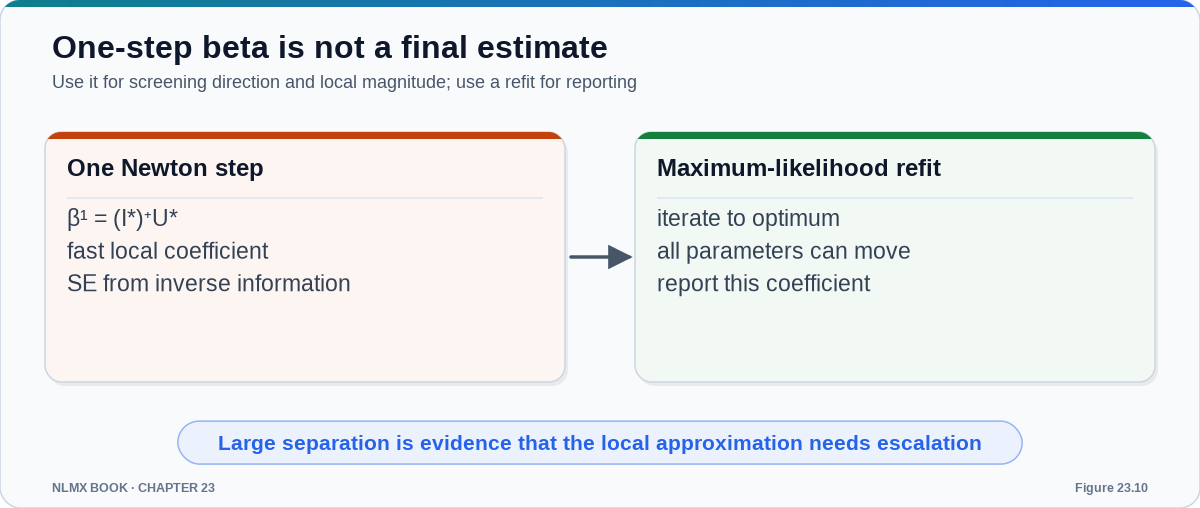
In the verified example, V–WT had a one-step exponent of 1.433 but a univariate refit estimate of 0.998. CL–WT was 1.027 by one step and 0.725 after refitting. Both pointed in the correct direction, but the local approximation overstated magnitude. This is exactly why draft and final reporting should prefer the joint-refit coefficient when available.
Sign depends on the equation and reference. A positive power exponent means the parameter rises with a positive covariate ratio; a positive proportional coefficient increases a non-reference category relative to the reference. Reverse a category reference and the coefficient changes parameterization. Multi-column candidates do not have one unambiguous sign, so sign-stability summaries require careful interpretation.
Use one-step estimates to prioritize and diagnose. Use refitted estimates and uncertainty for pharmacometric or clinical interpretation.
Translating a local coefficient
For a power model TVV × (WT/72.2)^β, the one-step β = 1.433 predicts a ratio of about (100/72.2)^1.433 = 1.59 at 100 kg before ETA. The refit β = 0.998 predicts about 1.38. Both indicate increasing V with WT, but their clinical magnitudes differ materially. This calculation shows why sign can be suitable for rapid prioritization while magnitude needs a fitted model. Always evaluate the coefficient at supported covariate values and propagate its refit uncertainty. A coefficient with the correct direction but poor magnitude is not “accurate enough” for exposure or dosing decisions.
Common mistakes
- Calling
one_step_betathe selected model estimate. - Comparing coefficients across different forms or references.
- Reporting local SEs after a different joint model is fitted.
- Interpreting the first component as the sign of an entire multi-column block.
- Converting a local coefficient directly into a dose recommendation.
Checklist
- Label one-step and refit estimates separately.
- Verify equation, units, and reference.
- Compare magnitude and sign after refinement.
- Use joint-refit uncertainty for final interpretation.
- Escalate large one-step/refit discrepancies.
Further reading
Continue to refinement and final refit and clinical interpretation.