39.5 Exit code 3: discovery, files, output, and server I/O
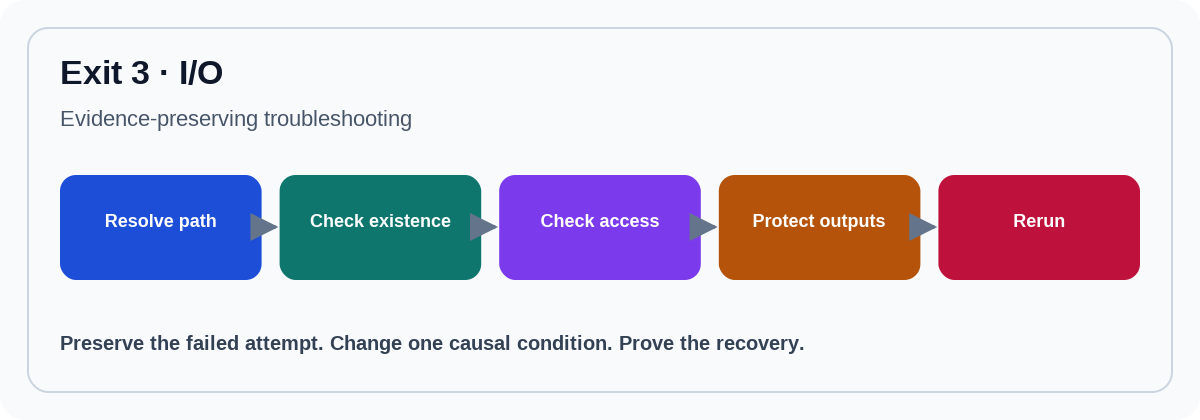
What you will learn
- Resolve relative paths from the correct anchor
- Separate not-found, access, overwrite, and capacity failures
- Recover without corrupting prior output
Prerequisites: Chapter 36 exit-code reference, Chapter 38 output completion, and the Chapter 39 overview.
This page describes nlmx 4.16.2. Troubleshooting must preserve the failed attempt: keep its exact command, working directory, log, resolved settings, input/model identities, partial outputs, and process exit code. Correct one causal condition at a time and compare the new evidence with the failed run. Never convert a nonzero exit into success in a wrapper, and never interpret exit 0 as scientific acceptance without the command-native verdict.
Exit 3 covers file discovery and operating-system I/O, plus local model-server communication. Read the named path literally. Record the current working directory, control-stream location, settings location, and output root: different path fields have different anchors. In particular, $DATA is resolved relative to the control stream; settings-relative paths follow their documented command rules.
For “not found,” establish whether the path was typed, discovered, or read from $DATA/settings. Use a literal existence check and resolve the absolute path without moving files. For “cannot read,” check permissions, a cloud placeholder, file lock, encoding when relevant, and whether a directory was supplied where a file was expected. For “cannot create/write,” check the exact parent, illegal/reserved names, path length, quota/free space, antivirus/ransomware protection, and concurrent writers.
Overwrite protection is evidence protection. Inventory and archive an existing folder before considering --overwrite; a new run may not remove stale optional files. Prefer a new attempt directory. If a write failed mid-run, treat every output as partial until checksums and the command-native completion evidence prove otherwise.
For Maxson server I/O, distinguish connection refusal/timeout, HTTP status, non-JSON response, and JSON without the expected message. Preserve the endpoint without credentials, the response status/excerpt, and server-side log. Do not disable a firewall or enable remote policy casually.
A successful rerun must prove the same intended input was read and the intended output target was used. Compare input manifests/hashes, row counts, command line, and output inventory. “The path exists now” is necessary, not sufficient.
Page checklist
- Did you retain the exact exit code, stage, message, hint, log, and partial output?
- Did you identify one causal layer before changing anything?
- Is the recovery a new, traceable attempt with the same intended estimand?
- Did you check command-native and scientific acceptance after process completion?
Navigation
See the previous page, next page, and complete error reference.