17.22 Recommendation rule, ties, and passed-over models
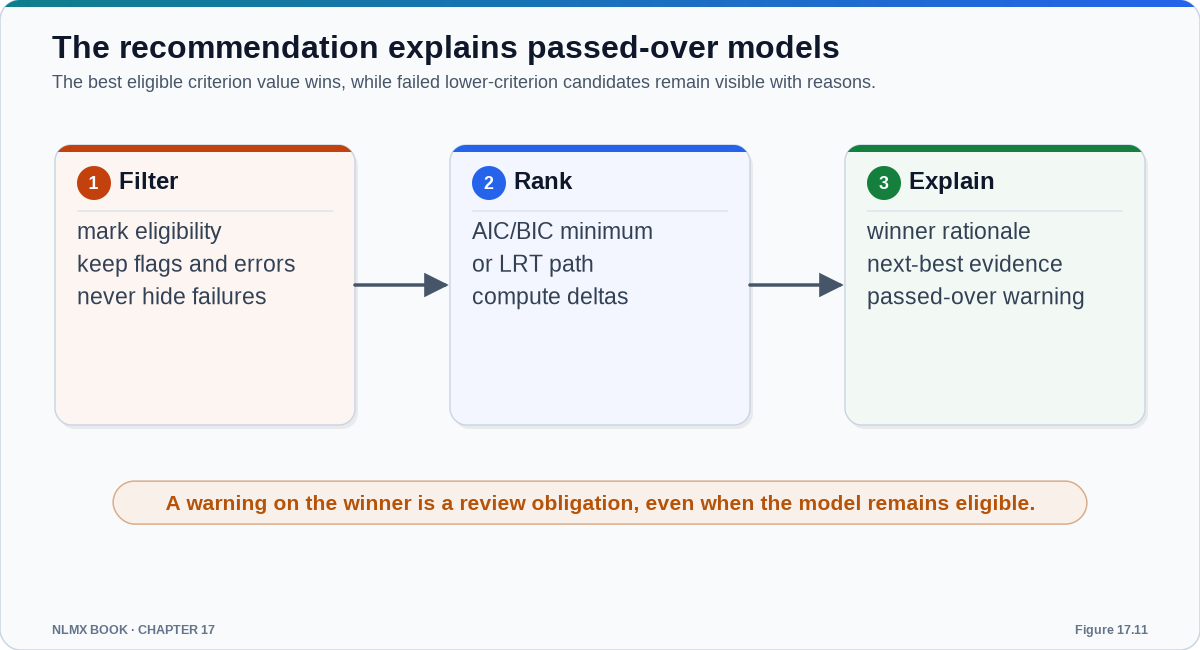
The recommendation is produced in three stages: determine eligibility, apply the predeclared criterion to eligible candidates, and explain the result. For AIC/BIC, the minimum eligible value wins. For LRT, the algorithm follows recognized nested edges at the specified alpha. The summary gives the rationale, next-best eligible model and relevant warnings.
When delta is below about two, models are practically close by the criterion. Prefer the simpler, more stable or more interpretable candidate unless diagnostics or scientific knowledge strongly favor the alternative; document the rule. Do not manufacture a sharp conclusion from a rounded difference.
A lower-criterion ineligible model is not discarded silently. The summary states that it fits better numerically but was passed over and gives reasons such as nonconvergence or ill-conditioning. This is a trigger for targeted sensitivity work. If the model becomes reliable under justified settings, rerun the entire declared decision rather than manually replacing the winner.
Warnings on an eligible winner remain review obligations. “Recommended” means best under the configured algorithm, not approved for final inference. Archive all rows so readers can reconstruct the choice.
If no candidate is eligible, the correct output is no recommendation plus a documented recovery plan. Do not automatically choose the least-bad failed fit. If only one candidate is eligible, report that the criterion could not provide a meaningful competition and focus review on why alternatives failed.
Common mistakes
Do not promote an ineligible model outside the rule, hide close alternatives, or claim the winner is true. Avoid changing thresholds, alpha, or penalty after seeing names and then presenting the revised rule as planned.
Checklist
- Apply eligibility before ranking.
- State criterion, penalty/alpha and tie policy.
- Report next-best and passed-over candidates.
- Carry winner warnings into follow-up work.
- Require diagnostic and sensitivity confirmation.
Further reading
The next pages document the evidence files, beginning with model comparison CSV.