Chapter 23 — The frozen-model engine
The frozen-model engine is nlmx's high-speed covariate screening method. It asks whether adding a candidate relationship at coefficient zero would improve the completed base model, while avoiding a full population re-estimation for every candidate. Its central tool is a nuisance-adjusted efficient score test. The speed is valuable when a pharmacometrician must examine many scientifically plausible parameter–covariate pairs, but the approximation has an explicit accuracy boundary: it is local to the base solution and cannot replace a final likelihood refit, diagnostics, or cross-software qualification.
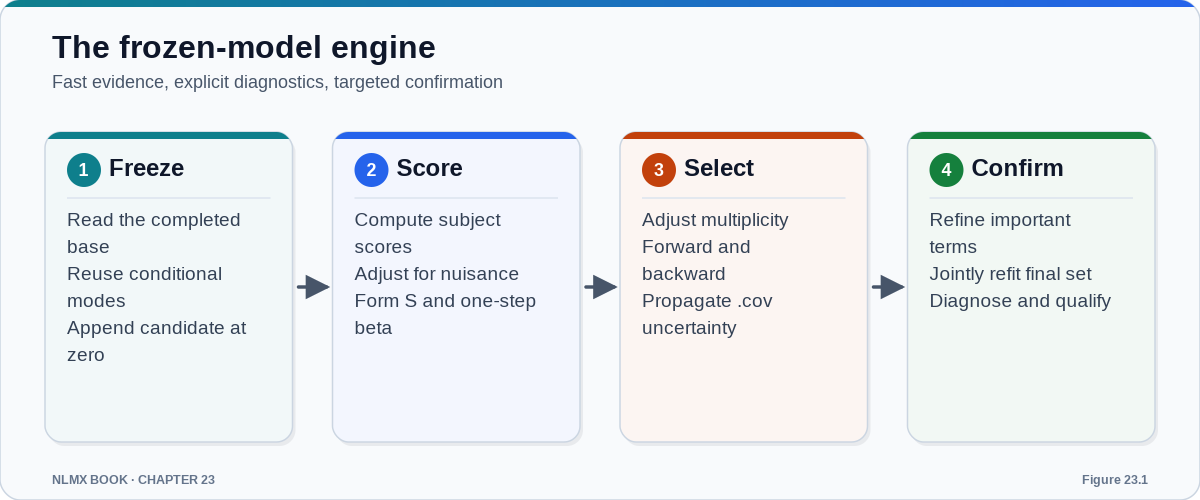
This chapter derives the score statistic, explains subject-level and nuisance information, distinguishes OPG from observed-Hessian information, and shows how stationarity, effective rank, ridge stabilization, multiplicity, calibration, and parameter uncertainty affect the evidence. It then documents all frozen-specific command and configuration controls, candidate construction, equation comparison, conditional forward/backward selection, targeted refinement, refit caching, output files, troubleshooting, and reporting.
The worked material uses the deterministic 60-subject, 480-observation Chapter 22 model. Five version 4.8.0 frozen variants are preserved under documents/ch23. The refined run compares every score statistic with a one-candidate likelihood refit. A permutation run demonstrates calibrated and Westfall–Young p-values. An exact-uncertainty run recomputes scores at 200 covariance draws. An observed-Hessian sensitivity run intentionally preserves a non-positive efficient-information failure so readers can see how nlmx stops instead of manufacturing a p-value.
How to read this chapter
New users should read pages 23.1–23.18 before changing defaults, then follow the worked example and checklist. Statistical readers can begin with pages 23.7–23.18. Operational users can start with the complete command and settings index, worked run, output guide, or validation checklist.
The engine produces screening recommendations. A retained relationship is not a validated dosing conclusion, and an uncertain relationship is not a rejected biological hypothesis.