23.28 Permutation calibration
--calibration permutation estimates the null distribution by jointly permuting covariate rows across subjects while keeping each subject's score contribution attached to that subject. The efficient statistic is recomputed for every permutation. Because baseline subject scores are cached, this can be much cheaper than simulating and refitting complete datasets.
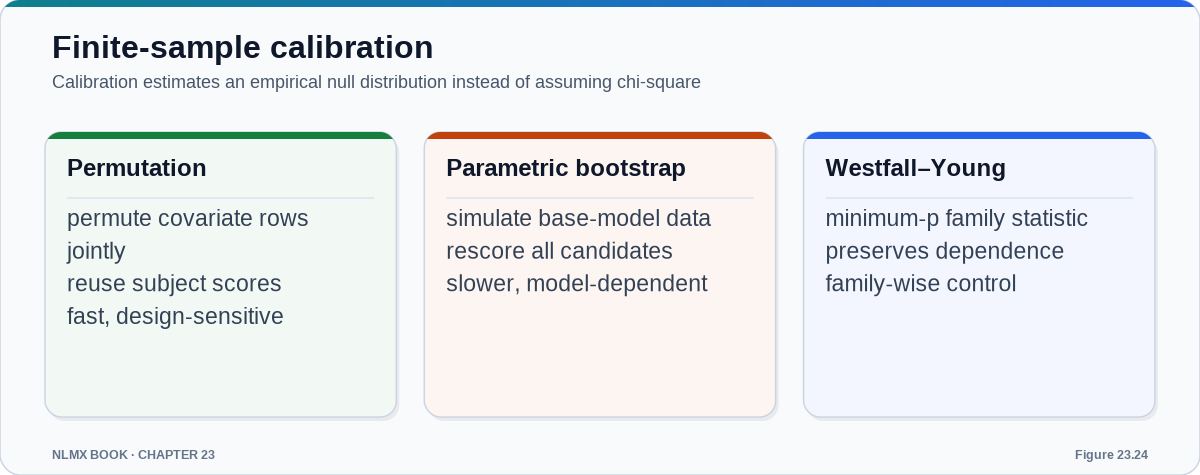
Permutation validity depends on exchangeability. Study, treatment, site, or design strata can make unrestricted permutation inappropriate. Covariates are permuted jointly so their correlation structure is preserved; permuting each column independently would construct an unrealistic null. The implemented method reports candidate calibrated p-values and can support Westfall–Young family-wise adjustment.
With B replicates, the smallest attainable conventional empirical p-value is approximately 1/(B+1). The Chapter 23 run uses 200 permutations for a fast teaching demonstration, so its smallest value is 1/201 = 0.004975; that resolution is insufficient for a production claim of extreme significance. Use more replicates for stable tail probabilities and record the calibration seed.
Permutation calibrates the test statistic under the chosen design; it does not validate the covariate model or coefficient magnitude.
Reading the verified calibration run
With 200 permutations, CL–WT and V–WT both reached the resolution floor of 0.004975; CL–EGFR had a Westfall–Young p-value 0.00995. These numbers do not establish that the first two candidates have equal underlying evidence. They mean no finer ranking is available at this replicate count. The nominal statistics and refit results still show different magnitudes. A production run seeking evidence near 0.001 would need substantially more than 200 permutations. Report the empirical numerator/denominator convention and avoid printing more apparent precision than the Monte Carlo design supports.
Common mistakes
- Permuting observations instead of subjects.
- Breaking covariate correlation by independent column permutations.
- Ignoring nonexchangeable design strata.
- Reporting p below the replicate resolution.
- Treating a 200-replicate demonstration as high-precision calibration.
Checklist
- Justify the exchangeability scheme.
- Preserve covariates jointly.
- Choose replicates for the required p-value resolution.
- Record seed, failures, and empirical formula.
- Compare nominal and calibrated evidence.
Further reading
Open the permutation report, then continue to Westfall–Young.