22.26 Posterior stability selection
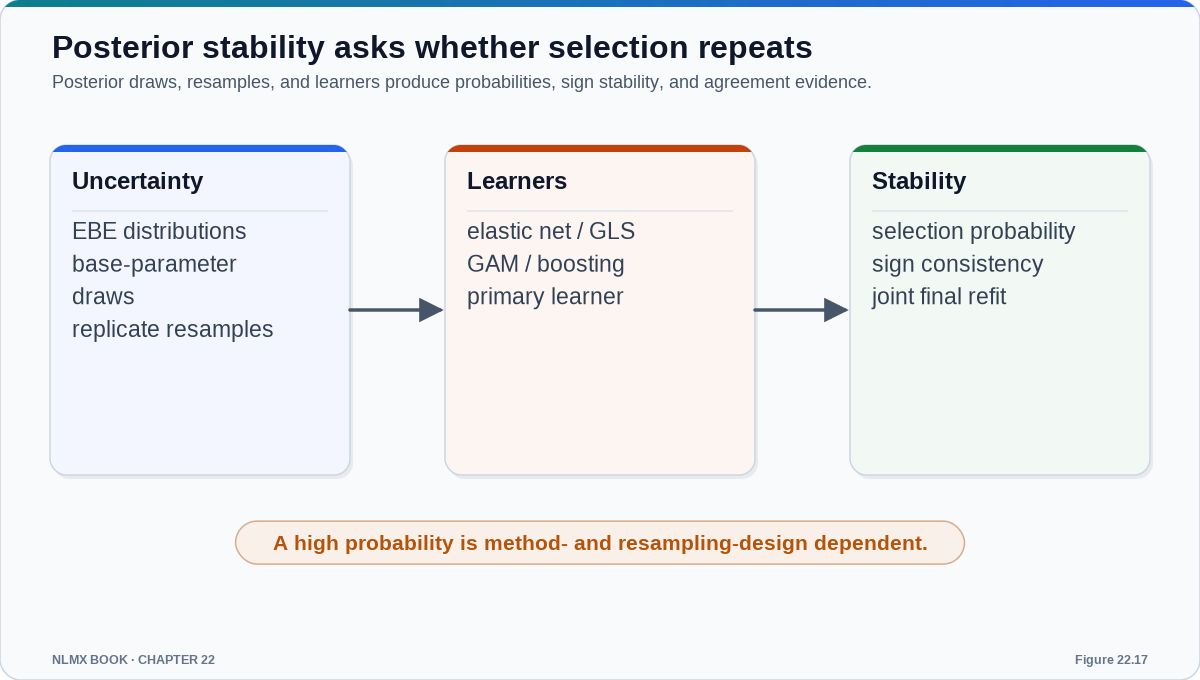
The posterior method evaluates whether relationships are repeatedly selected across posterior uncertainty, subject resampling, and one or more learners. Its output emphasizes selection probability, sign stability, pair-level probability, and algorithm agreement rather than one p-value.
--posterior-source require-phi|prefer-phi|reconstruct controls EBE/posterior sourcing. --allow-point-ebe permits exploratory point estimates when usable curvature is absent; such results require explicit qualification. --response posterior-draws|posterior-mean defines the learning target.
Draw methods include normal, antithetic-normal, and Sobol-normal. Resampling includes complementary pairs, subsampling, bootstrap, and repeated k-fold. Configure replicates, subject fraction, draws per resample, base-parameter draws, and CV folds.
Learners include adaptive/group elastic net, weighted GLS, GAM, boosting, and multivariate approaches. --primary determines which learner drives retention. Threshold, uncertain-lower bound, and sign-threshold define classifications. --variance-consistency controls how posterior variability is reconciled.
Large output options can write subject summaries, posterior draws, and replicate selections. Plan storage and privacy. Results depend on seed and resampling design; repeat sensitivity across seeds/settings when decisions are material.
Reading stability evidence
Selection frequency answers how often a learner selected a feature under the configured perturbation scheme. It depends on the posterior source, resampling fraction, number of replicates, tuning procedure, learner, feature coding, and threshold. Sign stability asks a separate question: whether the direction is consistent when selected. Review the primary learner alongside alternative learners and pair-level summaries so multiple forms or category columns do not exaggerate evidence. Monte Carlo uncertainty decreases with more replicates but model and data uncertainty remain. Repeat borderline results across seeds or increased replicates, and inspect whether a few influential subjects control the relationship. Use a likelihood refit for final pharmacometric interpretation.
Common mistakes
- Interpreting selection probability as a Bayesian posterior probability of truth.
- Using point EBEs without exploratory labeling.
- Ignoring the primary learner and resampling design.
- Comparing probabilities from different thresholds/settings directly.
- Treating high stability as proof of clinical importance.
Checklist
- Verify PHI/posterior source and curvature.
- Record draws, resampling, learners, seed, and thresholds.
- Review sign stability and algorithm agreement.
- Assess sensitivity to seed and design.
- Jointly refit and clinically interpret retained effects.
Further reading
See Chapter 24 for algorithms, method comparison, and uncertainty/stability.