17.33 Troubleshooting failed, imprecise, and ineligible models
Start with the failure class. Data failures include invalid events, route mistakes, inconsistent units, impossible times and empty filtered populations. Initialization failures include wrong scaling, apparent/absolute mismatch and poor starts for newly introduced parameters. Numerical failures include maximum iterations, nonfinite gradients, covariance failure and sensitivity to starts. Structural failures include confounding, boundaries and unsupported complexity.
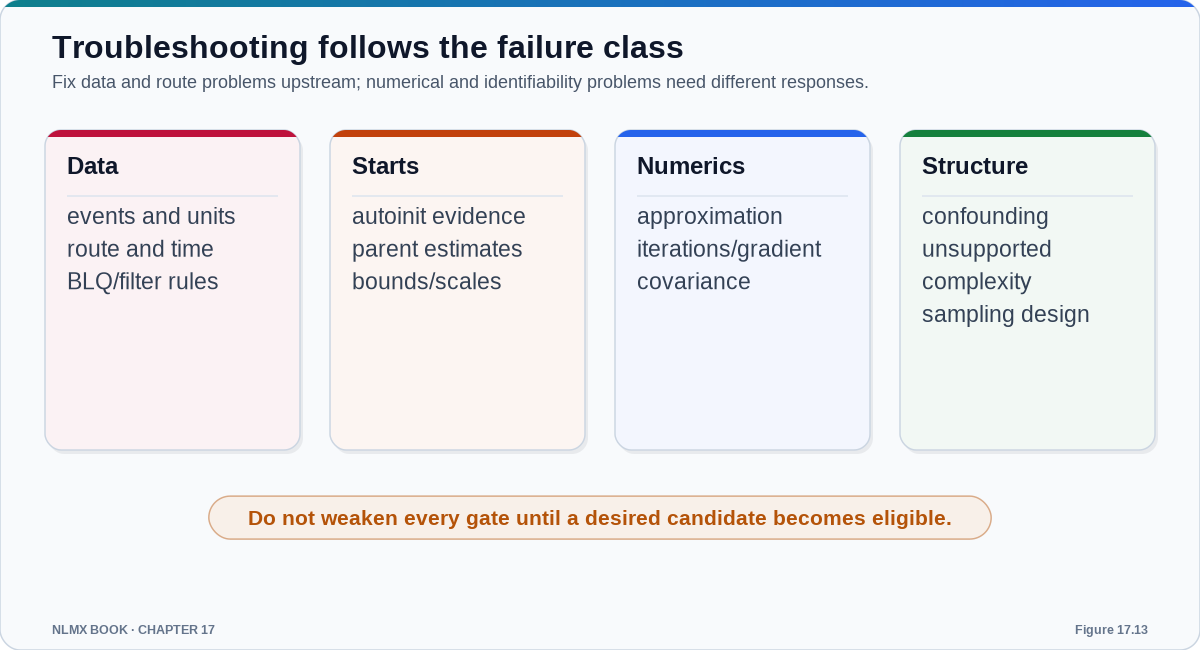
For a failed root, recheck data and autoinit before descendants. For a failed child, inspect its parent and new-parameter starts. Refit from a small prespecified grid of plausible starts. Improve scaling before loosening tolerances. If covariance fails, inspect boundaries and correlations; simply disabling covariance removes evidence rather than resolving the cause.
For high RSE or condition number, identify the offending parameter/direction. Consider whether the design samples the relevant phase, whether parameters are redundant, and whether a simpler scientifically adequate model is preferable. For high shrinkage, reduce unsupported ETAs or collect richer individual data; do not use shrunken EBEs as if they were observations.
Record every recovery attempt. Changing data, likelihood, candidate set, thresholds or criterion creates a new screen and should receive a new output directory.
A concise troubleshooting log should include symptom, hypothesis, single change, expected result, observed result and disposition. This prevents circular tuning and lets another analyst resume work. When escalation is needed, provide the minimal dataset/settings, version, command, top-level summary and relevant error text without exposing confidential identifiers.
Common mistakes
Do not increase iterations reflexively, weaken all gates, or delete failed candidates from the report. Do not “fix” units by changing parameter bounds until estimates look familiar.
Checklist
- Classify data, start, numerical or structural failure.
- Change one justified factor at a time.
- Preserve original and recovery outputs separately.
- Reapply the complete decision rule.
- Escalate unresolved instability as a limitation.
Further reading
Return to starts, numerics, and eligibility.