21.29 From a diagnostic finding to a model decision
A diagnostic review is incomplete until findings have dispositions. Use a repeatable chain: observe, classify, hypothesize, test, compare, and record.
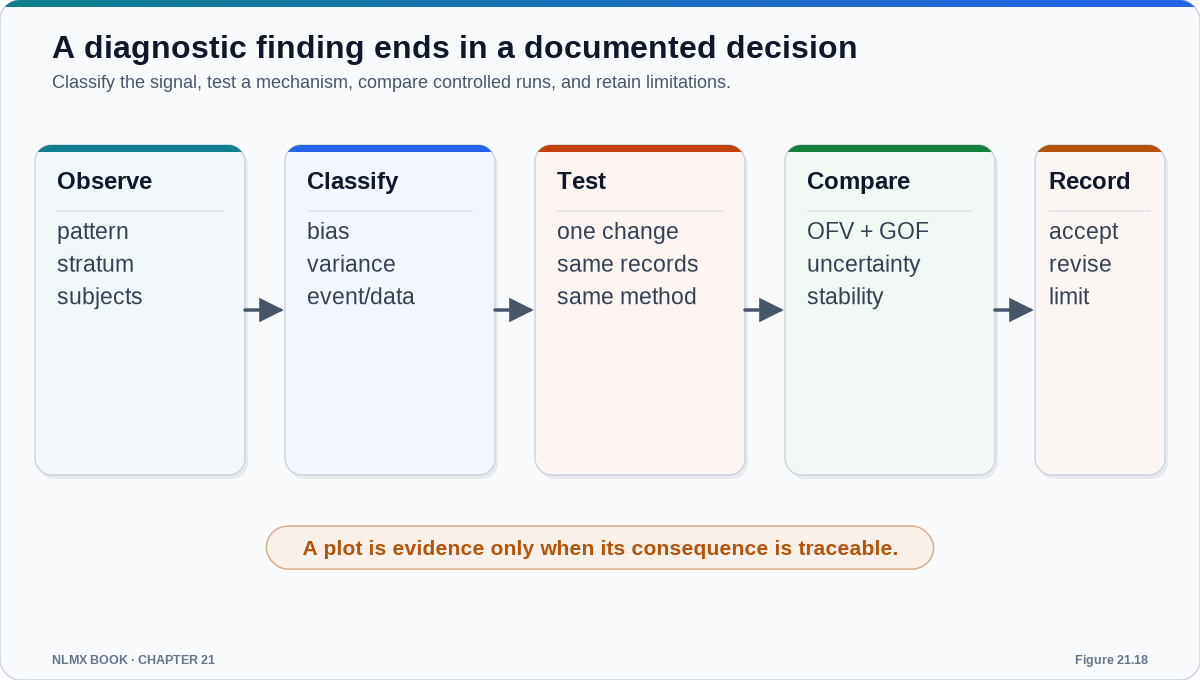
Observe: describe what is visible without assigning a cause. Include plot, direction, range, stratum, subjects, sample size, and transformation. “CWRES trend rises after 12 hours in both dose groups” is better than “elimination is wrong.”
Classify: determine whether the signal concerns record eligibility, mean structure, dynamics, residual variance, random effects, endpoint likelihood, parameter support, or presentation.
Hypothesize: list plausible data and model causes. Rank them by scientific plausibility and risk. Include a null explanation such as sparse-edge smoother behavior.
Test: design the smallest controlled experiment. Keep dataset, row policy, method, and comparison criteria fixed unless the hypothesis specifically concerns them. Preserve each run separately.
Compare: review convergence, OFV under comparable likelihoods, estimates, uncertainty, boundaries, shrinkage, all diagnostic panels, and clinical implications. A localized improvement that creates instability elsewhere is not a clear success.
Record: assign accept, revise, investigate data, retain with limitation, or reject. State who reviewed the evidence and what further work remains. Negative findings and unsuccessful tests belong in the audit trail.
This framework prevents model development from becoming a sequence of undocumented visual reactions. It also supports independent review: another pharmacometrician can see why complexity was added or not added.
Common mistakes
- Jumping from a plot directly to a preferred model.
- Describing causes as observations.
- Changing several dimensions in one test.
- Recording only the winning run.
- Leaving findings without explicit dispositions.
Checklist
- Describe evidence neutrally and quantitatively.
- Separate model, data, and display hypotheses.
- Design one-change controlled tests.
- Compare the whole evidence package.
- Record decision, rationale, reviewer, and limitation.
Further reading
Continue to the complete checklist, common patterns, and Chapter 42 validation when drafted.