17.18 AIC, BIC, and corrected BICc
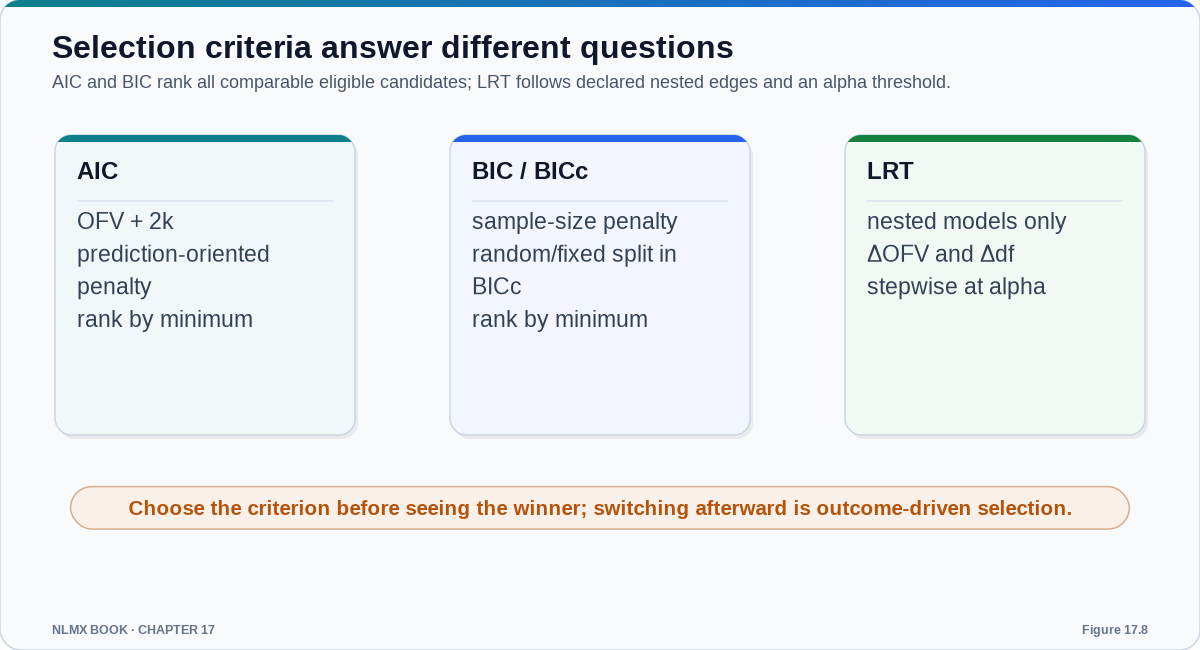
For k estimated parameters, AIC = OFV + 2k. AIC aims at predictive information balance and imposes the same two-unit penalty per parameter. The usual BIC is OFV + k ln(N), but population models have subject-level random effects and observation-level parameters, making one sample size debatable.
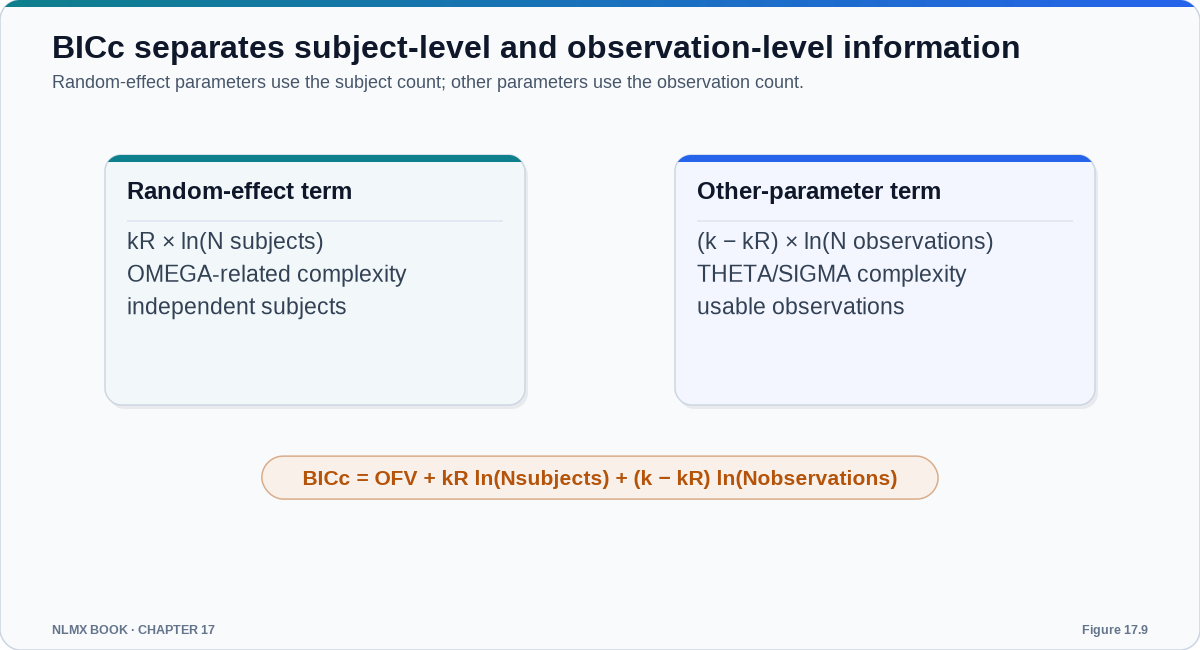
The default bicc penalty separates them:
BICc = OFV + kR ln(Nsubjects) + (k − kR) ln(Nobservations)
where kR is the random-effect parameter count. --bic-penalty obs uses observation count for all parameters; subjects uses subject count for all. This “BICc” is the nlmx corrected population-model penalty, not the small-sample AICc formula.
The lowest criterion among eligible candidates wins. DELTA is the difference from the minimum, and WEIGHT normalizes relative support. As a descriptive guide, Δ below 2 is often practically indistinguishable, 2–10 positive evidence, and above 10 strong evidence; these are heuristics, not universal error probabilities.
Choose criterion and penalty before seeing results. The oral example yields the same winner under BICc and stepwise LRT, but that agreement is not guaranteed. When close models differ scientifically, parsimony, parameter stability and external plausibility remain relevant.
For independent QC, take one CSV row and calculate the penalty with the exported counts. Repeat for a model with a different ETA count. This catches accidental use of observations for every parameter, incorrect random-parameter counting, and rounding. Record the formula beside the table so “BIC” does not conceal which variant was used.
Common mistakes
Do not call weights posterior probabilities without explicit assumptions, mix BIC variants across runs, or select by rounded table values. A minimum criterion cannot rehabilitate an ineligible model.
Checklist
- State criterion and BIC penalty variant.
- Verify
k,kR, subject and observation counts. - Recalculate at least one row independently.
- Report delta and eligibility, not only winner.
- Treat close models as unresolved when appropriate.
Further reading
See eligibility and the BIC-versus-LRT example.