39.19 Troubleshooting the control stream and run family
What you will learn
- Parse model support separately from artifact consistency
- Reconcile THETA/OMEGA/SIGMA and labels
- Prove all files belong to one estimation step
Prerequisites: Chapter 36 exit-code reference, Chapter 38 output completion, and the Chapter 39 overview.
This page describes nlmx 4.16.2. Troubleshooting must preserve the failed attempt: keep its exact command, working directory, log, resolved settings, input/model identities, partial outputs, and process exit code. Correct one causal condition at a time and compare the new evidence with the failed run. Never convert a nonzero exit into success in a wrapper, and never interpret exit 0 as scientific acceptance without the command-native verdict.
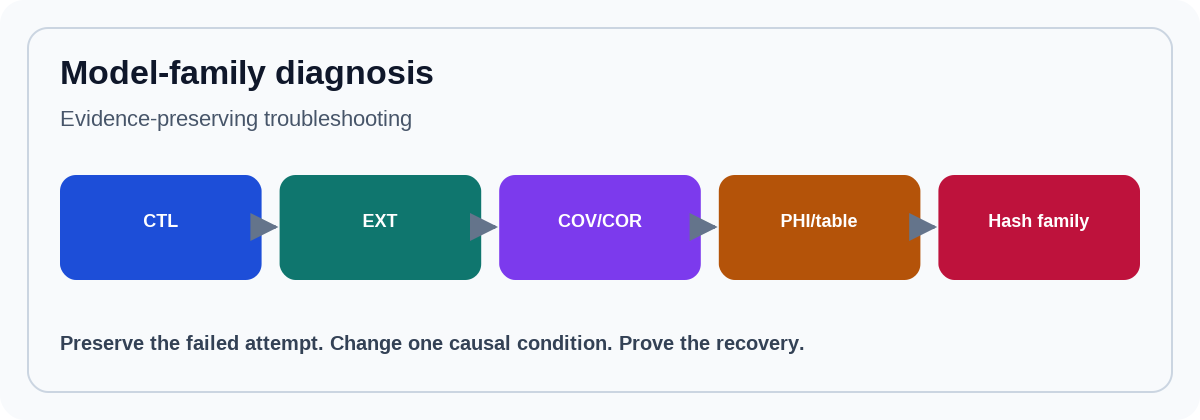
Troubleshoot a run family in order. Parse the .ctl and list model type, subroutine/TRANS, THETA count/bounds/fixed state, OMEGA/SIGMA structure, ETA uses, residual model, dataset mapping, and records that are ignored/refused. Then inspect .ext final row/status and parameter names, .cov/.cor labels/dimensions/definiteness, .phi subject/ETA map, and table IDs/columns.
Do not rely on a shared stem alone. A file can be copied or a rerun can overwrite only part of a family. Use input manifests, hashes, timestamps as supporting—not sole—evidence, run numbers, and native headers. Confirm .ext and covariance correspond to the intended estimation step when multiple $ESTIMATION records exist.
Classify the failure correctly: parser/support refusal (5), inconsistent family (6), dataset mapping (7), posterior source (8), or numerical fit/covariance (9). This prevents ineffective retries. If translating unsupported model code, create a separately named model and validation record; never edit the archived original.
After repair, run inspect/validate and a controlled prediction/fit check. Reconcile parameter order and matrices programmatically by labels, then review scientifically.
Page checklist
- Did you retain the exact exit code, stage, message, hint, log, and partial output?
- Did you identify one causal layer before changing anything?
- Is the recovery a new, traceable attempt with the same intended estimand?
- Did you check command-native and scientific acceptance after process completion?
Navigation
See the previous page, next page, and complete error reference.