Appendix C — Bibliography
What you will learn
- Find the primary source of any method of the book: the estimation methods, the diagnostics, the covariate procedures, the NCA rules, the design tools, the tests and the response models.
- Know exactly how the sources were checked, and what the appendix does not claim.
- Cite a source, and the chapter that applies it, in a methods section.
Prerequisites: none.
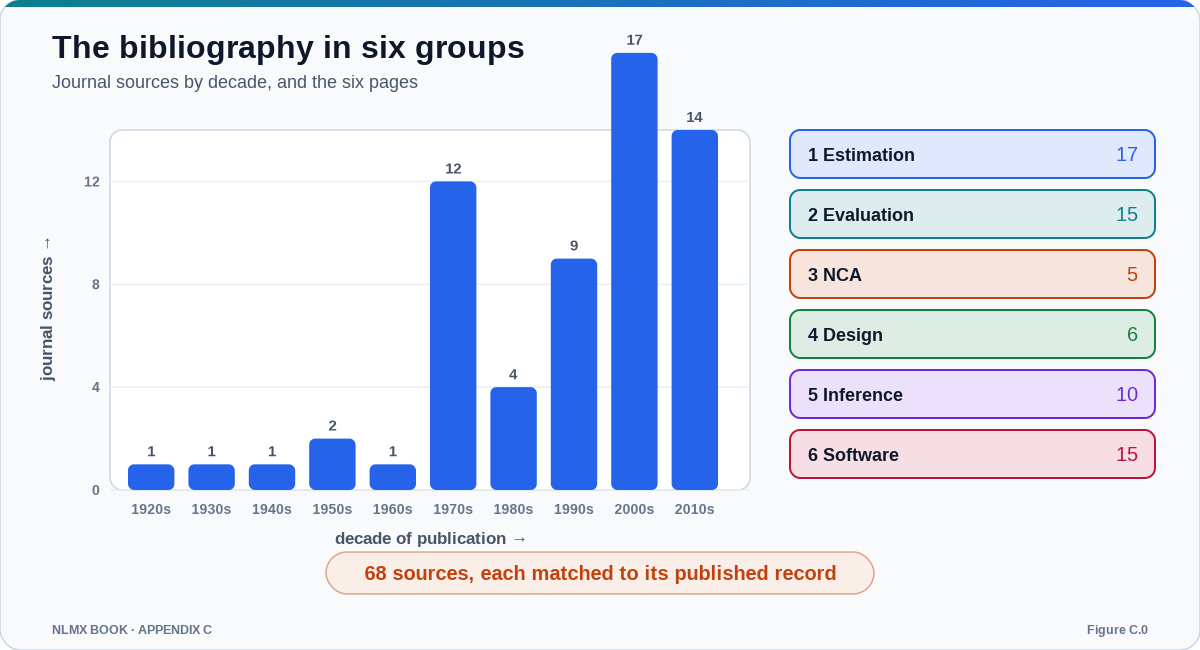
The chapters state what the program does and the equations it uses. This appendix names the papers and documents behind those methods, so that a reader can read the original, and so that a report can cite it. It is a selection of 68 sources — 62 journal articles and 6 documents — chosen because the book uses the idea, not a survey of the field. It is organised in six groups.
| Group | Page | Sources | What it holds |
|---|---|---|---|
| Estimation and algorithms | C.1 | 17 | the mixed-effects likelihood and its approximations, EM and SAEM, importance sampling, the BFGS search |
| Evaluation, covariates, censoring | C.2 | 15 | diagnostics, VPC, NPDE, stepwise covariate modelling, stability selection, data below the limit |
| NCA | C.3 | 5 | trapezoid rules, dose proportionality, bioavailability and equivalence |
| Design and simulation | C.4 | 6 | Fisher information, optimal design, intervals for proportions, random and quasi-random numbers |
| Inference and response models | C.5 | 10 | the three tests, AIC, BIC and BICc, the robust covariance, survival, ordinal and generalised linear models |
| Software, practice, guidance | C.6 | 15 | NONMEM, PsN, Xpose, nlmixr, Monolix, tutorials, best practice, regulatory guidance |
| Lookup | the A–Z reference | 68 | every source by first author and year |
How the sources were checked
Every journal article in this appendix was matched, on 14 November 2026, against its record in the Crossref registry: the authors, the title, the journal, the volume, the issue and the DOI were compared with the citation. Where the record gave a page range, it is given; where the record gave no page range (or only the first page), the citation omits the pages and the DOI identifies the article. The guidance and documentation entries were checked against the page of the issuing body, and give the version or date consulted.
What the appendix does not claim
- It is not complete. Many good papers are not here. A source is included because a method of the book rests on it.
- A citation does not say how the program behaves. The program's behaviour is documented in its chapters; the paper says why the method is sound. The pages say which chapter applies which source, and a reader who needs the program's exact rule reads the chapter.
- Guidance changes. A regulator or a harmonisation body can revise a document; check the issuing body's page for the current version before citing it.
- The summaries are the book's, not the authors'. The line What it gives is a short description of the source's contribution as it matters here, and is not a substitute for reading it.
How to read it
- Looking for the source of a method? Go to the page of the group, or the A–Z lookup.
- Writing a methods section? C.6 has a table that gives, for common sentences, what to cite.
- Checking a number? The last section of each page traces numbers of the book to the sources that explain them.
The appendix has six numbered pages, this overview and the lookup: eight Markdown pages in total. Continue with C.1.