39.24 Reporting a problem that can be reproduced
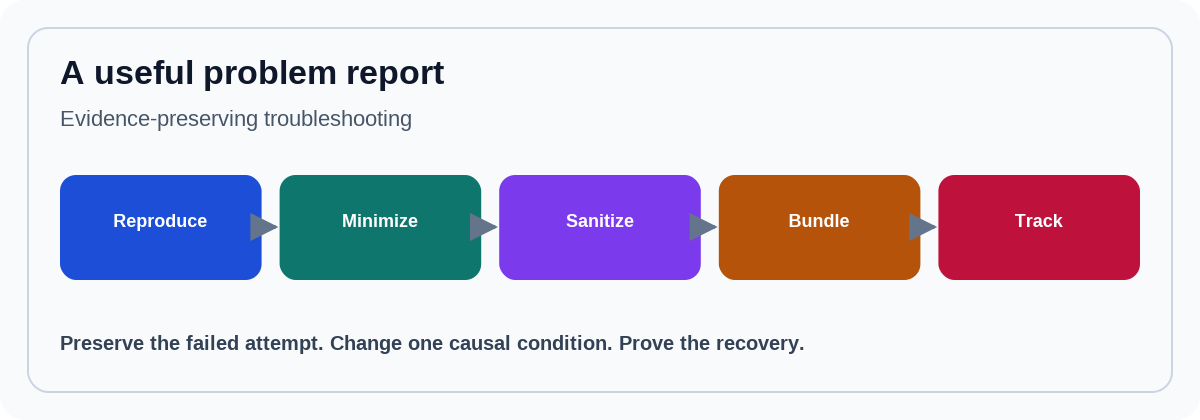
What you will learn
- Assemble the minimum technical bundle
- Minimize and sanitize without changing the failure
- Track resolution and regression evidence
Prerequisites: Chapter 36 exit-code reference, Chapter 38 output completion, and the Chapter 39 overview.
This page describes nlmx 4.16.2. Troubleshooting must preserve the failed attempt: keep its exact command, working directory, log, resolved settings, input/model identities, partial outputs, and process exit code. Correct one causal condition at a time and compare the new evidence with the failed run. Never convert a nonzero exit into success in a wrapper, and never interpret exit 0 as scientific acceptance without the command-native verdict.
A useful report lets another person reproduce the problem without guessing and without receiving unnecessary sensitive data. Lead with expected versus observed behavior, impact, reproducibility frequency, and exit code/stage. Assign an internal incident/defect ID.
Include: nlmx version/banner and executable hash; OS/architecture; installation/build provenance; exact command as an argv-safe block; CWD; relevant environment/backend/thread/seed; full unedited log or captured stderr; settings and resolved settings; input manifest/hashes; minimal control stream/artifacts/data needed; output inventory/checksums; and the first failing message. For numerical issues include method, initial values, parameter/gradient/status summaries, retry lineage, and whether thread/seed/platform matters.
Sanitize deliberately. Remove direct identifiers and secrets; replace subject IDs consistently; minimize rows/columns while rerunning after every removal to ensure the same failure/class/stage persists. State what was transformed. Do not send production PHI, proprietary code, credentials, model-server tokens, or an entire project when a synthetic fixture suffices. Follow the organization's secure transfer and retention policy.
Use a bundle structure such as README.md, version.txt, command.txt, environment.txt, log.txt, settings/, inputs/, outputs_manifest.txt, and checksums.sha256. Avoid absolute user paths in published artifacts when they disclose identity; retain a controlled internal mapping if needed.
Close the report only after the fix is linked to a version/change, the minimal reproducer passes, regression coverage exists, the original controlled case is reassessed, and impact on prior analyses is documented. A workaround can unblock work but does not close a confirmed defect.
Page checklist
- Did you retain the exact exit code, stage, message, hint, log, and partial output?
- Did you identify one causal layer before changing anything?
- Is the recovery a new, traceable attempt with the same intended estimand?
- Did you check command-native and scientific acceptance after process completion?
Navigation
See the previous page, next page, and complete error reference.