C.6 Software, practice and guidance
What you will learn
- Find the documentation of the programs the book compares with, and the tutorials that introduce the field.
- Find the regulatory documents, with their versions.
- Pick the right source to cite for a sentence of a methods section.
Prerequisites: the glossary, B.6. The entries are written in the form authors, title, journal, year, volume(issue):pages, DOI; the first line of each entry is the citation, and the second says what the source gives and where the book uses it.
The programs that the book is compared with, the tutorials that introduce the field, and the documents that say what a regulator or an industry group expects. Guidance documents change. The entries give the version consulted, and a reader who cites one should check the issuing body's page for a later version.
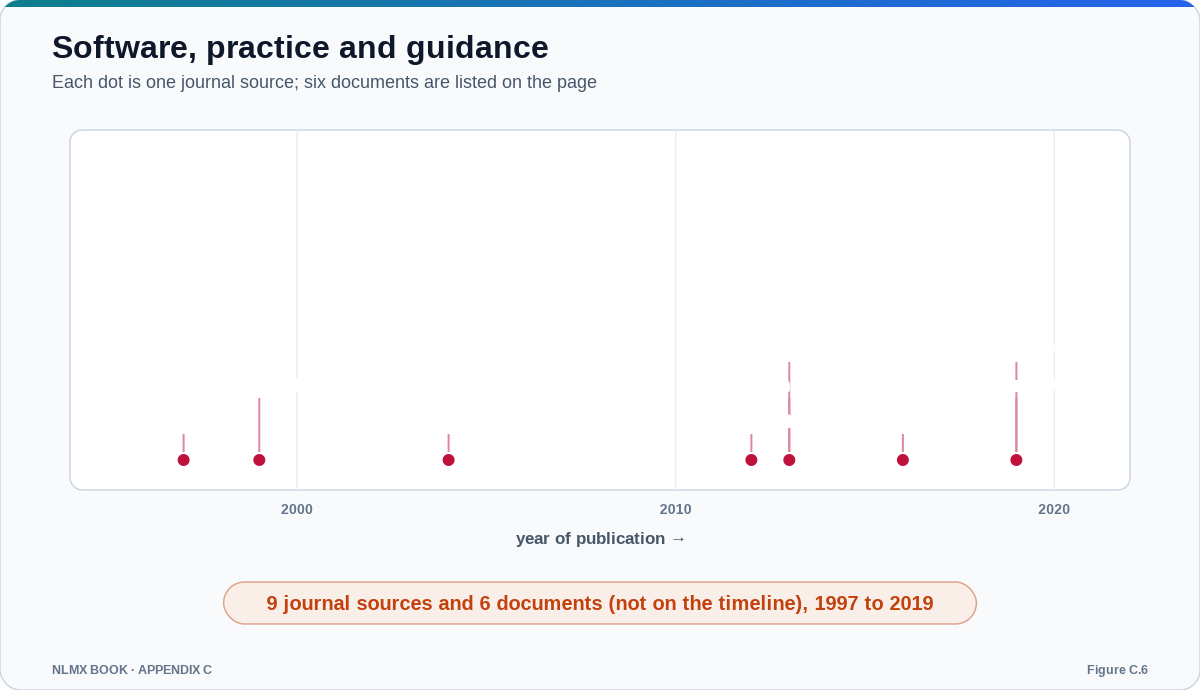
This page has 15 entries.
NONMEM and its companion tools
[Bauer 2019] Bauer RJ. NONMEM tutorial part I: description of commands and options, with simple examples of population analysis. CPT Pharmacometrics Syst Pharmacol. 2019;8(8):525–537. doi:10.1002/psp4.12404 What it gives: A tutorial on the commands and options of NONMEM, the program whose files and control streams the book follows. Used in: Chapter 5; B.3.
[Lindbom 2004] Lindbom L, Ribbing J, Jonsson EN. Perl-speaks-NONMEM (PsN)—a Perl module for NONMEM related programming. Comput Methods Programs Biomed. 2004;75(2):85–94. doi:10.1016/j.cmpb.2003.11.003 What it gives: Describes PsN, the toolkit that automates NONMEM runs and the model-building procedures built on them. Used in: Chapter 40.
[Jonsson 1999] Jonsson EN, Karlsson MO. Xpose—an S-PLUS based population pharmacokinetic/pharmacodynamic model building aid for NONMEM. Comput Methods Programs Biomed. 1999;58(1):51–64. doi:10.1016/s0169-2607(98)00067-4 What it gives: Describes Xpose, the diagnostic-graphics system for NONMEM output. Used in: Chapter 40.
[Keizer 2013] Keizer RJ, Karlsson MO, Hooker A. Modeling and simulation workbench for NONMEM: tutorial on Pirana, PsN, and Xpose. CPT Pharmacometrics Syst Pharmacol. 2013;2(6). doi:10.1038/psp.2013.24 What it gives: A tutorial on the NONMEM workbench tools Pirana, PsN and Xpose used together. Used in: Chapter 40.
Other implementations
- [Fidler 2019] Fidler M, Wilkins JJ, Hooijmaijers R, Post TM, Schoemaker R, Trame MN, Xiong Y, Wang W. Nonlinear mixed-effects model development and simulation using nlmixr and related R open-source packages. CPT Pharmacometrics Syst Pharmacol. 2019;8(9):621–633. doi:10.1002/psp4.12445 What it gives: Describes the nlmixr open-source environment for nonlinear mixed-effects modelling in R. Used in: Chapter 40.
Practice and the framing of a modelling study
[Mould 2012] Mould DR, Upton RN. Basic concepts in population modeling, simulation, and model-based drug development. CPT Pharmacometrics Syst Pharmacol. 2012;1(9). doi:10.1038/psp.2012.4 What it gives: A tutorial introduction to population modelling and simulation, for a newcomer to the field. Used in: Chapter 1; Appendix B.
[Sheiner 1997] Sheiner LB. Learning versus confirming in clinical drug development. Clin Pharmacol Ther. 1997;61(3). doi:10.1016/s0009-9236(97)90160-0 What it gives: Distinguishes studies that learn (estimate and describe) from studies that confirm (test a prespecified claim); the frame for reading what a model result can support. Used in: Chapter 41.
[Byon 2013] Byon W, Smith MK, Chan P, et al.. Establishing best practices and guidance in population modeling: an experience with an internal population pharmacokinetic analysis guidance. CPT Pharmacometrics Syst Pharmacol. 2013;2(7). doi:10.1038/psp.2013.26 What it gives: How an organisation set out the content of a population pharmacokinetic analysis and its report as an internal guidance. Used in: Chapter 42.
[EFPIA MID3 2016] EFPIA MID3 Workgroup, Marshall SF, Burghaus R, et al.. Good practices in model-informed drug discovery and development: practice, application, and documentation. CPT Pharmacometrics Syst Pharmacol. 2016;5(3):93–122. doi:10.1002/psp4.12049 What it gives: Good practices for the planning, conduct and documentation of modelling and simulation that supports a decision. Used in: Chapter 42.
Documentation and guidance documents
[NONMEM] ICON plc. NONMEM Users Guides. Online documentation. The guides are written by SL Beal, LB Sheiner, AJ Boeckmann and RJ Bauer. https://nonmem.iconplc.com What it gives: The reference for the control-stream records, the data items and the result files that the book follows. Used in: Chapter 5; B.3.
[Monolix] Lixoft (Simulations Plus). Monolix documentation. Online documentation, including the description of the SAEM method. https://monolix.lixoft.com What it gives: The reference for an established implementation of SAEM, against which the method can be compared. Used in: Chapter 40.
[FDA2022] US Food and Drug Administration, Center for Drug Evaluation and Research. Population Pharmacokinetics: Guidance for Industry. Final guidance, February 2022. https://www.fda.gov/regulatory-information/search-fda-guidance-documents/population-pharmacokinetics What it gives: The regulator's expectations for the planning, conduct and reporting of a population pharmacokinetic analysis. Used in: Chapter 42.
[FDA2003] US Food and Drug Administration, Center for Drug Evaluation and Research and Center for Biologics Evaluation and Research. Exposure-Response Relationships: Study Design, Data Analysis, and Regulatory Applications. Final guidance, May 2003. Check the agency's page for a later revision. https://www.fda.gov/regulatory-information/search-fda-guidance-documents/exposure-response-relationships-study-design-data-analysis-and-regulatory-applications What it gives: The regulator's description of what an exposure–response analysis is for and how to design and report one. Used in: Chapters 32 and 33.
[EMA2007] European Medicines Agency, Committee for Medicinal Products for Human Use. Guideline on reporting the results of population pharmacokinetic analyses (CHMP/EWP/185990/06). First published June 2007; effective 1 January 2008. https://www.ema.europa.eu/en/reporting-results-population-pharmacokinetic-analyses-scientific-guideline What it gives: The European guideline on the content of a report of a population pharmacokinetic analysis. Used in: Chapter 42.
[ICHM15] International Council for Harmonisation. M15: General principles for model-informed drug development. Adopted guideline (reference EMA/CHMP/ICH/496426/2024); published by the European Medicines Agency in February 2026. https://www.ema.europa.eu/en/ich-m15-guideline-general-principles-model-informed-drug-development-step-2b-scientific-guideline What it gives: The harmonised principles for planning, documenting and assessing model-informed drug development. Used in: Chapter 42.
Documents consulted on 14 November 2026. Online documents change; the URL is the issuing body's page.
Which source to cite for which statement
A report states methods in sentences. The table gives, for common sentences, the kind of source that supports each. It is a guide to citing, not a statement of what the program does; the program's own behaviour is documented in its chapters.
| If your report says… | Cite |
|---|---|
| "Estimation was by FOCE with interaction" or "by the Laplace method" | Wang 2007 (and the program's own chapter for its implementation) |
| "Estimation was by SAEM" | Delyon, Lavielle and Moulines 1999; Kuhn and Lavielle 2005; the Monolix documentation for an independent description |
| "Covariates were added stepwise" | Jonsson and Karlsson 1998; Hutmacher and Kowalski 2015 |
| "Observations below the limit were treated by M3" | Beal 2001; Ahn et al. 2008 |
| "Dose proportionality was assessed by the power model" | Smith et al. 2000 |
| "The model was evaluated with a prediction-corrected VPC" | Bergstrand et al. 2011 |
| "The analysis followed good practice for model-informed development" | EFPIA MID3 Workgroup 2016; ICH M15 |
| "The report follows the regulator's expectations for a population analysis" | the FDA 2022 guidance or the EMA 2007 guideline, as applicable |
Review checklist
- Is each statement of method in your report supported by a citation to a primary source?
- Have you checked the issuing body's page for a later version of any guidance you cite?
- Do you cite the program's chapter for what the program does, and the paper for why?
Navigation
See the previous page, overview and the A–Z lookup.