36A.6 Paragraphs, emphasis, links, and raw HTML
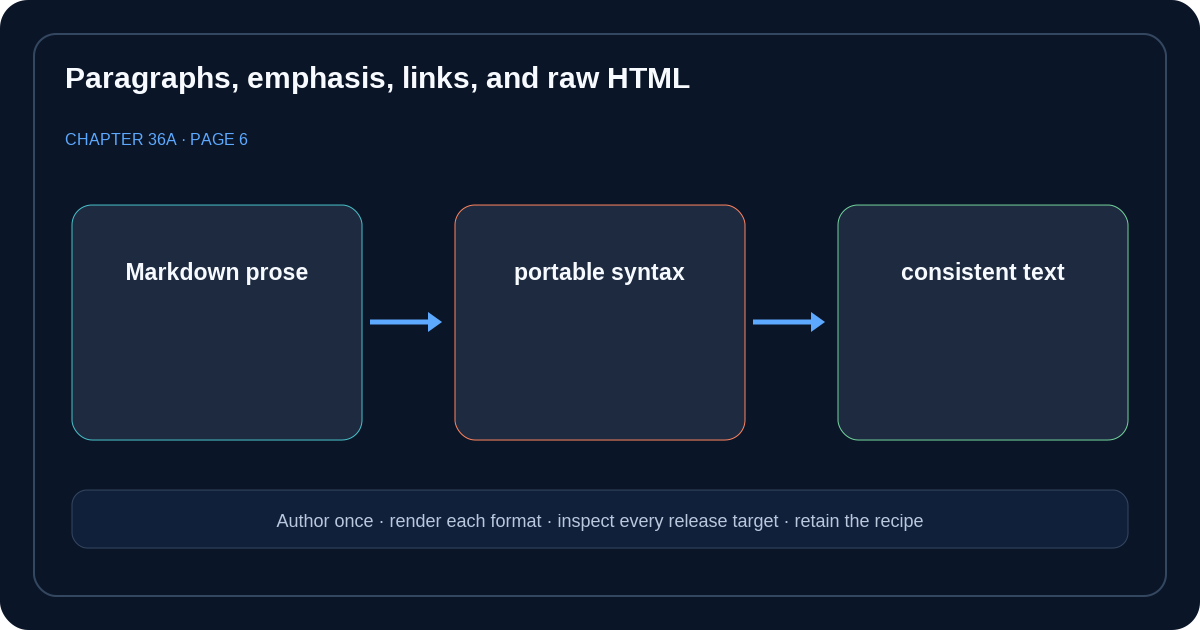
nlmx report publishes one Markdown source into retained Markdown, Word and PDF by default, with optional HTML. The command solves document generation; it does not validate the scientific analysis or approve its interpretation. Treat the source Markdown and .report file as the controlled recipe, and treat every released format as a separate review target.
Portable inline syntax
Plain paragraphs, **bold**, *italic*, ~~strikethrough~~, inline `code` and Markdown links are carried into every target. Use bold sparingly for labels and essential distinctions; italics work well for source captions. Inline code is appropriate for filenames, commands, settings keys and literal values.
Links remain clickable where the target supports them. A readable label is better than a bare URL. Links do not prove that an external resource will remain available, so essential evidence should be retained in the study package. Avoid javascript: and other executable schemes; HTML output neutralizes unsafe script links.
Raw HTML is deliberately format-specific: it is ignored in Word and PDF but can pass into HTML. Therefore raw HTML must not carry essential content. Use Markdown constructs for anything that must survive all outputs.
Escaping matters. Use backticks for literal Markdown characters or a backslash where supported. Currency dollar signs can interact with equation delimiters; ordinary prices such as $5 and $10 are recognized as text by the math parser, but inspect ambiguous prose. Unicode depends on available fonts; verify accented letters, Greek and specialized symbols in every released format.
Portability test
Create one small fixture containing bold, italic, strikethrough, inline code, an internal/external link, currency and accented/Greek text. Render all selected targets and inspect it before committing a long report. This quickly exposes font or escaping surprises. Keep critical instructions out of raw HTML because Word/PDF omit it. For links, verify both visible label and destination; a label such as “click here” is less accessible and less meaningful when printed. For literal settings or paths, inline code prevents Markdown punctuation from changing the content.
Practical review questions
- Does the released content answer the stated question without exceeding the evidence?
- Can every number, table, figure and decision be traced to a retained native file and run?
- Were all generated targets—not merely the source—inspected after the latest change?
- Are warnings, failed runs, limitations and unverified steps visible rather than silently omitted?
- Could another qualified analyst rebuild the same document from the retained recipe?
Navigation
See the previous page, next page, and complete report reference.