22.16 Centering and reference values
Every nlmx covariate factor equals one at its reference. The corresponding typical parameter therefore describes a subject at all reference covariate values. This interpretation is central to parameter reporting and numerical stability.
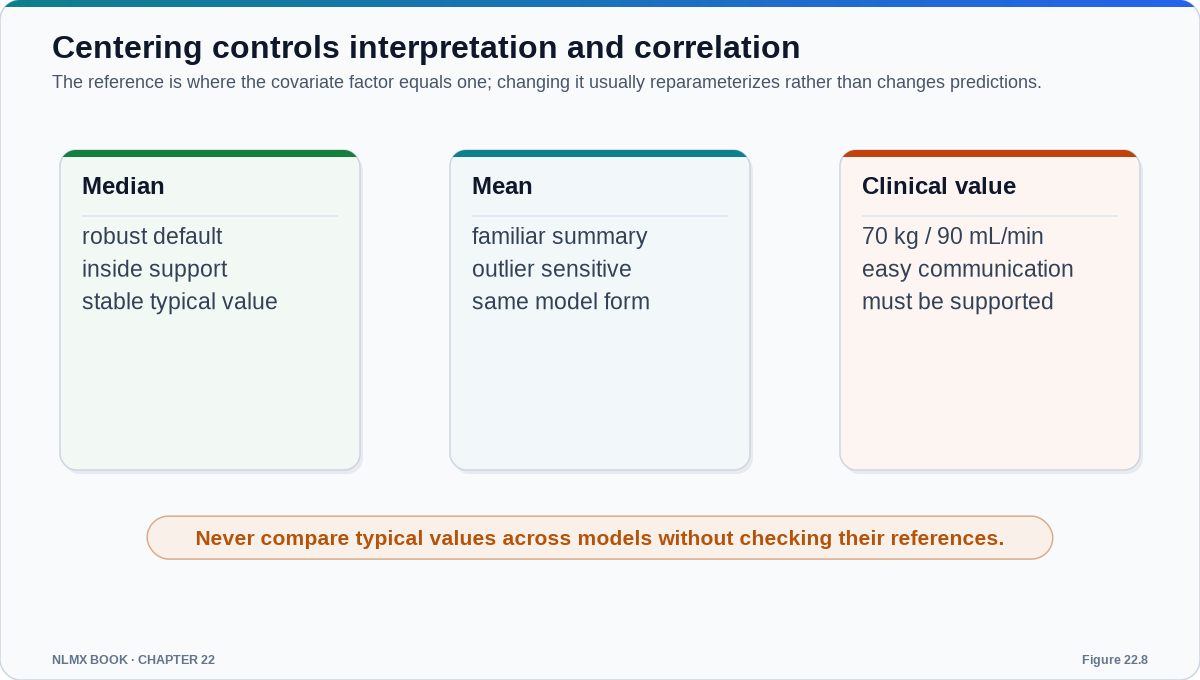
Continuous defaults use the median. It is robust and usually inside observed support. The mean may be useful for symmetric distributions but is sensitive to outliers. A clinical reference such as 70 kg or eGFR 90 can improve communication if it is supported by the data.
Categorical defaults use the most frequent level. Override when a standard comparator is required, but avoid a tiny reference group. Changing reference reverses or transforms contrasts while fitted predictions should remain equivalent after correct reparameterization.
Centering affects correlation between typical value and effect coefficient, optimizer scaling, and interpretation of multiple covariate effects. A reference far from the data can make TVP extrapolated and imprecise. For time-varying covariates, define what reference means across records.
When comparing model versions, state references. A change in TVCL may be entirely due to centering rather than a biological difference. Forest plots and clinical summaries should calculate ratios relative to the same declared reference.
Why the reference changes the story
Centering determines the person represented by the base typical parameter. A median reference usually reduces correlation between the intercept and covariate coefficient, but it may be awkward for communication if the median is 72.2047 kg. A conventional 70 kg reference is easier to compare across studies but may be poorly supported in a special population. The mean is sensitive to skewness and outliers. For categorical variables, the most frequent level often improves precision, whereas a clinically standard group may improve interpretation. Whatever the choice, report its value and units, show its location in the distribution, and keep it constant across candidate models being compared.
Common mistakes
- Reporting TVP without its reference subject.
- Centering outside observed support.
- Comparing TVP across different references directly.
- Choosing a rare categorical reference.
- Changing references after selection without refitting and documenting.
Checklist
- Choose supported, interpretable references prospectively.
- Record units and category labels.
- Review parameter correlation and precision.
- Use consistent references in comparisons and plots.
- Refit and verify predictions after reparameterization.
Further reading
Continue with effect meaning, overrides, and forest plots.