Complete case-study reference
What you will learn
- Find, for any case, the bundles it reads and the page that reads them.
- Cite a number from the chapter in the form a reviewer can check.
- See the headline decision of each case, with the one number that carries it.
- Know which output file holds which kind of result.
Prerequisites: the chapter overview.
How to cite a number
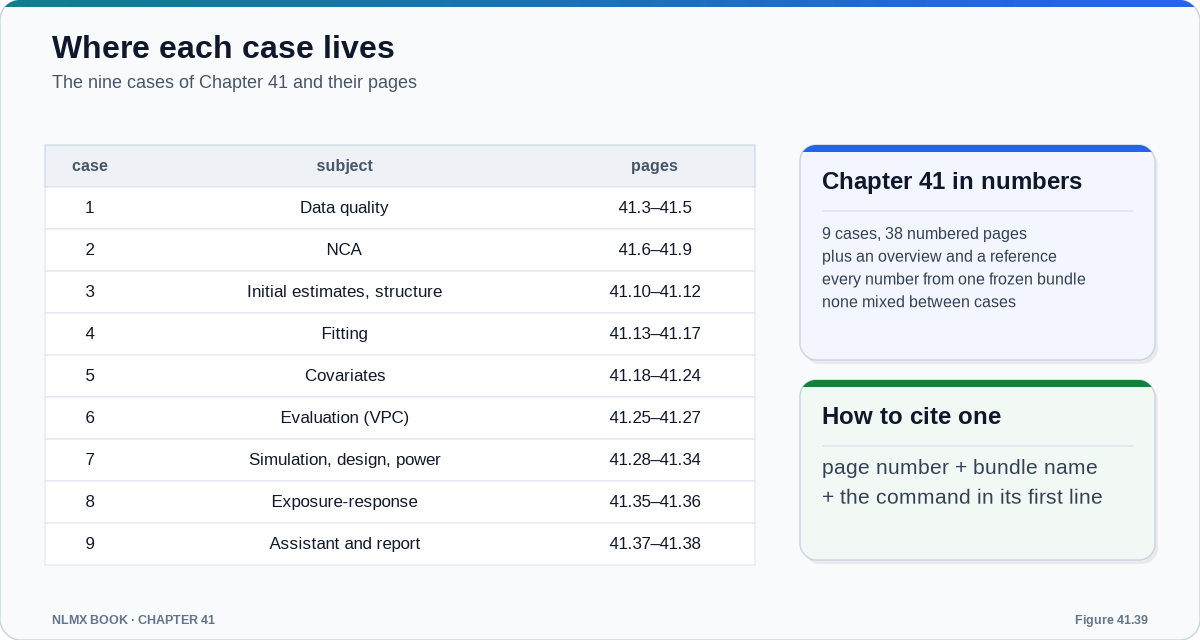
A number in this chapter is cited by three things: the page, the bundle and the command that produced it. For example, the clearance window of page 41.28 is 41.28, Chapter 28 bundle dose_levels, the sims command on the final covariate model. The first line of the stored summary of each bundle holds the command, and the checksum list beside it proves that the file is the one that was frozen. A number that cannot be cited this way is a worked illustration, and the page says so in italics.
Inventory of cases and bundles
| Case | Pages | Bundles read | Headline decision | The number that carries it |
|---|---|---|---|---|
| 1. Data quality | 41.3–41.5 | Chapter 11: defective, clean |
the defective file is not ready; the repaired file is; the gate is exit code 7 at error |
4 FAIL and 13 WARN, then 0 and 0 |
| 2. NCA | 41.6–41.9 | Chapter 15: oral_single, iv_infusion, steady_state, dose_proportionality, crossover_bioavailability, blq_sparse |
report CMAX, AUCINF and CL/F with their rules; no AUCinf at steady state or in the sparse study | dose-proportionality slope 1.000 (0.909–1.091); F = 0.713 |
| 3. Initial estimates and structure | 41.10–41.12 | Chapters 16–17: oral_one_compartment, oral_distribution, oral_lag, nonlinear_mm |
start at CL 3.04, V 40.6, KA 1.47; carry 2 and 3 compartments forward, base on 2 | 2→3 compartments: ΔBIC 15.4 but max RSE 42.8 % |
| 4. Fitting | 41.13–41.17 | Chapter 20: oral_focei, oral_laplace, oral_saem, oral_block, the retry bundle, iteration_limit, evaluate_only |
report the FOCE-I fit; the other methods agree within 2 % | block OMEGA: LRT p = 0.069, kept diagonal |
| 5. Covariates | 41.18–41.24 | Chapters 22–26: base_fit, frozen, scm, refined, permutation, primary, both, resume_recovered, fitted_covariate_model, forest bundles |
V |
refit OFV −1157.8135; CL~EGFR selected with probability 0.72 |
| 6. Evaluation | 41.25–41.27 | Chapter 27: primary_pcvpc, missing_covariates, stratified_pvcvpc, npc_tables, blq_pcvpc, uncertainty_vpc |
the final model describes the data; the base model did not | 1 of 24 percentiles outside; base model 16 of 96 outside by stratum |
| 7. Simulation and design | 41.28–41.34 | Chapters 28–31: adult_fixed, dose_levels, pediatric_weight, mixed_targets, typical_subject, custom_design, preset_analytic, study_*, fim_*, sse_* and others |
100 mg for adults; 2 mg/kg and the weight bands as drawn both need revision; plan on 44 subjects (reduced FIM), 55 by simulation | 100 mg: 89.33 % in range; N for 80 % power 44 (formula), 55 (simulation) |
| 8. Exposure–response | 41.35–41.36 | Chapters 32–33: binary, count, ordinal, continuous, tte, longitudinal, selection, placebo, metrics, filters |
response is related to exposure; the benefit over placebo is large and the benefit between active exposures is small and model-dependent | change score −10.7 vs placebo; −1.18 between active quartile boundaries (unadjusted) |
| 9. Assistant and report | 41.37–41.38 | Chapters 34–36A: nine assistant sessions on a scripted backend; full, inline, stdin |
the guardrails refuse what they must, and every session is auditable; a report is not release-ready until it has been opened | exit code 0 with a figure missing |
One lesson per page
| Page | The lesson in one line |
|---|---|
| 41.3 | The defective file carries 4 failures and 13 warnings; the verdict is a count, not an opinion. |
| 41.4 | Every finding is answered in one of three ways (query, exclude, accept); a plan with no queries is suspect. |
| 41.5 | A gate is an exit code; keep a written exception table for warnings. |
| 41.6 | Three hand checks (half-life from λz, the extrapolated area, CL/F from dose and AUCinf) confirm an NCA table. |
| 41.7 | At steady state report AUCτ and the fluctuation, not AUCinf. |
| 41.8 | Proportionality is judged by an interval against a band, with three possible verdicts. |
| 41.9 | Bioavailability needs a washout note; a sparse BLQ study supports only CMAX, TMAX and AUClast. |
| 41.10 | Three routes to initial estimates agreeing is a check on all three. |
| 41.11 | A structure that wins on BIC can lose on RSE and condition number. |
| 41.12 | A recommendation with a caution is carried to the fit as a sensitivity run. |
| 41.13 | Read the ending, the gradient, the RSEs and the shrinkage before the estimates. |
| 41.14 | Three methods agreeing within 2 % is evidence about the model, not the method. |
| 41.15 | An extra parameter must earn its place by test and by criterion. |
| 41.16 | The parent folder of a retried fit is attempt 0, not the result. |
| 41.17 | Seven runs of one model, and only one is the reported fit. |
| 41.18 | Every method of Case 5 starts from the same base fit. |
| 41.19 | A one-step screen can leave a relationship undecidable. |
| 41.20 | The refit search confirms the model by an explicit fit. |
| 41.21 | A variant that fails with exit 9 is documented, not used. |
| 41.22 | A selection probability is reported with the relationship. |
| 41.23 | An interrupted run that resumes must equal the uninterrupted one. |
| 41.24 | A forest plot can be rebuilt by hand; an extrapolated scenario is flagged. |
| 41.25 | A VPC outside count is compared with the count expected by chance. |
| 41.26 | A pooled check can pass while a stratified one fails. |
| 41.27 | A check holds under a declared LLOQ and under parameter uncertainty. |
| 41.28 | Translate an exposure window into a clearance window, and a population into a proportion in range. |
| 41.29 | mg/kg dosing overshoots at high weight (exposure ∝ WT^0.273); band edges underdose. |
| 41.30 | Reproduce a simulation with a pencil, with uncertainty, and from its settings file. |
| 41.31 | A generated project has a known truth, so an estimate is judged in standard-error units. |
| 41.32 | One or two replicates say nothing about a rate; the replicate rows and the refusals do. |
| 41.33 | A Wald power and a sample size can be done by hand; the reduced and full information differ five-fold. |
| 41.34 | Simulation chose the reduced matrix; non-monotone power is noise; powered is not precise. |
| 41.35 | Overall exposure dependence and the effect between active exposures are different questions. |
| 41.36 | Compare subgroups with a test of their difference; covariates change the interval more than the estimate. |
| 41.37 | A scripted model shows the guardrails, not the model's judgement. |
| 41.38 | Exit code 0 and a file on disk are not release criteria. |
Which file holds what
| Kind of result | Typical file |
|---|---|
| Data check | qc_summary.txt, qc_findings.csv, qc_flagged_data.csv |
| NCA | nca_summary.txt, nca_parameters.csv, nca_lambda_z.csv, nca_dose_proportionality.csv, nca_bioavailability.csv |
| Initial estimates and structure | initial_estimates.csv, screen_summary.txt, model_comparison.csv, best_model.ctl |
| Fit | fit_summary.txt, parameters.csv, the .ext file, retries.csv |
| Covariates | candidate_results.csv, score-refit-comparison.csv |
| Power | fim_power.csv, sample_size.csv |
| Design study | study_results.csv |
| Exposure–response | er_summary.txt, and per analysis …_models.csv, …_parameters.csv, …_effects.csv, …_by_exposure_group.csv, …_excluded.csv |
| Assistant session | transcript.md, ask_log.jsonl, ask_settings.ask, commands.txt |
| Report | checksums.sha256, the Markdown, and the quality-assurance note |
The name of a file in a bundle can differ from the table by the analysis name; the page that uses a file names it exactly.
Reading the chapter as a project
If the chapter is read as the story of one project, the order is: the data are returned for repair (Case 1) and pass; exposure is summarised (Case 2); a starting point and a structure are chosen (Case 3); the model is fitted and its ending read (Case 4); covariates are added, and one is kept with its evidence stated (Case 5); the model is checked against the data it was built from (Case 6); the design of the next study is simulated and its power planned (Case 7); response is related to exposure (Case 8); and the work is reported with its limits (Case 9). The cases use different data sets, so the story is one of method, and the numbers from one case do not carry into the next.
Review checklist
- Can you cite any number of the chapter by page, bundle and command?
- For each case, can you state the decision and what would have changed it?
- Can you find the file that holds a result without searching?
Navigation
See the chapter overview, the first page and Chapter 42.