21.15 ETA distributions and the population random-effects model
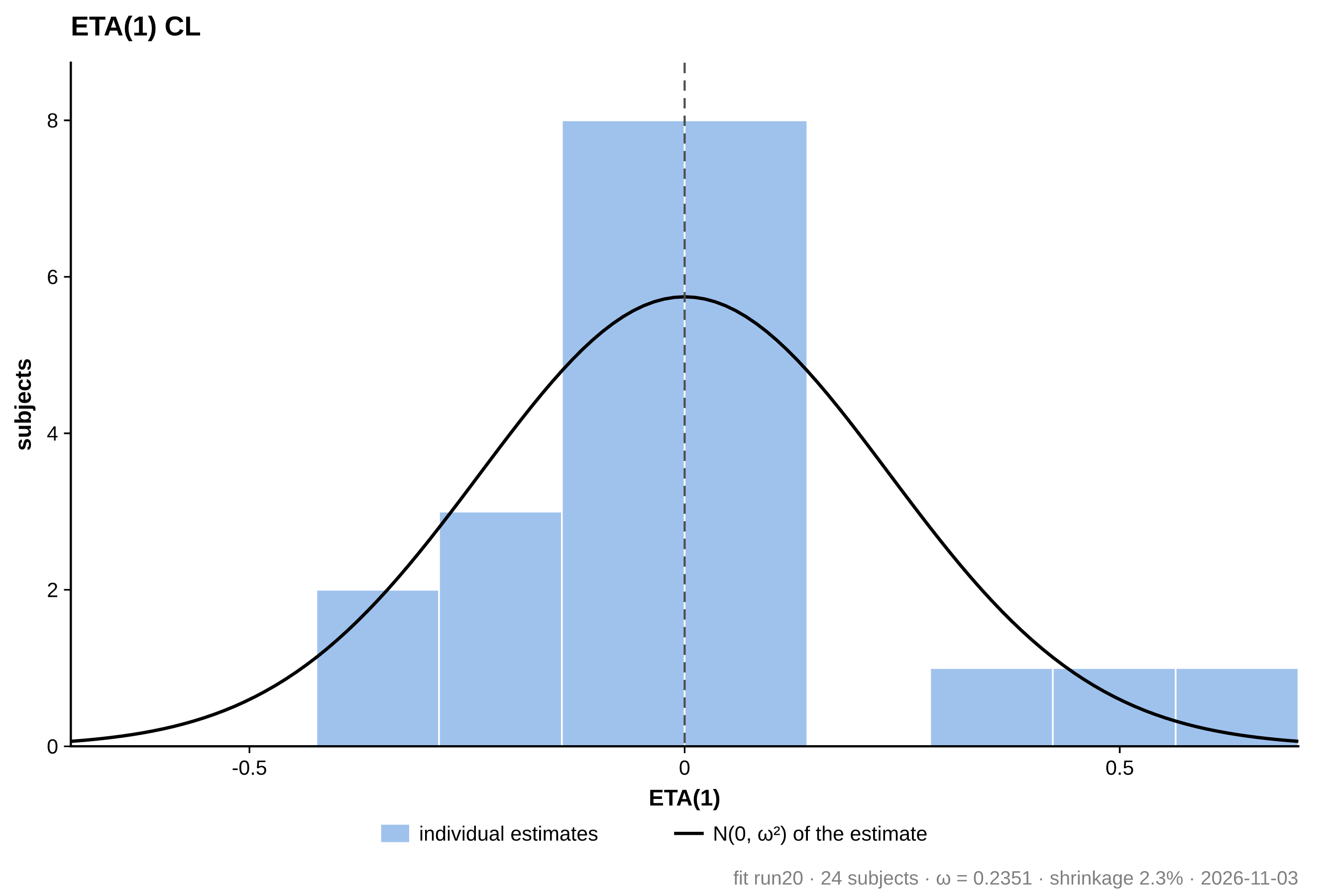
For each estimated, used ETA with positive OMEGA variance, nlmx draws a histogram of subject-level estimates, overlays the N(0, omega) density implied by the population estimate, and marks zero. The caption reports the population SD and ETA shrinkage. This compares the empirical EBE distribution with the assumed random-effects distribution, but shrinkage prevents a literal distributional test.
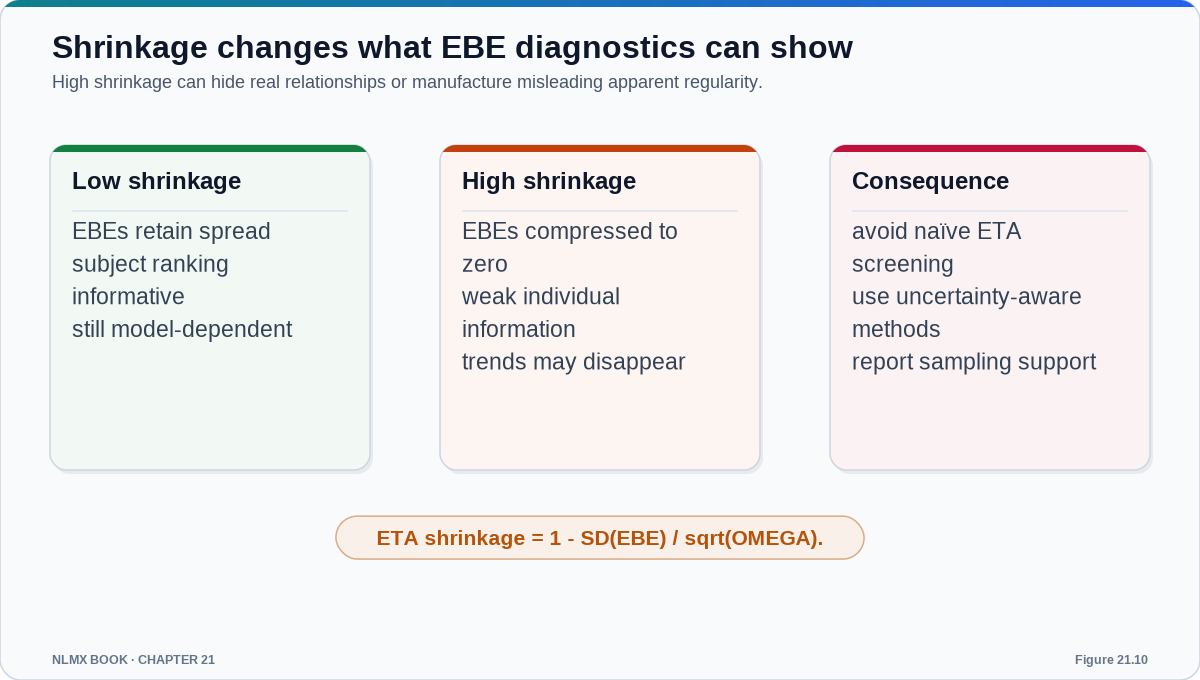
Look for centering, symmetry, tails, multimodality, isolated subjects, and compression. A shifted distribution may indicate biased typical values or imbalanced sampling. Skewness can suggest a transformation mismatch or subgroup mixture. Multiple modes can indicate missing categorical covariates, formulations, studies, occasions, or data problems. Narrow EBEs relative to the OMEGA density may reflect high shrinkage rather than an overestimated variance.
The Chapter 20 rich-sampling example has low ETA shrinkage, so its CL and V EBE histograms retain substantial individual spread and can be compared cautiously with their population densities.
EBEs are conditional estimates derived from the same outcomes used to fit the model. They are neither observed subject parameters nor independent draws from OMEGA. Do not apply an ordinary normality test without accounting for estimation error and heterogeneous information. Covariate searches based directly on EBEs are especially vulnerable to shrinkage bias; later chapters describe population-level and uncertainty-aware alternatives.
Common mistakes
- Treating EBE histograms as direct samples from OMEGA.
- Interpreting a narrow histogram without shrinkage.
- Deleting tail subjects to make ETAs look normal.
- Inferring a covariate relationship from histogram shape alone.
- Ignoring different information content across subjects.
Checklist
- Review OMEGA SD and ETA shrinkage together.
- Inspect center, symmetry, modes, tails, and isolated subjects.
- Trace unusual ETAs to profiles and sampling density.
- Consider missing strata or transformations.
- Avoid naïve EBE-based inference.
Further reading
Continue with ETA pairs, shrinkage, and Chapter 22 covariate principles.