40.3 Why correct implementations can give different numbers
What you will learn
- Classify differences before setting tolerances
- Distinguish semantic defects from numerical variation
- Escalate material differences with the right evidence
Prerequisites: Chapter 39 troubleshooting, Chapter 36 command reference, and Chapter 38 output reference.
This page is scoped to nlmx 4.16.2 and an external-documentation snapshot of 2026-11-10. Product names describe different system boundaries; a blank or “outside role” is not a quality ranking. Treat every migration as a new implementation until model semantics, analysis population, objective definition, numerical behavior, outputs, and decisions have been independently reconciled.
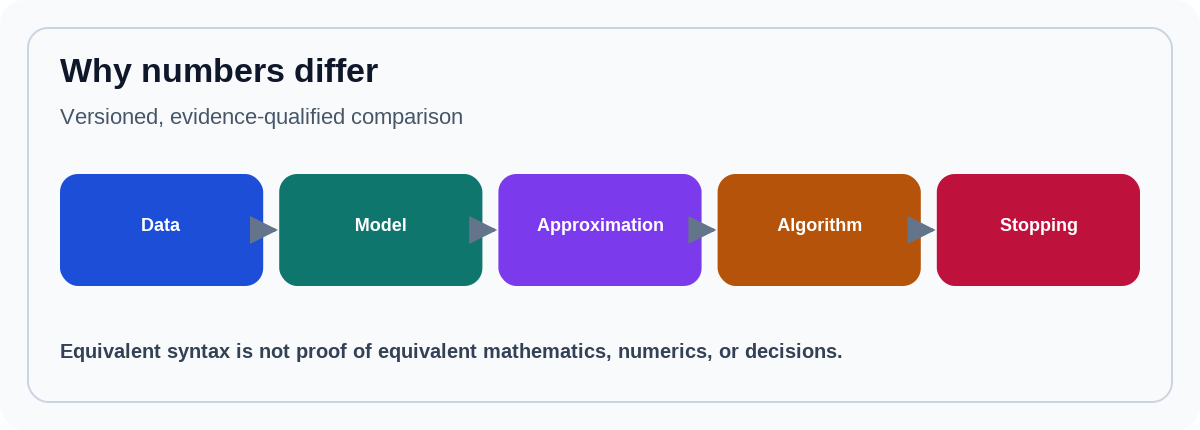
Differences arise from six sources: different data/population; different model/event semantics; different approximation or likelihood; different parameterization/constants; different numerical algorithms/stopping; and stochastic Monte Carlo error. Diagnose in that order. Optimizer choice is not a credible explanation for a 50-unit OFV gap at the same frozen parameters.
Start with exact invariants: rows, subjects, doses, observations, censoring, missingness, covariate reference, fixed parameters, and parameter ordering. Compare predictions at ETA=0 and chosen ETA vectors. For ODEs compare state profiles at event boundaries and a dense grid. Evaluate the objective at identical parameters before allowing either tool to optimize.
Classical deterministic methods should be reproducible within a problem-specific numerical tolerance, but different minima are possible from different starts/transforms/searches. Stochastic methods require Monte Carlo uncertainty: repeat seeds or increase samples and compare distributions/intervals, not final decimals. Standard errors may differ because matrices are computed on different scales or by different FIM/curvature definitions.
Use absolute and relative tolerances together, plus a decision tolerance. A tiny absolute parameter difference can be large near zero; a small OFV difference can cross a predeclared LRT threshold. Investigate directional/systematic bias, not only maxima. Preserve raw precision before display rounding.
Difference-triage order
For an OFV mismatch, compare counts and exclusions, then predictions at frozen parameters, then per-subject contributions, then the total. For a parameter mismatch with matching frozen OFV, compare starts, bounds/transforms, gradients, and final basins. For an SE mismatch with matching estimates, compare matrix type and scale/Jacobian. For a stochastic mismatch, estimate Monte Carlo error before diagnosing bias. This ordering prevents “different optimizer” from becoming a catch-all explanation.
Review checklist
- Are the exact product versions, task boundaries, inputs, methods, and settings named?
- Were semantics and frozen-parameter results aligned before optimized outputs?
- Is the comparison using a method-appropriate deterministic or stochastic tolerance?
- Are unsupported or analogous features described without implying equivalence?
- Can every claim be reproduced from retained primary evidence?
Navigation
See the previous page, next page, and complete comparison reference.