39.7 Exit code 5: unsupported model or method feature
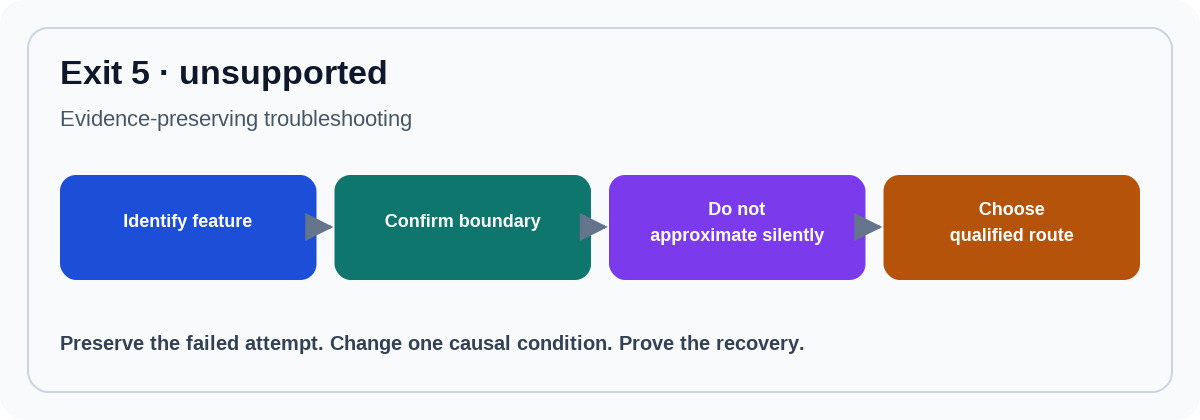
What you will learn
- Recognize a capability boundary
- Avoid silent semantic simplification
- Select and qualify an alternate route
Prerequisites: Chapter 36 exit-code reference, Chapter 38 output completion, and the Chapter 39 overview.
This page describes nlmx 4.16.2. Troubleshooting must preserve the failed attempt: keep its exact command, working directory, log, resolved settings, input/model identities, partial outputs, and process exit code. Correct one causal condition at a time and compare the new evidence with the failed run. Never convert a nonzero exit into success in a wrapper, and never interpret exit 0 as scientific acceptance without the command-native verdict.
Exit 5 is a deliberate refusal: nlmx recognized a requested feature but cannot represent or execute it faithfully in this context. Examples include likelihood-changing control-stream records, unsupported ADVAN/TRANS combinations, verbatim/user subroutines, or records such as $MIX, $PRIOR, $LEVEL, and $AES families. The exact boundary is version- and command-dependent.
Do not treat “unsupported” like a spelling error. Removing a record, replacing a model, or translating code can change likelihood, predictions, random effects, estimand, or intended population. The safe options are: use the originating/another qualified engine; construct a mathematically equivalent supported model and validate it independently; or defer the analysis until support exists.
Document the original feature, why it matters, the nlmx refusal, the proposed alternative, proof of equivalence or known differences, validation datasets, tolerances, and reviewer approval. A model that runs after deleting the unsupported element is a different model until demonstrated otherwise.
Also distinguish “ignored with note” from “refused.” Some records/options do not affect the supported computation and may be noted; others alter the likelihood and must stop. Read THINGS_TO_KNOW and Chapter 40 for versioned limits, but let the executable's current failure control the incident. Never configure a wrapper to swallow code 5.
Page checklist
- Did you retain the exact exit code, stage, message, hint, log, and partial output?
- Did you identify one causal layer before changing anything?
- Is the recovery a new, traceable attempt with the same intended estimand?
- Did you check command-native and scientific acceptance after process completion?
Navigation
See the previous page, next page, and complete error reference.