16.34 Validation, accuracy boundaries, and known limits
autoinit is a starting-value assistant, not a population parameter estimator and not a substitute for model qualification. Accuracy must be evaluated at three distinct levels: implementation correctness, recovery on controlled fixtures, and downstream usefulness. Passing one level does not prove the others.
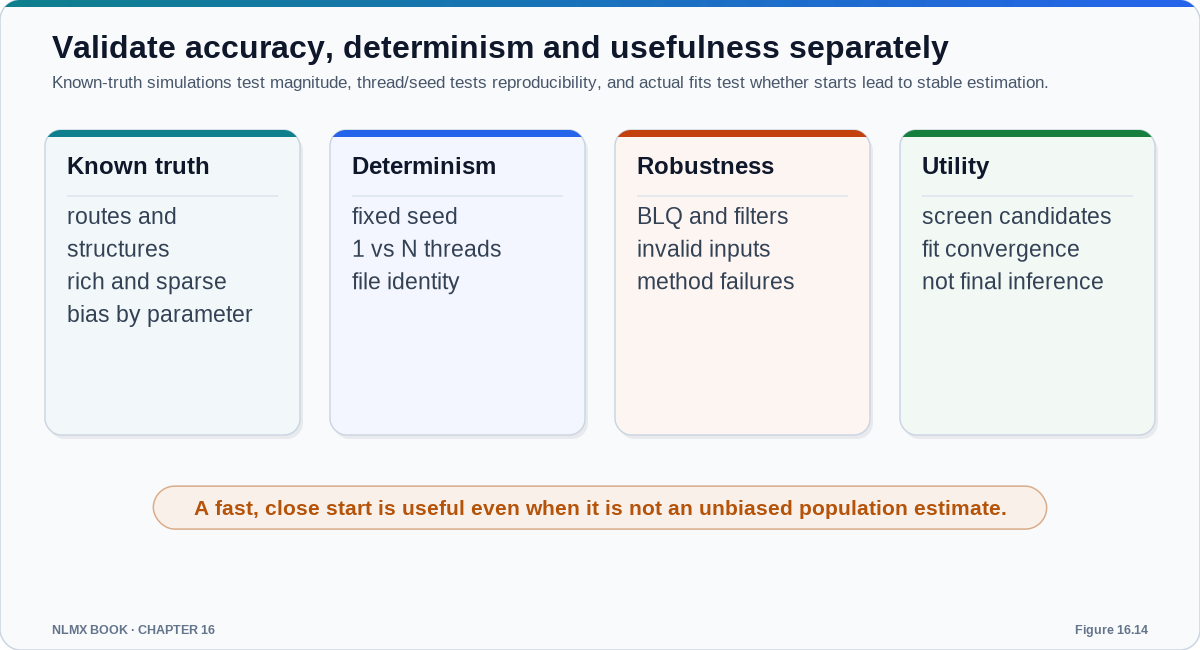
What this chapter reproduces
The six worked workflows were executed with the repository's release binary, recorded as nlmx 4.5.0. The examples cover rich one-compartment oral data, rich two-compartment IV data, pooled mixed regimens, sparse oral sampling, paired IV–oral data, and explicit unit scaling with transit-block generation. Each result bundle includes its input, settings, command transcript, machine-readable outputs, report, and plots. This permits a reviewer to recompute values rather than relying on prose.
The controlled examples show close recovery of their principal generating values. They also expose important negative evidence: sparse data produce no acceptable NCA values, oral-only data fix F1 to 1 and report apparent parameters, structural rule rows are labelled as rules, and a requested transit block does not imply transit estimation. These are fixture-specific observations, not universal accuracy guarantees.
A practical validation matrix
| Question | Minimum evidence | Failure signal |
|---|---|---|
| Is the run reproducible? | Same inputs, version, seed, and settings produce equivalent CSV values and checksums | Unexplained parameter drift |
| Are methods implemented as documented? | Unit tests plus independently calculated reference cases | Wrong route, units, AUC, slopes, or recommendation rule |
| Are starts numerically reasonable? | Simulations spanning design, noise, BLQ, and parameter ranges | Bias, boundary piling, or frequent method absence |
| Do starts help fitting? | Convergence and objective-function comparison against neutral and perturbed starts | Slower or less reliable convergence |
| Are claims portable? | External datasets and another implementation when possible | Results only hold for one fixture family |
Present capability boundaries
The automatic methods target linear one- and two-compartment PK approximations. Three-compartment Q3/V3 values are rules of thumb. The command does not estimate covariate effects, interoccasion variability, parent–metabolite systems, nonlinear elimination, target-mediated disposition, or a complete absorption hierarchy. Dose non-proportionality can be flagged, but that is not the same as fitting a nonlinear clearance model. F1 requires mixed IV–oral evidence; oral-only CL and V remain apparent. OMEGA and residual safeguards impose floors, so a floor value is not a measured variance.
Route inference, unit conversion, BLQ handling, time origin, dose history, and sampling design remain upstream responsibilities. A syntactically successful run can be scientifically wrong if those inputs are wrong. The current examples are deterministic synthetic checks and do not cover the full range of messy clinical data.
Comparison with major pharmacometrics software
When benchmarking against established tools, compare equivalent mathematical models, parameterisations, units, likelihood assumptions, censoring rules, and solver tolerances. Compare estimates after conversion to a common scale rather than demanding textual equality of control streams. Record runtime separately from accuracy and convergence rate; a faster start generator is valuable only if the resulting population fits remain correct and robust.
Release qualification checklist
- Pin the
nlmxversion, input checksum, settings, and seed. - Maintain independent reference calculations for NCA, one-compartment, and two-compartment cases.
- Add noisy, BLQ-heavy, infusion, multiple-dose, missing-data, and unit-conversion cases.
- Test multiple CPU thread counts for equivalent numerical results.
- Compare convergence from
autoinit, neutral, and deliberately perturbed starts. - Review failure messages and conditional output-file behavior.
- Document every unsupported model class and every approximation.
- Require scientific review before generated blocks enter a production analysis.
Common mistakes
- Treating successful synthetic recovery as universal clinical validation.
- Comparing tools that use different models, units, censoring rules, or parameterisations.
- Reporting runtime without the hardware, workload, thread count, and generated artifacts.
- Converting a labelled fallback or rule into an accuracy claim.
- Measuring only convergence success and ignoring the correctness of the converged model.
Checklist
- Separate implementation, recovery, and downstream-utility claims.
- Preserve executable, input, configuration, seed, outputs, and checksums.
- Include both successful and deliberately difficult validation cases.
- Compare common-scale parameters and categorical method decisions.
- State unsupported model classes and remaining evidence gaps prominently.
Further reading
Return to the Chapter 16 overview, reproducibility and speed, troubleshooting, and the remaining chapter plan for the downstream screening and fitting workflow.