15.10 Terminal-slope methods and quality thresholds
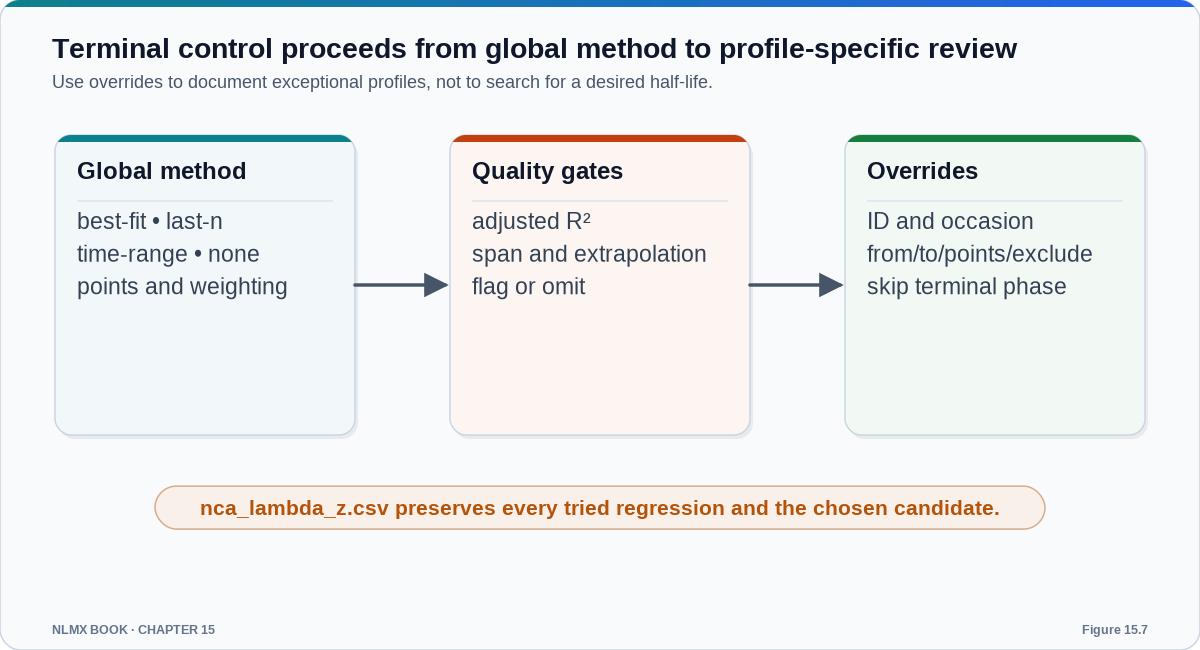
The [lambda_z] section controls how the terminal line is proposed, accepted, flagged, or omitted. --lz-method exposes four global strategies:
best-fit: default nested last 3, 4, 5… eligible points after Tmax;last-n: last configured number of eligible samples;time-range: samples between configured postdose times;none: no terminal phase or infinite-time descendants.
Candidate controls
min_points/--lz-min-points defaults to 3. max_points/--lz-max-points uses 0 for no limit. Configuration-only points controls last-n; from and to control time-range. include_tmax=false excludes the observed peak by default.
weighting accepts uniform, 1/y, or 1/y2. min_adj_r2 defaults to 0.7 and can be changed by --min-r2. tolerance=0.0001 defines an adjusted-R² tie; more points win within that tolerance.
Span and extrapolation rules
min_span_ratio=2.0 asks the selected observations to span two estimated half-lives. With require_span=false, a shorter span is retained with LZ_SPAN_SHORT; true removes lambda-z and dependent results.
max_extrap=20 is the largest accepted extrapolated AUC percentage. extrap_action="flag" retains values with AUC_EXTRAP_GT_20; omit blanks AUCinf, MRT, clearance, and volume descendants. The CLI supplies the numeric threshold but not the action.
Automatic best-fit must meet the adjusted-R² threshold. Manual methods/overrides preserve analyst choices but can carry quality flags. Always review nca_lambda_z.csv, not just the chosen slope.
Freeze these controls before unblinded group comparison so terminal selection cannot drift with the desired treatment conclusion.
Common mistakes
- Using ordinary R² when the threshold applies to adjusted R².
- Setting last-n without configuring
[lambda_z] points. - Treating a short-span flag as a confidence interval.
- Lowering thresholds per profile until every half-life exists.
Checklist
- State method, eligible points, weighting, and Tmax rule.
- Reproduce candidate ranking and ties.
- Review adjusted R² and span together.
- Define flag versus omit before analysis.
- Trace missing/flagged lambda-z to dependent parameters.
Further reading
See best-fit theory, terminal quality theory, and profile-specific overrides.